
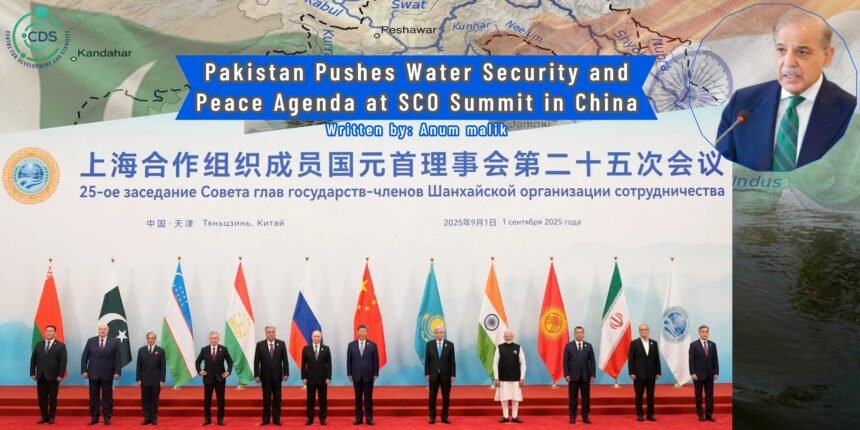

Prime Minister Shehbaz Sharif’s address at the Shanghai Cooperation Organization (SCO) summit in Tianjin has placed Pakistan’s concerns and vision for peace at the forefront of regional and global discussions. His speech was wide-ranging, touching upon the Indus Waters Treaty (IWT), climate challenges, terrorism, economic cooperation, and international conflicts, but its most striking aspect was his call for a “structural and comprehensive dialogue” on water security.
- The author Anum Malik, is affiliated with the State News Agency and contributes her research to the think tank, CDS.
- *The views and opinions expressed herein, and any references, are those of the author and do not necessarily reflect the editorial policy of the Centre for Development and Stability (CDS).
The Indus Waters Treaty, signed in 1960 between Pakistan and India with the World Bank’s mediation, has long been seen as a rare example of cooperation between the two rivals. It divides control of the rivers between the two countries, giving Pakistan rights over the Indus, Jhelum, and Chenab, and India control over the Ravi, Beas, and Sutlej. Despite decades of wars and tensions, the treaty has survived and ensured stability in water-sharing. Yet recent actions by India have shaken this arrangement. Following an attack in occupied Kashmir’s Pahalgam in May, which killed 26 people and was blamed on Pakistan without evidence, India declared that it would hold the treaty in abeyance.

Pakistan strongly rejected this unilateral move, calling it an “Act of war.” Just weeks ago, the Permanent Court of Arbitration in The Hague confirmed that India had no right to suspend the treaty on its own, marking a diplomatic victory for Pakistan. By raising the issue at the SCO, PM Shehbaz made it clear that water disputes are not simply bilateral quarrels but a matter of regional security, as uninterrupted access to water is a lifeline for millions.
The prime minister’s call for structural dialogue was significant. He emphasized that Pakistan respected all treaties and expected the same from others. His remarks carried a clear message that confrontation would only worsen problems, while structured talks under wise leadership could bring stability and mutual benefits. This approach projected Pakistan as a responsible, peace-seeking nation rather than one that relies on threats or unilateral actions.
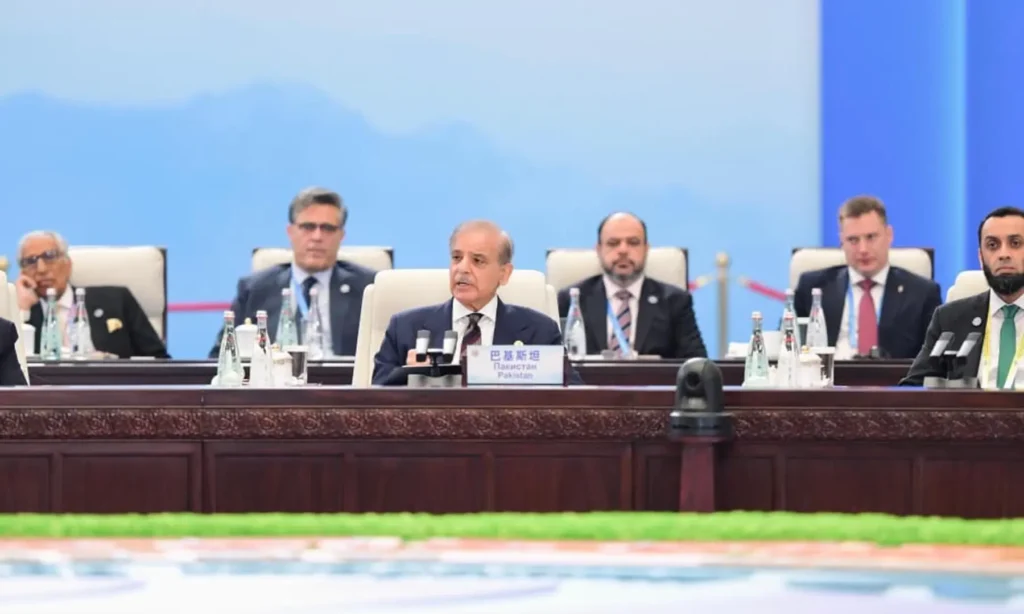
The Prime Minister Shehbaz Sharif also linked water issues with climate change, pointing to Pakistan’s devastating floods caused by torrential rains and cloudbursts. These disasters killed thousands, displaced families, destroyed infrastructure, and wiped out crops and livestock. He thanked the international community, especially China, for their support in these difficult times and highlighted the resilience of the Pakistani people.
His remarks underlined that South Asia, one of the most climate-vulnerable regions in the world, cannot afford to politicize water and environmental issues. Instead, it requires cooperative strategies to deal with floods, droughts, and glacial melting.
Another major theme of his speech was terrorism. He condemned it in all forms and recalled the March hijacking of the Jaffar Express in Balochistan, which left 26 people dead, stressing that there was irrefutable evidence of foreign involvement. He reminded the world of Pakistan’s enormous sacrifices in the fight against terrorism, over 90,000 lives lost and $152 billion in economic losses, sacrifices unmatched by any other nation. By presenting these figures, he sought to reaffirm Pakistan’s position as a victim of terrorism and as a country that has paid an extraordinary price for global peace.
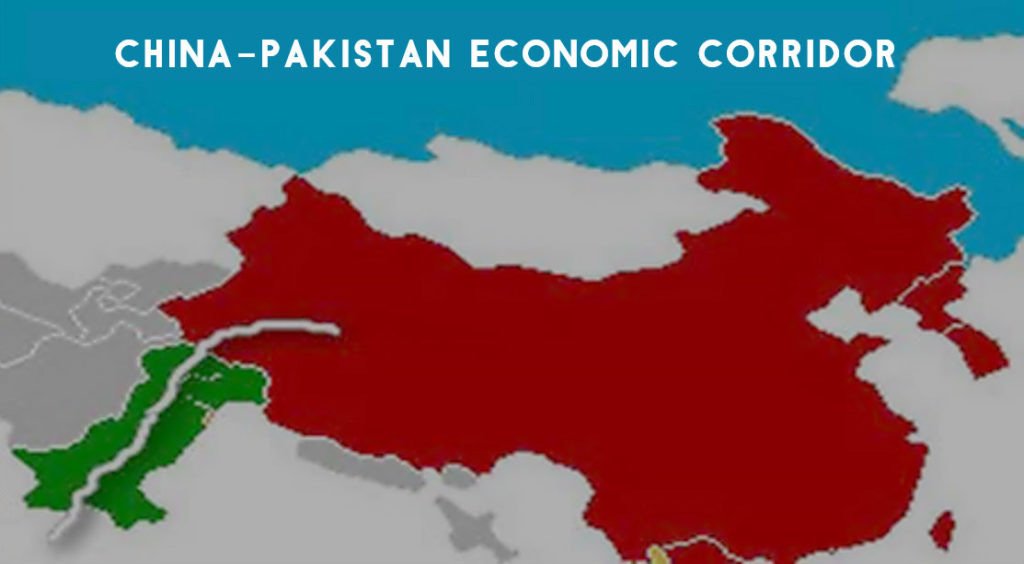
The Prime Minister further spoke about the importance of regional connectivity, particularly through the China-Pakistan Economic Corridor (CPEC). He described CPEC as not just a national project but also a practical demonstration of the SCO’s founding goals of integration and cooperation. By opening trade routes, creating jobs, improving infrastructure, and reducing poverty, CPEC could become a backbone for economic stability and prosperity in South and Central Asia.
In addition to regional issues, PM Shehbaz outlined Pakistan’s views on global conflicts. He condemned Israel’s aggression against Iran and Gaza, reaffirmed support for a two-state solution based on pre-1967 borders, and called for peace and stability in Afghanistan. These statements reinforced Pakistan’s commitment to justice, diplomacy, and international law.
He also expressed gratitude to President Xi Jinping for hosting the summit and praised China’s leadership role within the SCO. The significance of this speech lies in its broader message. By raising the Indus Waters Treaty, Pakistan successfully internationalized an issue that India has tried to keep limited to bilateral talks.
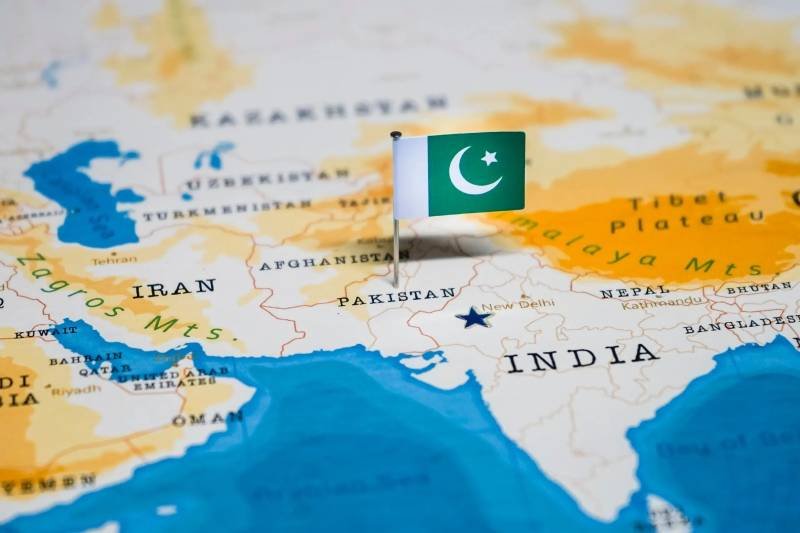
The speech also enhanced Pakistan’s image as a state that prefers dialogue over confrontation and law over unilateralism. More importantly, it provided a vision of how cooperation on water, climate, terrorism, and connectivity could become the foundation for lasting peace in South Asia.
For a region that has long suffered from mistrust, rivalries, and missed opportunities, such an approach could be transformative. Respecting treaties like the IWT would prevent water wars and ensure food security for millions. Cooperative action on climate change could save lives and reduce disasters. Counter-terrorism partnerships could stabilize fragile areas. Economic interdependence through projects like CPEC could make conflicts less likely. Above all, promoting dialogue as the only viable path could create a culture of trust that South Asia desperately needs.
PM Shehbaz’s words in Tianjin were not just a diplomatic statement but a reminder that South Asia stands at a crossroads. Either the region can descend further into conflict and instability, or it can choose the path of cooperation, trust, and shared growth. His call for a structural dialogue on the Indus Waters Treaty may well be remembered as an important step towards building that future.