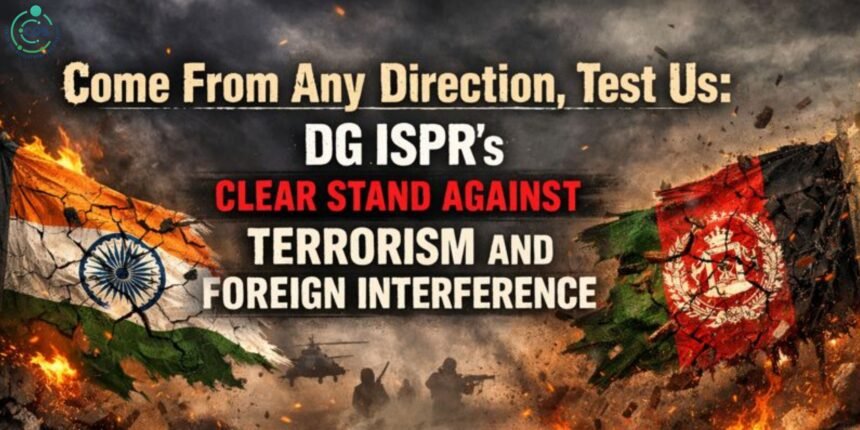

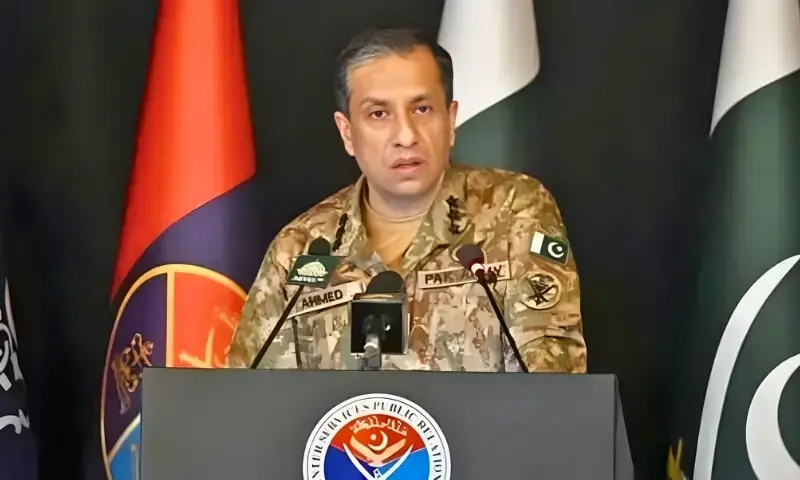
In a strongly-worded and assertive press conference, Director General Inter-Services Public Relations (DG ISPR) Lieutenant General Ahmed Sharif Chaudhry sent out one of the most powerful and unambiguous messages of the year.
- Purpose of the Press Briefing
- A Two-Decade Fight for Peace
- Four Reasons Why 2025 Was a Turning Point
- India–Afghanistan Nexus Exposed
- A Message to Political Parties: National Interest Comes First
- Revised National Action Plan: From Vision to Implementation
- Balochistan’s Transformation and New Policing Mandate
- Challenges in Khyber Pakhtunkhwa
- Addressing the Terror-Crime-Narcotics Nexus
- The Message beyond Borders
- Pakistan’s Renewed Clarity and Resolve
- Conclusion: Pakistan Speaks with One Voice
- The author is affiliated with the State News Agency and voluntarily contributes her research to the think tank, CDS.
- *The views and opinions expressed herein, and any references, are those of the author and do not necessarily reflect the editorial policy of the Centre for Development and Stability (CDS).
Both to Pakistan’s adversaries and to those within who doubt the nation’s resolve.
“Come together, come alone, or come from any direction, test us.”
These few words carried the weight of Pakistan’s two-decade-long struggle against terrorism, its sacrifices, and its unbroken commitment to defend its sovereignty. His speech reflected not only military firmness but also national clarity, conveying a message that Pakistan is now united, confident, and prepared to face all challenges.
Purpose of the Press Briefing
The DG ISPR began by outlining the objective of his press conference, which was to present a comprehensive overview of Pakistan’s counter-terrorism operations and progress in 2025. He made it clear that the briefing was not about politics but about Pakistan’s greatest internal challenge: terrorism.
He described 2025 as a landmark and consequential year in the nation’s long-standing war against terror, and he backed this statement with facts, figures, and policy developments.
“This is the only purpose of this press conference, to discuss terrorism, which remains the biggest threat to the state of Pakistan,” he stated.
A Two-Decade Fight for Peace
The DG ISPR reminded the audience that Pakistan’s fight against terrorism has not been a short or easy journey. It has spanned more than two decades, costing the lives of thousands of civilians, soldiers, and officers. Despite all challenges, Pakistan has stood firm.
In 2025, he said, the clarity of purpose finally reached every segment of society. The state and citizens now clearly understand that terrorism is not about religion, ethnicity, or politics, it is a direct assault on Pakistan’s existence.
“These terrorists are Khawarij, they have no relation with Islam or Pakistan. They are Fitna-al-Hindustan,” the DG ISPR explained, referring to the Indian hand behind certain terrorist networks operating from Afghanistan and Balochistan.
Four Reasons Why 2025 Was a Turning Point
Lieutenant General Ahmed Sharif Chaudhry laid out four major reasons that make 2025 a defining year in Pakistan’s counter-terrorism struggle:
- National Clarity on Terrorism: The entire nation, from leadership to grassroots, now sees terrorism as a war against the state, not an issue of ideology or negotiation.
- Exposure of the India–Afghan Taliban Nexus: Pakistan’s long-held stance that Afghanistan is being used as a launching pad for terrorist attacks has gained international recognition.
- Reinvigoration of the National Action Plan (NAP): Pakistan revised and updated its 20-point counter-terrorism strategy, ensuring all state institutions and provinces are aligned.
- Launch of Operation Azm-i-Istehkam: This comprehensive campaign is built on the revised NAP to eliminate terrorism through both kinetic and non-kinetic measures.
These, he said, form the foundation of Pakistan’s evolving counter-terrorism doctrine, one that integrates military, civil, and community efforts.
India–Afghanistan Nexus Exposed
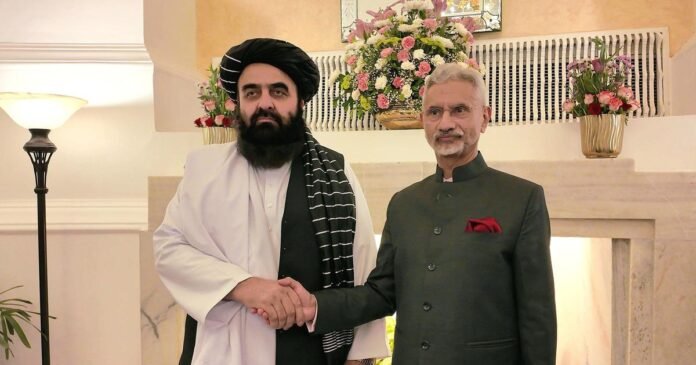
One of the most critical points of the DG ISPR’s address was the exposure of the India-Afghan Taliban nexus. Pakistan has long maintained that India funds, trains, and supports terrorist groups operating from Afghan soil to destabilize Pakistan, especially in Balochistan and Khyber Pakhtunkhwa (KP).
To substantiate this, the DG ISPR showed clips from Indian media celebrating attacks in Pakistan and promoting anti-state propaganda. He emphasized that India’s narrative, disguised as human rights advocacy, was in reality a cover for terrorist sponsorship.
“They promote terrorism under the guise of democracy and rights,” he stated firmly.
He also presented evidence involving a university professor from Balochistan, who allegedly confessed to terrorist involvement. The DG ISPR criticized individuals and organizations in Pakistan and abroad who defended such figures, warning that intellectual terrorism is just as dangerous as armed militancy.
Regarding Afghanistan, he clarified that the Taliban are not a recognized government but an occupying force that has allowed more than a dozen terrorist organizations to operate freely on Afghan soil.
“Everyone knows this — except perhaps the Khyber Pakhtunkhwa government,” he remarked sharply.
A Message to Political Parties: National Interest Comes First
Without naming specific parties, the DG ISPR directly addressed political elements who oppose counter-terrorism operations or attempt to politicize the fight against terror. He criticized those who rejected military actions in KP or sought negotiations with terrorists through Kabul, calling it a policy of appeasement.
“The army is a federal force — constitutionally bound to defend Pakistan’s territorial integrity. No one can hand over territory to terrorists for politics,” he warned.
Citing the example of ANP leaders who were targeted by terrorists for taking a stand, he questioned why some parties were never attacked, implying selective collaboration or appeasement.
His remarks reflected deep concern that political divisions and provincial indifference could undermine national security efforts.
Revised National Action Plan: From Vision to Implementation
A significant portion of the DG ISPR’s address was devoted to explaining the revival and implementation of the National Action Plan (NAP). Under Operation Azm-i-Istehkam, Pakistan is pursuing a comprehensive civil-military coordination strategy to root out terrorism.
He cited Balochistan as a successful case study of how the revised NAP is being implemented effectively.
The provincial government has established District Coordination Committees (DCCs) that include local MPs, district administration, police, army, and intelligence representatives. These committees hold regular meetings to identify local problems, plan development projects, and address the terror–crime nexus at the grassroots level.
Between February and November 2025, over 472 meetings were held, and Rs31 billion in funds were allocated for local initiatives, Rs23 billion by the Balochistan government and Rs8 billion by the federal government.
So far, 127 projects have been completed, 949 are in progress, and 54,000 social and community engagements have been conducted to strengthen the link between the state and the people.
“This is real devolution — governance reaching the grassroots,” said the DG ISPR. “Balochistan is showing how national unity and local empowerment can defeat terrorism.”
Balochistan’s Transformation and New Policing Mandate

A major step forward is the end of the Category-A and Category-B division in Balochistan. This administrative change has given Balochistan Police jurisdiction across the entire province, a move expected to significantly strengthen law enforcement and reduce the reliance on paramilitary forces.
The Balochistan government has also allocated Rs5 billion for training police and Counter-Terrorism Departments (CTDs) to ensure local forces are capable of handling internal threats.
This marks a transformation in how security is maintained, local ownership, federal coordination, and civilian empowerment, all integral to long-term peace.
Challenges in Khyber Pakhtunkhwa
While praising progress in Balochistan, the DG ISPR expressed concern over Khyber Pakhtunkhwa’s counter-terrorism response.
He noted that low conviction rates, delays in court cases, and political indecision have slowed progress. He criticized the KP government’s attempt to seek Afghan mediation for talks with terrorists, calling it a misguided approach.
“You cannot beg Kabul for peace while your own people suffer. Other nations are also facing terrorism from Afghan soil — Pakistan is not alone,” he said.
The DG ISPR rejected accusations that counter-terrorism operations were being conducted for dollars or minerals, calling them baseless and politically motivated narratives that insult the sacrifices of Pakistan’s soldiers and martyrs.
Addressing the Terror-Crime-Narcotics Nexus

The DG ISPR highlighted two emerging challenges that fuel terrorism, narcotics and illegal weapons. He explained that these networks generate the funds and logistics that sustain militant groups.
The security forces, he said, are actively working to curb the smuggling of Iranian oil, narcotics trafficking, and illegal arms trade, which have created a political-terror-criminal nexus in parts of Pakistan.
He emphasized the need for stronger legal frameworks and higher conviction rates to dismantle these networks permanently.
The Message beyond Borders
While the briefing was primarily focused on Pakistan’s internal security, the message to India and Afghanistan was unmistakable.
Pakistan’s patience, he signaled, should not be mistaken for weakness. The DG ISPR’s words: “come together, come alone, or come from any direction — test us”, were a direct warning to those who sponsor, harbor, or abet terrorism against Pakistan.
It was also a reassurance to the Pakistani public and the world that Pakistan is no longer reactive but proactive, no longer defensive but determined.
“This is not noise — this is national strength speaking,” remarked one analyst after the press conference.
Pakistan’s Renewed Clarity and Resolve
Lieutenant General Ahmed Sharif Chaudhry’s press conference symbolized more than a military update, it represented a strategic and psychological turning point for Pakistan.
After years of internal conflict, external propaganda, and political division, Pakistan is regaining its clarity, unity, and self-confidence. The revised NAP, Azm-i-Istehkam, and provincial empowerment are collectively steering the country toward long-term stability.
By confronting both external aggressors and internal sympathizers of terror, Pakistan is setting a firm boundary, one that signals peace for those who cooperate and consequences for those who challenge its sovereignty.
Conclusion: Pakistan Speaks with One Voice
The DG ISPR’s warning to India and Afghanistan was not about provocation, it was about asserting sovereignty and national dignity. His tone, words, and confidence reminded the world that Pakistan is a resilient nation, forged in sacrifice and driven by unity.
Terrorism, foreign interference, and internal divisions have tested the country for years, but 2025 marks the beginning of a new phase, one of clarity, cohesion, and national strength.
“Pakistan will always choose peace, but if tested, it will respond with full force,” the DG ISPR declared.
In essence, this was Pakistan speaking calmly, clearly, and courageously. Not in anger, but in power. Not in chaos, but in conviction. A message that both friends and foes will remember that Pakistan stands firm, united, vigilant, and unshakable.