
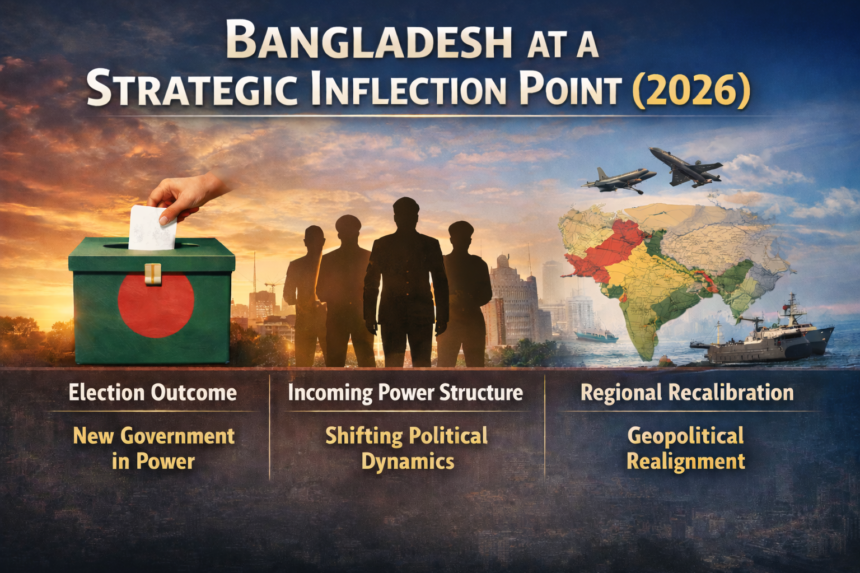

Election Outcome, Incoming Power Structure, and Regional Recalibration
By: Nuzhat Nazar and Maimona Saleem
Bangladesh’s 2026 Election: A Political Reset, Not a Routine Transition
Bangladesh’s February 2026 general election represents a decisive break from the country’s recent political trajectory, marking the end of a prolonged phase of institutional centralisation, contested legitimacy, and political exclusion. Unlike previous elections that revolved around the consolidation or preservation of power, this vote unfolded as a corrective moment, one driven as much by public exhaustion with authoritarian governance as by a demand for restored political agency.
The result has been unequivocal. The Bangladesh Nationalist Party (BNP) has returned to power with a commanding parliamentary mandate, re-establishing itself as the central axis of Bangladeshi politics after nearly two decades in opposition. Jamaat-e-Islami emerged as the second-largest force, while the Awami League, long dominant under Sheikh Hasina, was absent from the contest following its disqualification, effectively collapsing the duopoly that had defined Bangladesh’s political life for years.
Official Results and Parliamentary Balance
Official figures released by the Election Commission of Bangladesh confirm that results were finalised in 297 constituencies. BNP secured 209 directly elected seats, a figure that alone places it well above the two-thirds threshold. Jamaat-e-Islami won 68 seats, while the National Citizen Party secured six, with independents and smaller parties accounting for the remainder. Elections in a handful of constituencies were postponed or withheld due to legal and procedural reasons, but these do not alter the overall parliamentary balance.
Under Bangladesh’s constitutional framework, the allocation of 50 women’s reserved seats, distributed proportionally, is expected to further reinforce BNP’s majority once formally notified. Even without these seats, BNP and aligned partners command at least 212 seats, ensuring not only government formation but decisive legislative control.
This arithmetic matters. It removes the fragility that has often constrained South Asian governments and gives the incoming leadership unusual political space to govern without constant coalition bargaining or legislative obstruction.
Why This Election Carried Credibility
What separates the 2026 election from Bangladesh’s deeply disputed polls of 2014 and 2018 is not perfection, but legitimacy. The vote was conducted in a post-uprising environment following the July 2024 collapse of Sheikh Hasina’s political order, under an interim governance arrangement that restored a degree of institutional neutrality to the electoral process.
Nearly 9,000 domestic and international observers monitored polling across the country. While irregularities were reported in isolated cases, election-day violence, historically endemic, remained limited. Turnout, recorded at 59.44 percent, reflected renewed voter engagement after years of boycott-driven apathy.
Equally important was the referendum held alongside the election, which approved structural reforms aimed at preventing the re-consolidation of executive authority. Term limits for the prime minister, stronger parliamentary oversight, and safeguards against power concentration collectively signal that voters were not merely replacing leadership, but recalibrating the system itself.
This dual mandate — electoral victory combined with institutional reform, significantly strengthens the democratic legitimacy of the incoming government, both domestically and in the eyes of external partners.
Incoming Leadership: Tarique Rahman and the Shape of Power
Expected Prime Minister: Tarique Rahman
The political reset is inseparable from the return of Tarique Rahman, BNP’s chairperson and son of former president Ziaur Rahman and former prime minister Khaleda Zia. His return from 17 years of exile in London in December 2025 proved decisive, re-energising party organisation and reframing BNP’s public posture around restraint rather than confrontation.
His expected premiership carries symbolic and structural weight. He would become Bangladesh’s first male prime minister in 35 years, marking a departure from the female-led dynastic rivalry that had dominated politics for decades. More substantively, his leadership signals a generational shift, one that blends legacy with recalibration rather than rupture.
Anticipated Cabinet and Governance Style
The incoming cabinet is expected to reflect this balancing act. Senior BNP figures with institutional experience are likely to anchor core ministries, while technocrats are expected to be placed in finance, commerce, planning, and energy portfolios to stabilise the economy and reassure markets. Select figures associated with the Gen-Z-driven uprising may be incorporated to broaden legitimacy and signal inclusion.
Crucially, the cabinet is unlikely to be ideologically rigid. BNP’s supermajority reduces the need for political accommodation, allowing appointments to prioritise competence and credibility over coalition arithmetic.
China Policy Under the Incoming Government
China as the Strategic Constant, Not a Strategic Weapon
China will remain the most consequential external actor in Bangladesh’s strategic calculus under the incoming BNP government but the relationship is expected to be refined rather than expanded indiscriminately.
Historically, BNP has approached China as an economic and defence partner, not as a geopolitical counterweight. That distinction is critical. Unlike periods where Dhaka’s China engagement was perceived by some as strategically demonstrative, BNP has tended to keep the relationship functional, transactional, and deliberately low-profile.
Under the new government, Chinese engagement is expected to deepen selectively, particularly in infrastructure, energy, industrial zones, and defence maintenance but with greater scrutiny over debt exposure, project viability, and economic return. Participation in Belt and Road-linked projects is likely to continue, but framed strictly in developmental rather than ideological terms.
In defence, China will remain Bangladesh’s principal supplier of military hardware and training. However, BNP is expected to maintain this cooperation quietly, avoiding high-visibility acquisitions or regional signalling. The emphasis is likely to be on sustainment, capacity upgrades, and professionalisation rather than headline deals.
This posture serves multiple objectives simultaneously: it preserves Bangladesh’s strategic autonomy, reassures India and Western partners, and maintains continuity with Beijing without creating dependency.
For Pakistan, this approach is indirectly stabilising. A Bangladesh-China relationship that avoids adversarial framing reduces zero-sum dynamics in the Bay of Bengal and lowers regional strategic temperature, particularly given Pakistan’s own deep partnership with Beijing.
Policy Toward Pakistan: Normalisation Without Noise
BNP’s return fundamentally alters the political psychology surrounding Bangladesh’s engagement with Pakistan. Where previous governments treated ties with Islamabad as politically sensitive or symbolically fraught, the incoming administration appears inclined toward compartmentalisation.
The focus is expected to remain squarely on economics. The revival of direct sea trade between Karachi and Chattogram and the resumption of government-to-government rice exports over the past year have already demonstrated that transactional confidence can be rebuilt quietly.
With a stable government in place, BNP is well positioned to institutionalise these gains, restoring direct flights, easing banking and letter-of-credit constraints, and expanding trade in textiles, pharmaceuticals, and food security. Defence engagement, if any, is expected to remain technical and non-political, confined to training, maritime security, and disaster response.
Importantly, BNP is unlikely to frame Pakistan relations through an India-centric lens, reducing the risk of triangulated rivalry and allowing engagement to proceed on its own merits.
United States and India: Presence Without Control
India
India’s footprint in the election period was visible but restrained. Pre-election outreach by senior Indian officials reflected New Delhi’s interest in managing the transition rather than shaping the outcome. However, post-election allegations by senior interim government figures accusing India of attempted interference, allegations to which New Delhi has not publicly responded, underscore lingering mistrust.
India is now likely to prioritise post-election recalibration over contestation, focusing on restoring working relations with the new government while navigating public scepticism within Bangladesh.
United States
The United States adopted a posture of managed distance rather than direct involvement. Washington’s emphasis remained on electoral credibility and democratic restoration, followed by early diplomatic outreach after results became clear.
Going forward, US engagement is expected to centre on governance reform, defence cooperation alternatives, and economic diversification, particularly in the context of China’s enduring influence. The approach suggests hedging rather than confrontation.
Conclusion: Strategic Space Has Opened and How It Is Used Will Matter
Bangladesh’s 2026 election marks a political reset, not a geopolitical realignment. A strong BNP mandate, reinforced by referendum-driven institutional reform, has created rare strategic space, domestically and regionally.
For Pakistan, this moment calls for strategic patience rather than exuberance.
For China, it signals continuity.
For India and the United States, it demands recalibration rather than resistance.
History has not disappeared but for the first time in years, it is no longer dictating Bangladesh’s future.