

By Asif Haroon Raja
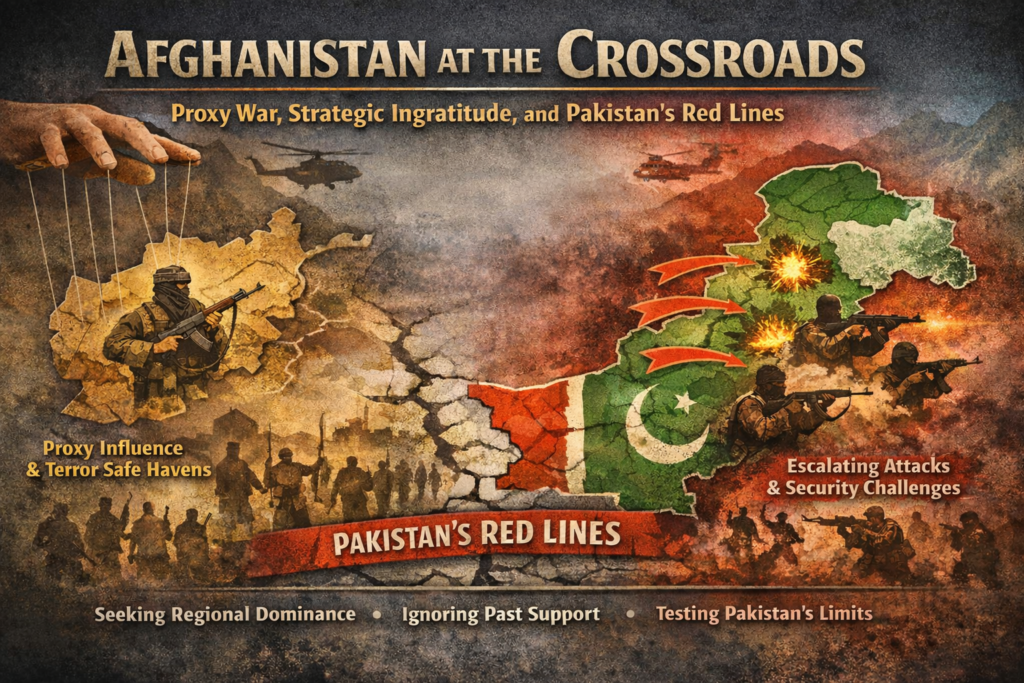
A Perplexing Question
Afghanistan shares borders with six countries—yet why is “jihad” declared obligatory only against Pakistan?
Relations between Pakistan and Afghanistan have rarely been cordial. Except for the Taliban regime under Mullah Omar, successive governments in Kabul have maintained hostility toward Pakistan while cultivating close ties with India.
For over four decades, Pakistan has borne the consequences of instability in Afghanistan. Cross-border terrorism over the past two decades alone has resulted in more than 80,000 Pakistani deaths, hundreds of thousands injured, and economic losses exceeding $150 billion.
A Pattern of Hostility
From Zahir Shah and Daoud Khan to Noor Mohammad Taraki, Babrak Karmal, Najibullah, and later administrations under Hamid Karzai and Ashraf Ghani, Kabul’s posture toward Pakistan has remained adversarial. Even the current Taliban regime, led by Haibatullah Akhundzada, has continued this trend.
Notably, no Afghan regime has declared jihad against any other neighboring state. This raises a critical question: why is Pakistan—an Islamic Republic with constitutional adherence to the Qur’an and Sunnah, with a Federal Shariat Court and an Islamic Ideology Council—singled out?
The Reality Behind the Narrative
The so-called “jihad” is, in reality, a political and proxy conflict cloaked in religious rhetoric. The reality is that this so-called jihad is actually a political and proxy game being played in the name of Islam. Such statements serve no purpose other than spreading discord within the Muslim Ummah and advancing the agendas of hostile powers.
It serves the interests of hostile external actors, particularly India and Israel, seeking to weaken Pakistan. Such narratives do not serve Islam; they deepen divisions within the Muslim Ummah while advancing foreign agendas.
Territorial Ambitions and Strategic Frictions
A core source of tension lies in Afghanistan’s refusal to recognize the Durand Line as an international border. Kabul has historically laid claims to territories in Khyber Pakhtunkhwa and Balochistan, fueling irredentist sentiments.
Successive Afghan regimes have also supported separatist movements, including those advocating “Pakhtunistan” and insurgency in Balochistan. Driven by territorial ambitions, the Afghans have often been heating the western border.
State-Sponsored Destabilization
After 2006, Afghanistan’s intelligence agency (NDS), in coordination with India’s RAW, actively supported militant groups such as Tehreek-e-Taliban Pakistan (TTP), Baloch Liberation Army (BLA), political movements like Pashtun Tahaffuz Movement (PTM), and Baloch Yakjehti Commetti (BYC), also received external backing, contributing to internal instability in Pakistan.
Post-2021: Changing Profile of Taliban
The Taliban’s return to power in August 2021—following the U.S. withdrawal—did not bring stability. Instead, cross-border terrorism surged dramatically. Despite their past resistance against U.S. forces, the Taliban regime has continued to receive substantial financial inflows. Meanwhile, regional intelligence networks—including India’s RAW, Israel’s Mossad, and the CIA—remain active in Afghanistan. The result is a complex proxy environment where Afghanistan is increasingly used as a staging ground for hybrid warfare against Pakistan.
Escalation and the Breaking Point
Relations between Pakistan and the Taliban regime deteriorated sharply, reaching their lowest point in recent years. For the first time, Afghan forces launched coordinated attacks along Pakistan’s western border. This marked a significant escalation. In response to sustained terrorist attacks—including strikes on civilian and military targets—Pakistan abandoned its policy of strategic restraint.
Operation Ghazab Lil-Haq: A Strategic Shift
After decades of fighting someone else’s war, playing the game of good and bad Taliban, and earning the animosity of both, and after nearly a decade of hesitation and oscillation, Pakistan lost its cool, shed its strategic patience, and finally stirred from its strategic slumber.
For years, Pakistan exercised restraint toward Kabul in the expectation that Afghan soil would not be used against us. That expectation has not been honoured by the ungrateful IEA regime, and it continues to draw the blood of Pakistanis brutally. Pakistan’s response came in the form of Operation Ghazab Lil-Haq, a decisive military campaign aimed at neutralizing cross-border threats.
The operation marked a doctrinal shift from restraint to proactive defence, and from tolerance to deterrence. Precision airstrikes targeted militant sanctuaries across multiple Afghan provinces, including Nangarhar, Paktia, Paktika, Khost, and Kandahar. Pakistani forces also degraded key military infrastructure used to facilitate cross-border attacks.
Gudwana Enclave
32 sq km of ground space in the Zhob sector across the border has been seized by ground forces, and the captured area has been fenced and named Gudwana Enclave. The enclave is located between the Pakistani Zhob district of Baluchistan and Afghanistan’s Paktika province.
Smaller bridgeheads have been occupied in Angoor Adda (SW) and Ghulam Khan sector (NW).
Objectives of the Operation
Clear strategic objectives guided the operation:
Eliminate terrorist safe havens.
Deter state-sponsored proxy warfare.
Safeguard Pakistan’s territorial integrity.
Protect civilian lives and national assets.
Establish limited buffer zones along critical border sectors to prevent infiltration.
Diplomatic Fallout and Regional Dynamics
Kabul sought mediation from countries such as Qatar and Saudi Arabia, but these efforts failed to produce results. Eventually, China stepped in, hosting talks in Urumqi. Initial engagements suggest cautious progress, but trust remains fragile. Pakistan has made its position unequivocal, such as ending support for TTP, handing over wanted militants, and ceasing the use of Afghan soil for terrorism.
A History of Support—A Question of Ingratitude
Pakistan’s historical role in Afghanistan cannot be ignored, including hosting millions of Afghan refugees for over four decades, supporting resistance against Soviet occupation, facilitating the Doha Agreement, and enabling the U.S. withdrawal. Yet, instead of fostering brotherly relations, Kabul has aligned itself with distant powers hostile to Pakistan.
The Strategic Reality Today
Pakistan’s recent military actions have altered the strategic equation. The Taliban regime faces mounting internal and external pressures, forcing a reassessment of its policies.
There are early signs of a shift, for instance, willingness to address Pakistan’s concerns, reduced overt support for TTP, and engagement in dialogue. However, credibility will depend on verifiable actions—not verbal assurances.
The people of Afghanistan must reflect: who is their real enemy? The one who sheltered and educated them, or the one using them to fight Pakistan while watching from behind?
The Way Forward
Peace between Pakistan and Afghanistan remains possible—but only under clear conditions such as mutual respect for sovereignty, non-interference in internal affairs, and verifiable counterterrorism commitments. Pakistan remains open to dialogue but has made it clear that it will continue targeting terrorist sanctuaries threatening its security.
Conclusion: A Defining Choice
Afghanistan stands at a crossroads. It must decide whether to continue serving as a proxy battleground for external powers, or
build genuine, cooperative relations with its immediate neighbor.
History is unambiguous, and Pakistan has consistently exercised patience. But when its sovereignty is challenged, its response is decisive.
The choice now rests with Kabul.
Brigadier (Retd) Asif Haroon Raja is Patron-in-Chief of CDS Think Tank and regularly appears on national and international media platforms.