

By Asif Haroon Raja
Strategic Importance of Balochistan
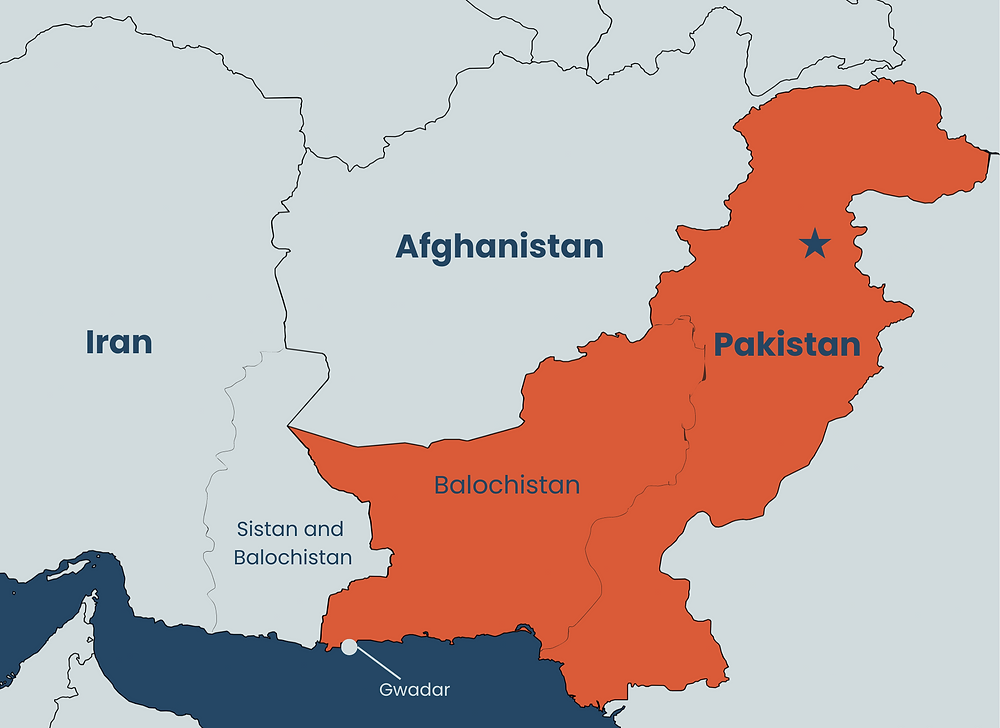
Balochistan occupies a pivotal geographic position, bordering Iran and Afghanistan, and sitting at the crossroads of South Asia, Central Asia, and the Middle East. This location makes it strategically vital for monitoring instability in Afghanistan, observing Iran—particularly amid its tensions with the United States—and serving as a logistical hub for regional operations.
Rich in untapped natural resources—copper, gold, natural gas, and rare minerals—Balochistan is also a gateway to the Arabian Sea and critical global energy routes. Its coastline enhances Pakistan’s maritime significance while attracting international interest.
Great Power Competition
Balochistan has quietly emerged as a theatre of strategic competition among major powers. China seeks economic and naval access through Gwadar Port, a flagship node of the China-Pakistan Economic Corridor.
The United States remains wary of China’s expanding footprint in the Indian Ocean and continues to view the region through a strategic lens. India perceives CPEC and Gwadar as altering the regional balance. It has supported anti-state proxies to destabilize the province.
Iran is equally sensitive, given its own Baloch population and the development of Chabahar Port—with Indian assistance—as a counterweight to Gwadar.
Security Challenges and Hybrid Warfare
Balochistan’s long-running insurgency, coupled with underdevelopment and governance deficits, has made it vulnerable to external exploitation. Competing powers employ indirect means—information warfare, proxies, and economic leverage—to influence outcomes.
Historical Background
The partition of the subcontinent in 1947 entrenched enduring hostility between India and Pakistan. India’s reluctance to reconcile with Pakistan’s existence led to efforts to foment unrest in various regions, including Balochistan.
Simultaneously, mistrust between Pakistan and Afghanistan took root when Kabul refused to recognize the Durand Line as an international boundary. Afghanistan’s support for the Pakhtunistan movement and its claims over Pashtun-majority areas further strained relations.
Balochistan witnessed recurrent insurgencies (1948, 1958, 1962, 1973, and post-2004), with dissidents often finding sanctuary across borders. Perceptions of political marginalization and disputes over resource control—particularly gas and mineral revenues—deepened mistrust between the province and the federal government.
Internal Failings
Internal weaknesses have significantly contributed to instability. These include governance deficits, weak provincial institutions, corruption among local elites, and underutilization of financial allocations.
The Sardari system, elite capture of resources, resistance to education and reform, and contradictory political behavior—anti-state rhetoric coupled with dependence on state patronage—have compounded the problem.
Narratives of exploitation, such as the belief that Sui gas fueled the rest of Pakistan while Balochistan remained underdeveloped, or that the benefits of Gwadar and CPEC are confined to elites, have further widened the trust deficit. Internal mismanagement has thus amplified the effects of external interference.
External Interference and Proxy Dynamics
Pakistan has consistently maintained and provided concrete proofs to the world bodies of deep-seated involvement of Research and Analysis Wing (RAW) in destabilizing Balochistan by supporting separatist elements and exploiting socioeconomic grievances through disinformation and narrative warfare.
Militant groups such as the BLA, BRA, and BLF are the paid proxies and are being used as instruments to accomplish foreign agendas. A misperception has been created that these militant groups are the representatives of a broad-based popular movement. Following the killing of Nawab Akbar Bugti in 2006, the insurgency is widely seen to have intensified and evolved into a more organized separatist movement, with external backing.
Balochistan in the Larger Strategic Game
Balochistan today is increasingly viewed as a theatre of proxy and hybrid warfare. Pakistan’s perspective highlights the involvement—direct or indirect—of multiple actors, including India, Afghanistan, Israel, and others, in shaping instability to undermine strategic projects such as Gwadar and CPEC.
The convergence of geopolitical rivalries, economic interests, and internal vulnerabilities has made the province a focal point of international contestation. The Indo-Afghan-Israel nexus is making use of Afghan soil to destabilise Baluchistan and Khyber Pakhtunkhwa through cross-border terrorism.
National Resolve and Security Response
Pakistan maintains that its territorial integrity is non-negotiable and that Balochistan is an integral part of the federation. The armed forces have played a central role in countering militancy and safeguarding strategic assets.
Under the leadership of Field Marshal Asim Munir, the State has signaled a firmer approach toward counterterrorism and internal security, emphasizing both kinetic and non-kinetic measures.
Apart from intelligence-based operations in the two conflict zones against the terrorists, Operation Ghazab Lil-Haq is in progress to destroy all the sanctuaries, hideouts, launchpads, training grounds, and suicide bombers training centres inside Afghanistan, as well as the sources of supplies of arms, ammunition, and explosives to root out terrorism.
Conclusion
Balochistan is not merely a peripheral province—it is a geopolitical pivot. Influence over this region can shape energy corridors, maritime routes, and regional alignments across South Asia, the Middle East, and Central Asia.
The crisis in Balochistan is neither solely an insurgency nor purely a governance issue. It is a complex interplay of historical grievances, internal weaknesses, external interference, economic disparities, and hybrid warfare. For Pakistan, stabilizing and integrating Balochistan is not just a domestic necessity but a strategic imperative.
Lasting stability will depend not only on security operations but on synchronized political reconciliation, economic inclusion, and institutional reform. Balochistan is not a burden—it is Pakistan’s strategic crown. Its stability lies in addressing both internal deficiencies and external challenges with clarity, balance, and resolve.
Brigadier (Retd) Asif Haroon Raja is Patron-in-Chief of CDS Think Tank, and regularly appears on national and international media platforms.