

By Nuzhat Nazar
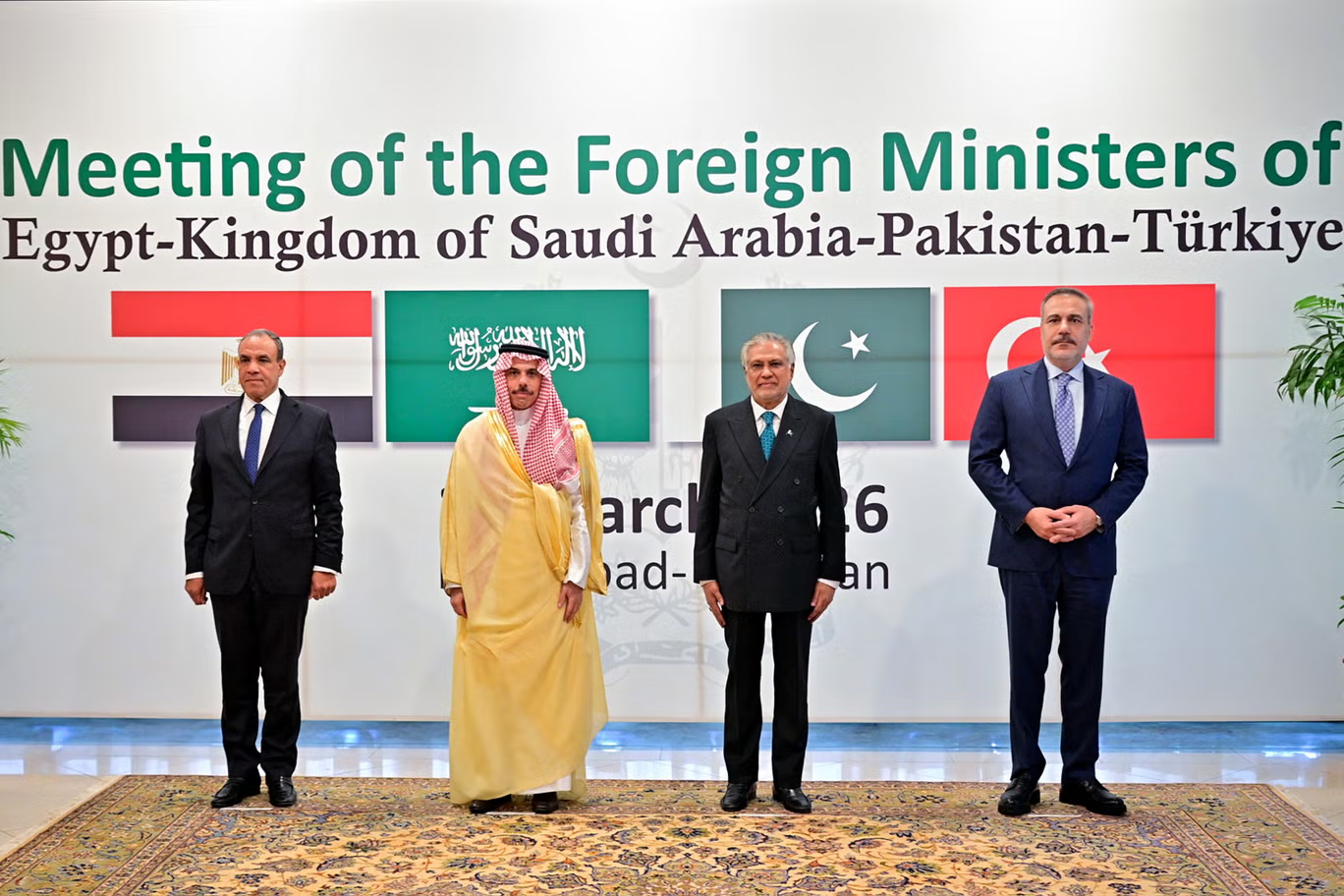
For a long time, Pakistan’s foreign policy has been seen through the lens of reaction, responding to crises, aligning under pressure, or managing fallout. But what we are seeing now feels different. The recent diplomatic activity in Islamabad, followed by Foreign Minister Ishaq Dar’s visit to China, suggests a more deliberate attempt to step into the conversation, not just respond to it.
This shift is unfolding against the backdrop of an intensifying conflict involving the United States, Israel and Iran, one that has moved beyond shadow confrontation into direct military exchanges. Strikes, counter-strikes and rising tensions around energy routes have created a situation where escalation is already underway. The risk is no longer confined to one geography. It is systemic, affecting energy security, shipping lanes and political stability across regions.
It is within this context that the quadrilateral engagement in Islamabad becomes significant. This was not just another diplomatic meeting. It produced something concrete. Pakistan formally offered to host direct or indirect talks between Washington and Tehran. The four countries also agreed to continue coordination through a structured diplomatic mechanism, effectively creating a working channel rather than a one-off engagement. The focus was clear, to prepare the ground for de-escalation, not to impose outcomes.
What strengthens this further is that Pakistan is not operating in isolation. During his visit to China, Ishaq Dar and Chinese Foreign Minister Wang Yi jointly adopted a five point initiative that effectively internationalises Pakistan’s mediation framework. This included an immediate cessation of hostilities, the start of dialogue, protection of civilians and critical infrastructure, securing maritime routes including the Strait of Hormuz, and reinforcing the primacy of the United Nations framework.
This is a significant development because it moves Pakistan’s position from a regional diplomatic effort to one that carries backing from a major global power. In practical terms, it gives Pakistan’s mediation attempt legitimacy, scale and strategic depth.
In other words, the Islamabad meeting created a diplomatic pathway, and the Beijing engagement reinforced it.
For decades, Pakistan’s relevance came from geography and security compulsions. Today, it is trying to turn that same geography into leverage. The question is no longer whether Islamabad is involved, but how it is being used, as a venue, as a connector, and increasingly, as a potential mediator in one of the most dangerous conflicts currently unfolding.
Part of this shift lies in Pakistan’s unique positioning. It maintains working relationships across competing axes, engagement with Gulf states that are directly exposed to Iranian retaliation, political and defence ties with Türkiye, strategic depth with China, and a functional relationship with the West. At the same time, Pakistan is not a direct party to the Iran, United States and Israel confrontation. That distance allows it to remain relevant without being perceived as hostile. Combined with its military credibility, this gives Pakistan weight that goes beyond routine diplomacy.
What is emerging is a form of multi-vector engagement. Not neutrality in the passive sense, but a deliberate attempt to remain accessible to all sides. In a conflict where communication channels are shrinking, access itself becomes influence.
Timing is also working in Pakistan’s favour. The conflict is beginning to reshape energy security, with growing concerns around the Strait of Hormuz and global supply disruptions. Gulf states are exposed. Major powers are involved but cautious of escalation. In such an environment, there is a growing demand for intermediaries, not necessarily to resolve the conflict immediately, but to prevent it from spiralling further.
Pakistan appears to be testing whether it can occupy that space.
There is also a noticeable restraint in how Islamabad is signalling its role. Despite speculation about emerging blocs or defence alignments, Pakistan has avoided committing to any rigid structure. That ambiguity is strategic. In a highly polarised conflict, even perception can close doors. By staying flexible, Pakistan preserves credibility across divides.
However, this positioning also comes with clear limitations that cannot be ignored. Pakistan does not have direct leverage over the core parties to the conflict. The United States and Israel are operating within their own strategic calculus, while Iran’s decisions are shaped by security and ideological considerations that external mediation can only partially influence. This means Pakistan’s role, at least for now, is facilitative rather than decisive.
There is also the risk of overestimation. Diplomatic visibility does not automatically translate into diplomatic influence. Hosting meetings and relaying messages is one level of engagement, but shaping outcomes in a conflict of this scale requires sustained pressure, economic leverage and long term strategic alignment, areas where Pakistan’s capacity remains constrained.
Another layer of risk lies in external perception. Any deepening coordination with China, even if framed as peace diplomacy, could be viewed with caution by the United States and its allies. Similarly, managing sensitivities between Iran and Gulf states requires careful calibration. A misstep could reduce Pakistan’s credibility rather than enhance it.
Yet even with these constraints, one thing is already clear. Pakistan is no longer just offering mediation. It is beginning to perform it, relaying messages, aligning positions and creating space for dialogue where little exists.
At the same time, the real test lies ahead. If this diplomatic channel leads to even limited engagement between the United States and Iran, Pakistan’s role will gain substance. If it does not, the current momentum risks being seen as symbolic rather than structural.
There is also an economic layer quietly underpinning this shift. As energy routes and trade corridors come under pressure, Pakistan’s geography becomes more relevant. Situated between the Middle East, Central Asia and South Asia, it has the potential to evolve from a transit state into a strategic node linking markets, flows and interests.
Historically, Pakistan has played intermediary roles at key moments, but often at the request of others. What appears different now is intent. Islamabad is not waiting to be brought in. It is trying to position itself where engagement naturally happens.
Whether this effort succeeds in shaping outcomes remains uncertain. The conflict itself is still evolving, and positions remain hardened. But success, in this case, is not only about resolving the war. It is about positioning within it.
And that positioning has already begun to change. Pakistan is no longer being seen only as a country reacting to crises. It is beginning to be viewed as a country that can connect, engage, and potentially influence how those crises are managed.
In a fragmented global order, where communication is breaking down and trust is scarce, even that role carries weight.
And for Pakistan, it may mark the beginning of a shift, from being pulled into crises to being present where they are negotiated.
Nuzhat Nazar is a journalist and strategic affairs analyst with more than ten years of experience reporting on foreign policy, defence, and economic developments. Based in Islamabad, she focuses on geopolitics, regional security dynamics, and Pakistan’s positioning in a shifting global order.