

By Obaid Ur Rehman
The recent joint military strikes by Israel and United Sates against Iran on 28 February 2026 has triggered profound geopolitical reverberations across the Middle East and beyond. For China, the crisis presents a complex strategic dilemma. Beijing maintains comprehensive strategic partnerships with Iran, signed in 2021, and relies heavily on Iranian oil: absorbing roughly 80% of Iran’s exports while 13% of China’s seaborne crude imports originate from Iran. Yet, despite these substantial economic and political ties, China has carefully avoided directly aligning with Tehran in this still unfolding conflict.
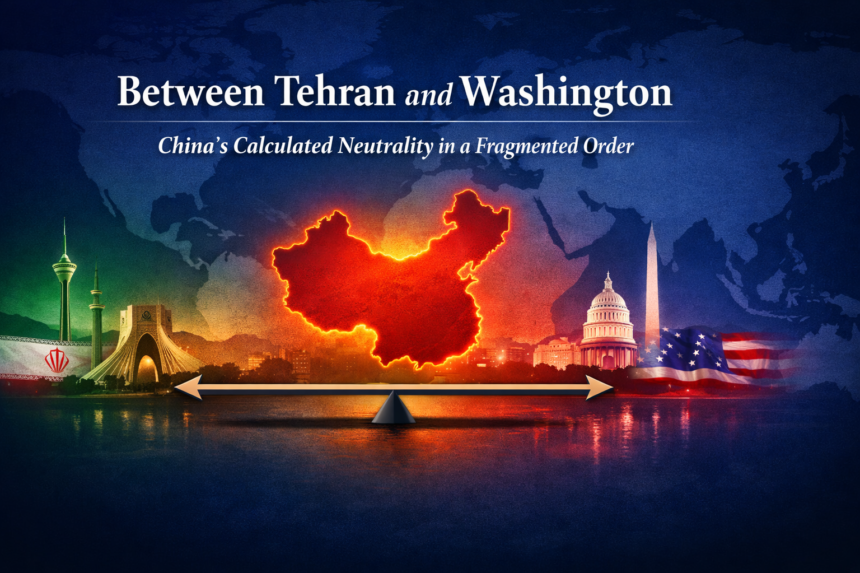
Instead, Beijing has adopted a policy best described as ‘’active neutrality’’ (积极中立): a posture combining legal condemnation of the strikes with a deliberate refusal to intervene directly. This approach reflects not indifference, but a sophisticated calculation rooted in Chinese political culture, strategic traditions and leadership assessments of global power dynamics.
Strategic Logic behind China’s Neutrality
China’s official reaction has been framed primarily through the language of international law and diplomatic norms. Beijing describes the strikes as a ‘‘grave violation of Iran sovereignty and security’’ and ‘’firmly oppose[d]’’ the targeted killing of Iran’s Supreme Leader. Chinese diplomatic tone tried to avoid direct confrontation with Washington and emphasized three principles articulated by Foreign Minister Wang Yi: cessation of hostilities, return to dialogue and opposition to unilateral military actions.
For China’s leadership, overt alignment with Iran would risk transforming a regional crisis into a broader front in the already tense U.S-China Strategic competition.
Indeed, one China scholar argued that China’s ‘’overriding priority should be preventing the Iran crisis from spilling into the U.S-China bilateral agenda.’’ This reveals the central concern in Zhongnanhai that Middle-Eastern conflict must not derail China’s larger priorities of trade negotiations with the United States and its broader focus in the Indo-Pacific.
The Chinese Intellectual Debate: Neutrality with Caution
Among Chinese scholars, the dominant recommendation is mediation rather than intervention. Scholars broadly support maintaining neutrality while positioning China as a diplomatic intermediary.
Yet beneath this consensus lies an important debate. The prominent political scientist Zhang Yongnian suggests that China should gradually adopt policies ‘’befitting a great power’’, implying that passive neutrality may not be sustainable indefinitely. Similarly, the legal scholar, Zhang Ge (郑戈) argues that the effectiveness of mediation will depends on the war’s trajectory and warns that meaningful diplomatic engagements may require China ‘’to transcend its traditional ‘Non-Interference’ principle.’’
These views highlight deeper tensions within Chinese strategic thought. Since the reform era, Beijing has built its image on non-interference and economic pragmatism. However, as China’s global influence grows, crisis such as the Iran-Israel conflict raise questions about whether this doctrine can remain unchanged.
For now, the prevailing view among Chinese scholars is that, the risk of intervention outweighs the cost of restraint. As one analysis bluntly concludes, China should continue focusing on domestic development while avoiding entanglement: ‘’the world is a ramshackle theatrical troupe; let the world remain in chaos, while China should keep China doing well.’’
American Military Capabilities and Lessons for China
One striking aspect of the Chinese scholarly commentary is the simultaneous condemnation of the strikes and recognition of American military capabilities. Several analysts describe the operation as a stark reminder that the international system remains fundamentally shaped by hard-power.
Zhang Yongnian argues that the ‘’post-Cold War’’ ‘rules based order’ is ‘’functionally dead,’’ replaced by what he calls a ‘’Fear-based international order’’ (基于恐惧的国际秩序). In this environment, moral rhetoric alone cannot secure national interest.
Some commentators even express reluctant admiration for the technical precision of the operation. One analyst, writes, he ‘’cannot but admire’’ the operational sophistication of the strikes. Others insist that China must carefully study American methods rather than dismiss them. As Zhang Yongnian warns, China should avoid falling into the traps of ‘’excessive moralization and self-restraint,’’ adding implicitly that ‘’not using [Power] is equivalent to not having it.’’
These reflections reveal that Chinese scholars view the crisis not only as regional conflict but as a strategic lesson in power politics about contemporary politics in international system.
The Offshore Balancing Concern
A major theme inside Chinese analysis of Iran-Israel war is that the Iran operation reflects broader strategy of ‘’offshore-balancing’’ (离岸平衡), where Washington relies on regional partners to engineer geo-political environments without committing large scale ground troops.
Some scholars interprets Israel role in strikes as evidence of this model in action. One scholar warns that a similar strategy could eventually be replicated with Japan playing a role analogous to Israel in the Middle-East, and other regional partners acting as instruments of strategic pressure on China.
This concern explains Beijing’s caution, where direct involvement in Iran-Israel conflict could accelerate the consolidation of anti-China coalitions in the Indo-Pacific, an-outcome Chinese policymakers are eager to avoid by now.
Strategic Uncertainty and Conditional Outcomes
Another reason for China’s restrained posture is the profound uncertainty surroundings war’s eventual outcome. Chinese scholars broadly doubt the United States and Israel to achieve a regime change in Iran without committing their ground troops, an option they think politically unlikely.
However, scholars emphasize that the strategic consequences for China depends on how the conflicts unfolds. As Zhang Ge (郑戈) observes, if Washington successfully reshapes the Middle-Eastern Order, it would challenges China’s assumptions of gradual decline in American hegemony. Conversely, if its gets trapped in a prolonged conflict, American overextension could accelerate shifts in global power.
This conditional logic encourages caution. Beijing prefers to observe developments rather than commit prematurely to any side.
Economic Stakes and Energy Security
Despite its neutrality, China’s material interests in Iran are substantial. The country remains a key energy supplier and an important node in the Belt and Road Initiative. Several scholars warn that regime change in Tehran could render Chinese investments worthless.
One scholar warn that Chinese investments Iran might ‘’turn-to-ash’’ if a new pro-Western government were installed. Others emphasize the risks of rising energy costs and rising disruptions to maritime routes.
Nevertheless, the prevailing view in Chinese analysis is the risks remain manageable in short-term, largely due to China’s strategic oil reserves and diversified energy supply.
Active Neutrality as Strategic Statecraft
China’s response to Iran conflict therefore represents a calibrated strategy rather than any passivity. By condemning the strikes legally while refraining from military involvement, Beijing preserves credibility with developing nations, maintains relations with all Middle-Eastern actors, and avoids confrontation with Washington.
This posture also enables to position itself as a potential mediator. Beijing’s decision to dispatch special envoy ‘Zhai Jun’ to the region suggests that Chinese diplomacy aims to transforms ‘active neutrality’ into influence through negotiation.
Ultimately, China’s ‘active neutrality’ represents a distinctive approach to great-power strategy in a volatile international environment. It reflects the enduring traditions of Chinese diplomacy: of non-interference; of economic pragmatism; and of strategic patience.
For now, Beijing appears determined to observe, mediate and learn rather than intervene. In a world, that many Chinese political and legal scholars now describe as increasingly ‘fear-based’ and unstable, restraint itself has become a strategic power.
Conclusion
In sum, China’s response to the Iran conflict reflects a deeper strategic philosophy embedded in its historical foreign policy tradition. While Beijing maintains substantial economic and strategic ties with Tehran, its adoption of ‘active-neutrality’ demonstrates China’s broader priorities of stability in global markets, avoidance of confrontation with Washington and of strategic flexibility. Such caution reflects the logic of a rising power that seeks to influence without entanglement, learning from the demonstration of American power while carefully avoiding the strategic traps that have historically drawn great powers into costly regional conflicts.
The author is a senior researcher at the Centre for Development and Stability (CDS).
*The views and opinions expressed herein, and any references, are those of the author and do not necessarily reflect the editorial policy of the Centre for Development and Stability (CDS).