
By: Asif Haroon Raja
Pakistan’s present turmoil did not emerge overnight. It is the cumulative result of political engineering, flawed experiments, institutional miscalculations, and the deliberate exploitation of internal fault lines by hostile external forces.
The military establishment bears a significant share of responsibility for the current crisis. In its quest for a “third political experiment,” it facilitated the rise of Imran Khan and his party through overt and covert support mechanisms that included political manipulation, judicial pressures, and an aggressive media narrative.
The assumption was that charisma and popularity would translate into governance stability.
However, governance demands far more than public appeal. Running a state requires administrative experience, diplomatic maturity, economic foresight, and political sagacity.
These were glaring deficiencies. Decision-making became centralized, often opaque, and heavily influenced by unelected advisors. Key appointments—particularly in Punjab and Khyber Pakhtunkhwa—reflected poor judgment. The induction of dual-nationality advisers and controversial figures further widened fault lines.
During the three years and nine months of PTI rule, institutional balance weakened. Economic indicators deteriorated, pushing Pakistan dangerously close to default. More alarming than the economic slide was the erosion of social cohesion.
A cult-like political culture took root, penetrating educational institutions, professional classes, and the youth.
Hero worship replaced critical thinking.
Dissent was demonized. Abusive rhetoric, misinformation, and conspiracy narratives became normalized tools of political mobilization. Ethical restraint and political decorum eroded. The corrosion of ikhlaqiyat (moral conduct) was perhaps the gravest casualty.
Over time, this defiant political culture hardened. The creation of parallel mobilization structures such as “Tiger Force,” the aggressive use of digital platforms, and alignment—direct or indirect—with disruptive elements intensified polarization.
Overseas funding networks amplified the media war and sustained high-intensity agitation campaigns.
The events of 9 May 2023 marked a dangerous tipping point. Attacks on military installations and state symbols crossed red lines and shook the foundations of national stability.
Although corrective action followed, the permissive environment that had existed earlier enabled the phenomenon to metastasize.
Meanwhile, terrorism, which had been substantially degraded by 2018 through kinetic and intelligence-based operations, resurged sharply after 2022. Groups such as the Tehrik-i-Taliban Pakistan exploited political instability and governance vacuums.
The term “Khawarij” has re-entered national discourse as security forces once again pay daily sacrifices in Khyber Pakhtunkhwa and Balochistan.
The provincial government in KP has often appeared conflicted—torn between political loyalties and security imperatives.
Mixed messaging toward banned outfits and a posture of defiance toward federal authority have further complicated counterterrorism efforts.
Externally, adversarial states—particularly India—have historically sought to destabilize Pakistan through hybrid warfare, information operations, and proxy support.
The Taliban takeover in Afghanistan added another layer of complexity to the regional security matrix.
However, no external actor can succeed without internal enablers, facilitators, or political fragmentation.
Political parties across the spectrum—including nationalist and religious outfits—must introspect. Power struggles should not come at the cost of national cohesion.
When political narratives begin to weaken the legitimacy of state institutions, adversaries find opportunity.
Corruption, unfortunately, remains pervasive across provinces. Governance deficits in Khyber Pakhtunkhwa are particularly troubling, especially when security challenges are acute.
Blocking highways, paralyzing economic activity, and encouraging mass agitation in a volatile security environment amounts to strategic irresponsibility.
The relentless vilification of the armed forces on digital platforms further erodes morale at a time when officers and soldiers are sacrificing their lives.
Internal delegitimization harms national security more effectively than external propaganda.
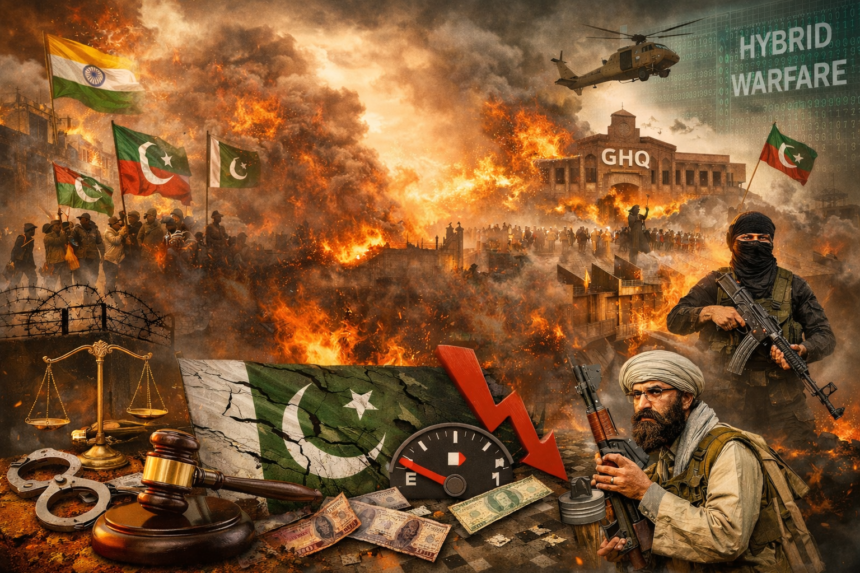
Pakistan today faces a convergence of threats: terrorism, economic fragility, political polarization, hybrid warfare, and declining institutional trust.
In such circumstances, appeasement, ambiguity, and half-measures are dangerous luxuries.
The question before policymakers is stark: Can the state afford prolonged accommodation with forces that consistently challenge its writ, undermine security institutions, and deepen polarization?
Or is it time for decisive, across-the-board accountability—without discrimination, without political engineering, and without selective application of law?
Selective justice and political manipulation created the crisis. Only impartial enforcement of the constitution, institutional neutrality, and national unity can resolve it.
Enough is indeed enough. The survival, stability, and integrity of Pakistan demand clarity of purpose, firmness of action, and an end to all political experiments.
About the Author
Brigadier (Retd) Asif Haroon Raja is a war veteran who fought in the Battle of Hilli in former East Pakistan and recovered the body of Major Akram Shaheed, NH. He is Command and Staff Course and War Course qualified, holds an MSc in War Studies, and served as Defence Attaché in Egypt and Sudan, as well as Dean of the Corps of Military Attachés in Cairo.
He served as the Pakistan Army’s spokesperson in 1992 and later as Honorary Colonel of the battalion he commanded for eight years. He is a defence, security, and geopolitical analyst, international columnist, author of five books, former Chairman of Thinkers Forum Pakistan, Patron-in-Chief of CDS Think Tank, Director of Meesakh Research Centre, and regularly appears on national and international media platforms.