
By: Nuzhat Nazar
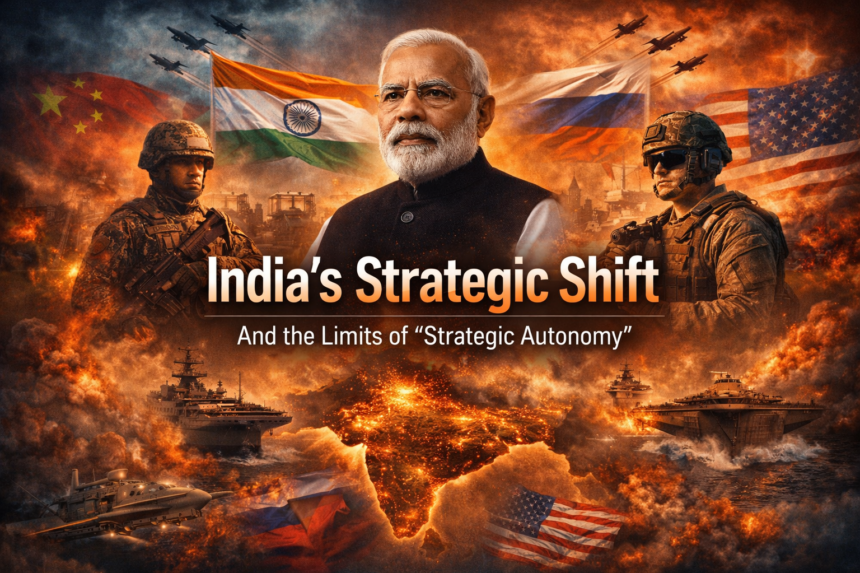
For decades, India has presented itself as a country capable of maintaining relations with competing global actors simultaneously. New Delhi often described this approach as strategic autonomy, the ability to cooperate with different power centres without formally aligning with any single geopolitical bloc.
This strategy allowed India to deepen partnerships with the United States, maintain diplomatic engagement with Iran, and simultaneously expand security cooperation with Israel.
However, recent developments in the Middle East suggest that India’s foreign policy is gradually moving away from that traditional balance. The latest escalation involving Iran has exposed the growing difficulty for New Delhi to maintain equidistance between competing regional actors.
Historically, India maintained a careful equilibrium in the Middle East. It relied heavily on energy imports from Gulf states, preserved diplomatic ties with Iran, and steadily expanded defence cooperation with Israel. This multi-directional diplomacy enabled India to safeguard its economic interests while avoiding direct involvement in regional rivalries.
Yet over the past decade, that balance appears to have shifted significantly.
Under Prime Minister Narendra Modi, India’s relationship with Benjamin Netanyahu and the Israeli government has strengthened to an unprecedented level. Defence cooperation between the two countries has expanded rapidly, turning Israel into one of India’s most important suppliers of advanced military technology.
Israeli systems, including surveillance platforms, drones and missile defence components, now form a significant part of India’s defence architecture. Over the past decade, Israeli arms exports to India are estimated to have reached between $20 and $25 billion, placing India among the largest buyers of Israeli military equipment globally.
Political symbolism has reinforced this growing partnership. Netanyahu has repeatedly referred to Modi as a “brother,” highlighting the depth of the relationship and signalling that the cooperation goes beyond routine defence transactions.
This closer alignment has strategic implications.
Israel frames its regional security policy around confronting groups and networks aligned with Iran, including organisations such as Hezbollah. As India expands defence cooperation with Israel and strengthens security ties with the United States, critics argue that New Delhi is gradually moving closer to a geopolitical alignment that directly conflicts with Iran’s strategic interests.
Such a shift carries serious risks for India because its economic and strategic stakes in the Middle East are substantial.
India imports nearly 85 percent of its crude oil, much of it coming from Gulf countries. A large portion of this energy supply passes through the Strait of Hormuz, one of the world’s most sensitive maritime corridors for energy transport. Any escalation involving Iran or disruptions in the Gulf could therefore directly threaten India’s energy security.
In addition, the Gulf region hosts nearly ten million Indian expatriate workers whose remittances represent a major source of income for the Indian economy. Instability in the region could disrupt employment opportunities for these workers and reduce financial inflows to millions of families in India.
Despite these substantial interests, India’s diplomatic reaction to the recent Iran crisis has been notably restrained. New Delhi has largely limited itself to carefully worded statements urging restraint while avoiding any explicit criticism of Israeli actions.
For Iran and several observers across the Muslim world, this cautious response has been interpreted as a signal that India is increasingly prioritising its strategic partnership with Israel and the United States.
Domestic political debates in India have also reflected this tension.
Opposition figures have raised questions about the timing of Modi’s diplomatic engagement with Israel shortly before the escalation involving Iran. Some political critics have suggested that the visit, which concluded roughly two days before the strikes began, raises questions about whether New Delhi had prior awareness of developments that were about to unfold.
The controversy intensified further after the Iranian warship IRIS Dena was sunk by a U.S. submarine in the Indian Ocean while returning home after participating in a naval exercise hosted by India. Because the Iranian vessel had effectively been a guest of the Indian Navy, opposition politicians questioned why the Indian government did not issue a stronger response.
These developments have triggered a broader strategic debate inside India about the future of its foreign policy doctrine.
For many years, strategic autonomy served as the guiding principle of India’s external relations. The idea was that India would maintain independent decision-making while avoiding formal alignment with any global bloc.
However, the expansion of India’s defence cooperation with the United States, including joint military exercises, intelligence coordination and security agreements, suggests that New Delhi is increasingly integrated into the Western security framework.
Energy policy has also become more constrained by international sanctions regimes and geopolitical pressures, particularly regarding oil imports from Iran.
These structural shifts indicate that India’s room for independent maneuver in global politics is becoming narrower.
The Iran crisis is also resonating within India’s domestic political environment. India has more than 200 million Muslims, making it the third-largest Muslim population in the world. Whenever conflicts involving Muslim-majority states intensify internationally, domestic political tensions within India tend to rise.
Recent reactions on Indian media and social platforms indicate that debates surrounding Iran have already triggered political polarization, with some nationalist voices accusing Indian Muslims of expressing divided loyalties when they show sympathy for victims of regional conflicts.
At the same time, critics argue that the ideological influence of Hindutva politics has increasingly shaped India’s domestic and foreign policy narratives.
Taken together, these developments suggest that India’s long-standing strategy of balancing relations across competing geopolitical camps is becoming harder to sustain.
The evolving crisis involving Iran illustrates how India’s growing strategic partnerships, particularly with Israel and the United States, are beginning to shape its diplomatic responses to regional conflicts.
Rather than maintaining equal distance from rival power centres, India appears to be gradually moving toward a more defined strategic alignment.
If this trajectory continues, India’s foreign policy may increasingly reflect the priorities of its emerging security partnerships rather than the traditional doctrine of strategic autonomy that New Delhi promoted for decades.