
(By Nuzhat Nazar)
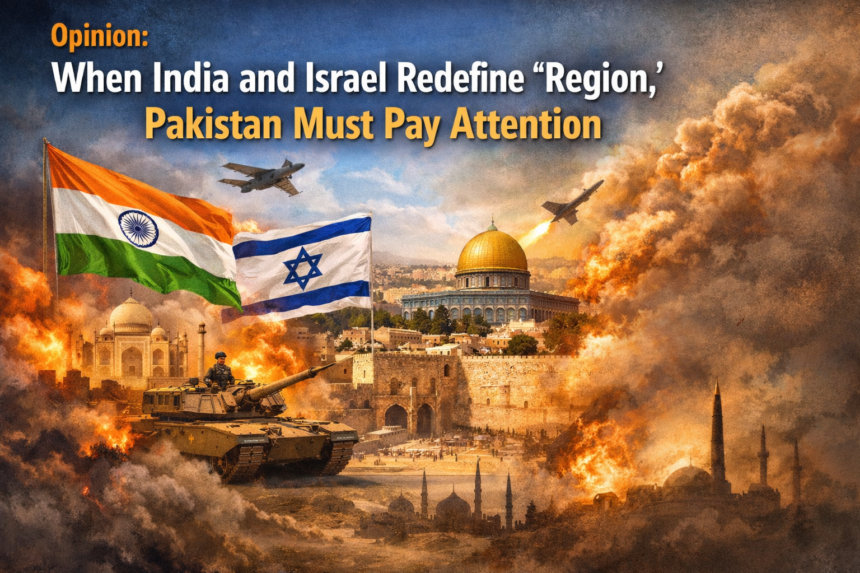
Indian Prime Minister Narendra Modi’s visit to Israel on 25 February, including an address to the Israeli parliament, is being presented as another step forward in a steadily warming relationship. On the surface, it looks like routine diplomacy. But when Modi and Israeli Prime Minister Benjamin Netanyahu say they will discuss “regional issues,” the phrase itself invites scrutiny. India and Israel do not share a geographic neighbourhood, so the question is less about maps and more about intent.
The reality is that India and Israel have grown closer not only through defence and intelligence ties, but through a shared way of thinking about security, influence, and how pressure is applied. This alignment goes beyond arms sales or intelligence sharing. It reflects a convergence around intelligence-led strategies, pre-emptive logic, and the use of narrative and perception alongside traditional instruments of power. For Pakistan, the concern is not symbolism; it is how this convergence may translate into indirect pressure focused on internal fault lines.
That concern becomes sharper when viewed through the lens of Balochistan. Balochistan is central to Pakistan’s economic connectivity, maritime access, and regional integration. Any sustained instability there has national consequences. India has previously indicated interest in highlighting Pakistan’s internal vulnerabilities as leverage. Israel, meanwhile, brings experience in intelligence analysis, strategic communications, and global narrative circulation. Together, these capabilities can reinforce each other without requiring overt confrontation.
This is where the role of Israel-based research and narrative platforms enters the discussion, particularly the Middle East Media Research Institute (MEMRI). Over time, MEMRI has published and amplified selective material related to Balochistan, often framed around separatism or grievance narratives that are detached from the wider security context and the role of external interference. In the contemporary strategic environment, think tanks play an increasingly influential role in shaping policy debates. Through research outputs, expert commentary, and media engagement, they contribute to determining which narratives gain prominence and policy attention.
When such framing closely mirrors India’s long-standing position on Balochistan, the overlap is difficult to ignore. This does not suggest open military coordination against Pakistan. Rather, it points to a subtler form of contestation, one that works through perception, advocacy, and the gradual internationalisation of an internal issue. These are classic hybrid-pressure dynamics, where influence and framing do much of the strategic work while remaining formally deniable.
The risk in the India–Israel alignment lies precisely here. Pakistan’s internal challenges risk being amplified without balance, while Balochistan is portrayed less as a province requiring development and stability and more as a global problem. Over time, this kind of framing can narrow Pakistan’s diplomatic space and complicate its internal security environment, even in the absence of direct confrontation.
None of this implies inevitability. But the pattern is visible enough to warrant serious attention. As intelligence cooperation, political alignment, and narrative ecosystems begin to move in parallel, Pakistan’s response must be calm, strategic, and forward-looking that rooted in proactive diplomacy, credible communication, and sustained engagement with international audiences.
When India and Israel talk about “regional matters,” Pakistan would be wise to listen carefully. In today’s strategic landscape, the most consequential contests are often not fought on borders, but in narratives, perceptions, and quietly coordinated agendas.