
Conducted by the Centre for Development and Stability (CDS)
Date:22/2/2026
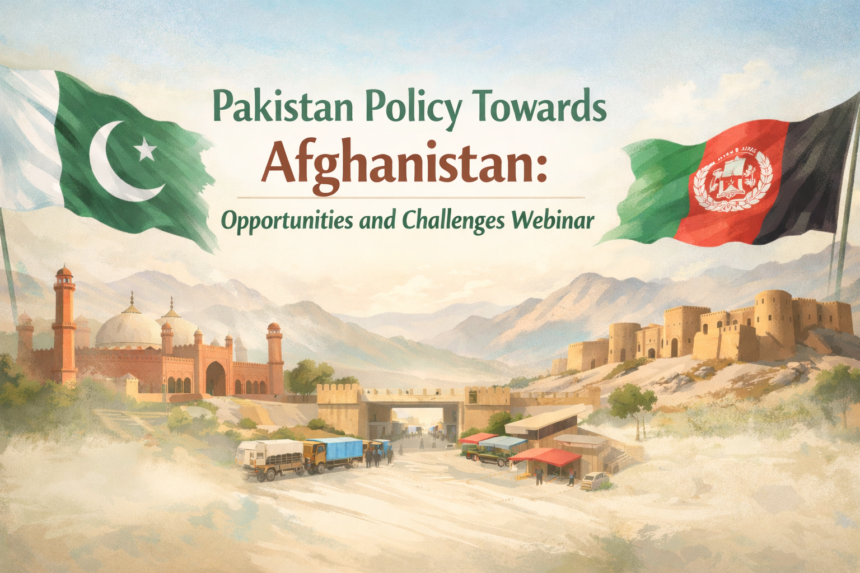
This document contains panel discussion hosted by Dr. Irfan Ashraf, presenting Security Analysts Brig (Retd) Asif Haroon Raja (Patron-in-Chief, Centre for Development and Stability) and Dr. Ali Chishti. The discussion focuses on Pakistan’s policy towards Afghanistan: Opportunities and Challenges, particularly in the context of cross-border terrorism, the Afghan Taliban’s role in sheltering groups like the Tehreek-e-Taliban Pakistan (TTP), and recent Pakistani military actions such as airstrikes against terrorist hideouts in Afghanistan.
The discussion appears to have taken place shortly after Pakistani airstrikes in Afghanistan which align with reported events around February 21-22, 2026, where Pakistan targeted TTP and affiliate camps in provinces like Nangarhar and Paktika and eliminated dozens of militants in response to suicide bombings in Pakistan e.g., in Islamabad and Bajaur.
1. Introduction and Context
Moderators: Dr. Irfan Ashraf and Maimona Saleem
Panelists:
Brig (Retd) Asif Haroon Raja, Patron-in-Chief of CDS
Dr. Ali Chishti, Security Analyst specializing in Afghanistan-Pakistan ties.
Main Topic
Pakistan’s evolving policy towards Afghanistan amid escalating cross-border terrorism. Pakistan has shifted from prolonged “strategic patience” and appeasement (due to historical facilitation of Afghan refugees, support during Soviet jihad and War on Terror) to more assertive actions, including recent airstrikes on TTP and the Islamic State – Khorasan Province (ISKP) hideouts in Afghanistan.
Dr. Irfan Ashraf presented the situation by noting that the discussion focused on Pakistan’s policy towards Afghanistan, the challenges it currently faces, and the possible way forward. He observed that Pakistan had long exercised restraint, viewing Afghanistan as a brotherly nation and hosting Afghan refugees for decades while extending various forms of support. However, he highlighted a visible shift in policy, pointing to recent Pakistani strikes against terrorist hideouts inside Afghanistan, including targets linked to the TTP and ISKP. Four questions were asked from the panelists.
- How can the broader strategic context of the current escalation be understood, and what viable policy options should Pakistan consider as a way forward in dealing with Afghanistan?
- What should Pakistan do if Afghanistan is sponsoring and facilitating terrorism, and what should Pakistan’s policy be towards Afghanistan in the coming days?
- Was India alone behind Afghanistan’s posture or were other international actors also involved in backing efforts to destabilise Pakistan?
- How China could stand with Pakistan to counter terrorism in Afghanistan, especially given that many terrorist groups threatening China enjoy safe havens there?
Below is a structured document containing the key points from the discussion.
2. Dr. Ali Chishti’s Analysis
Dr. Ali Chishti put light on the whole of the scenario and suggested some way forward while dealing with Afghanistan.
Pakistan’s strategic patience had finally worn thin, leading to seven airstrikes inside Afghanistan, primarily targeting border areas. Dr. Chishti described the operation as “retribution strikes,” arguing they were four to five months overdue. According to him, the current escalation traced back to August, when Pakistan adopted a doctrine of punitive deterrence, signaling that any terrorist activity on its soil would invite a direct response, with the cost borne by those governing Kabul or Kandahar. He further noted that although Pakistan pursued diplomatic avenues, including talks in Qatar and Turkey, valuable time was lost, during which high-value militant targets reportedly relocated to urban areas, complicating future operations.
Dr. Chishti added that cross-border infiltration by TTP militants continued, with sleeper cells activated inside Pakistan. He observed a shift in militant composition, claiming that formations entering Pakistan were increasingly made up of Afghan fighters rather than traditional TTP elements from the Mehsud and Wazir tribes. He further asserted that around 7,000 TTP militants and tens of thousands of their family members were based in Afghanistan, getting facilitation by the Afghan Taliban. He said Pakistan’s official rhetoric had evolved to explicitly refer to the Afghan authorities as a “Taliban regime,” while also calling for an inclusive government.
He also referenced recent diplomatic efforts, including Saudi mediation that secured the release of two Pakistani soldiers, and said Pakistan had employed kinetic, sub-kinetic, and non-kinetic tools, including trade restrictions. However, these measures failed to compel action by Afghan authorities against the TTP, ISKP, or Balochistan Liberation Army (BLA) elements allegedly operating from Afghan soil. Citing recent suicide attacks in Islamabad and Bajaur, he said that at least one attacker was an Afghan national.
The analyst argued that indecisiveness, rather than a single bad decision, had driven escalation, suggesting the killing of a Pakistani colonel and soldiers triggered a policy shift. He further said that regional considerations, including Iran, had previously constrained Pakistan’s response, but that the latest strikes marked the beginning of a sustained strategy. According to him, policymakers were considering a “hot pursuit” doctrine and the creation of a buffer zone extending five to eight kilometers inside Afghan territory. He concluded by stating that the strategy reportedly had tacit backing from multiple regional and global stakeholders.
3.Brig (Retd) Asif Haroon Raja’s Analysis
Brig (Retd) Asif Haroon Raj presented his analysis onWhat Pakistan should do in a situation where Afghanistan is sponsoring and facilitating terrorism, and outlined what Pakistan’s policy should be towards Afghanistan in the coming days.
Brig Haroon stated that before addressing the policy question, certain basic realities needed to be understood regarding Pakistan–Afghanistan relations. He said that since its inception, Pakistan faced hostility from two fronts, India in the east and Afghanistan in the west. He explained that Afghanistan was the only country that did not recognise Pakistan initially and even opposed its UN membership. He added that the Pashtunistan narrative emerged early and continued to shape Afghan policy, with successive governments refusing to recognise the Durand Line and laying claims over Pashtun regions of KP, former FATA, and parts of Balochistan.
He argued that except for the Mullah Omar period, most Afghan regimes were anti-Pakistan and pro-India. He explained that Pakistan’s strategic compulsions, particularly Indian hostility, forced it to seek friendly ties with Afghanistan and Iran to secure its western flank. He said this compulsion led Pakistan to overlook Afghan excesses and pursue a policy of appeasement. He also linked this approach to Pakistan’s broader foreign policy vision, rooted in Quaid-e-Azam’s emphasis on maintaining cordial relations with neighbours.
Brig Haroon maintained that Afghanistan exploited Pakistan’s conciliatory approach despite Islamabad’s support during the anti-Soviet jihad and later the war on terror. He stressed that Afghanistan’s survival during invasions was facilitated by Pakistan, which provided sanctuary and support.
He also highlighted Pakistan’s decades-long hosting of millions of Afghan refugees, describing it as an unprecedented humanitarian effort. Turning to recent developments, he said Pakistan played a key role in facilitating the Doha process and expected the new Afghan regime to mirror the earlier Taliban model under Mullah Omar, ensuring a stable western border. However, he argued that the current leadership proved more hostile, disregarding Pakistan’s contributions and indirectly benefiting India. He described this as a case of betrayal and added that India was now gaining strategic advantage from Afghan hostility towards Pakistan.
He then examined Pakistan’s own weaknesses, stating that the country never developed a comprehensive and coherent Afghan policy and instead relied on reactive, day-to-day decision-making. He said Pakistan failed to counter Afghan narratives on the Durand Line and Pashtunistan proactively and did not challenge claims over Pakistani territory effectively.
Discussing the war on terror, he said Pakistan fought two externally driven conflicts: the anti-Soviet jihad and the US-led war on terror, bearing heavy costs, including over 100,000 casualties and massive economic losses. He explained that during the Afghan war, two distinct Taliban factions emerged: the Afghan Taliban, which focused on fighting foreign forces in Afghanistan, and the TTP, which targeted Pakistan. He said Pakistan mistakenly perceived the Afghan Taliban as friendly due to this distinction, leading to the flawed categorisation of “good” and “bad” Taliban.
He argued that this distinction eventually collapsed, with both groups now aligned against Pakistan due to ideological and ethnic ties. He claimed the Afghan Taliban chose solidarity with the TTP despite Pakistan’s outreach. He further alleged that the Afghan regime had developed strategic alignment with India, forming what he described as a nexus aimed at destabilising Pakistan through proxy warfare.
Brig Haroon stated that terrorism had sharply escalated in recent years, with increased cross-border attacks and Afghanistan failing to honour commitments not to allow its soil to be used for terrorism. Afghanistan had become a hub for multiple militants organisations, creating a twin threat for Pakistan external hostility and internal destabilisation. He linked regional instability to coordinated proxy activity, citing unrest in Balochistan and attacks in Khyber-Pakhtunkhwa as part of a broader destabilisation pattern.
He said Pakistan had repeatedly exercised restraint and issued warnings but recent attacks marked a turning point. He recalled that Pakistan had earlier conducted counter-strikes and had the capacity to escalate further but was urged by friendly states to exercise restraint and pursue diplomacy. According to him, this pause allowed Afghan actors to regroup and relocate assets, prolonging the conflict.
Brig Haroon said the time had come for Pakistan to convert its responses into long-term strategic gains. He recommended exposing what he described as the India–Afghanistan nexus and eliminating internal facilitators of terrorism. He stressed the need to strengthen border management and transform Pakistan into a firmer “hard state.” He also urged mobilising international support by projecting Pakistan as a frontline bulwark against terrorism and calling on the global community to pressure Afghanistan into complying with its commitments, arguing that regional peace and stability depended on it.
4.Question & Answer Highlights
In this session, Dr. Irfan Ashraf asked whether Afghanistan was acting independently or if other regional or international powers were backing its actions against Pakistan. While India’s linkages with the Taliban were widely discussed, the scale of incidents suggested broader support. He questioned whether India alone was behind Afghanistan’s posture or if other international actors were also involved in backing efforts to destabilise Pakistan, and invited Brig Haroon’s assessment on the matter.
5.Brig Haroon’s Assessment on the Matter
Brig Haroon responded that historically, insurgencies, terrorism, and political unrest are often backed by foreign funding and external actors. He claimed that during the war on terror, a large proxy campaign was waged against Pakistan, alleging that multiple international intelligence agencies operated from Afghanistan with the aim of destabilising and denuclearising Pakistan.
He said that the current Afghan regime remained internationally isolated and unrecognised, facing humanitarian and economic crises, yet continued to challenge Pakistan. According to him, this suggested the presence of powerful external backing, as Afghanistan, being landlocked and economically dependent on Pakistan’s trade routes and ports like Karachi and Gwadar, would otherwise lack the capacity to sustain such a posture.
India as the primary external actor, it was providing guidance, funding, arms, and narrative support, including media campaigns against Pakistan. He further added that Israel had also maintained a presence in Afghanistan and remained aligned with India on regional issues, including Kashmir.
Moreover, the United States could not be ignored, arguing that a long-standing strategic nexus among the US, India, and Israel continued to shape regional dynamics. He suggested that despite changing rhetoric, Washington would not want Afghanistan to fall entirely into the influence of China, Russia, or Iran, and therefore maintained indirect strategic interests through regional partners.
He asserted that external involvement in anti-Pakistan terrorism could not be ruled out. Besides, continued strategic use of facilities like Bagram and advanced weapons, drones, and equipment left behind after the US withdrawal had significantly enhanced the capabilities of militant groups. He argued that the military hardware abandoned in Afghanistan was not accidental but had altered the operational landscape by empowering various militant actors.
Furthermore, Dr. Irfan Ashraf asked Dr. Ali Chishti about the role of regional powers, particularly China and Iran, in the current scenario. As a friendly country, Pakistan expects positive support from China in managing conflicts. He highlighted China’s presence in Afghanistan for business and mining activities near the Tajikistan border and asked how China could respond while Pakistan reacts to Afghanistan sponsoring terrorism. He also pointed out that Afghanistan might play the victim card, and Indian media have been portraying Pakistan’s strikes as targeting civilians rather than terrorists.
Dr. Chishti view was sought on: How China could stand with Pakistan to counter terrorism in Afghanistan, especially given that many terrorist groups threatening China enjoy safe havens there?
6.Dr. Chishti Analysis on Regional Powers (particularly China)
Dr. Ali Chishti stated that the region now understands Pakistan’s position regarding Afghanistan. He explained that it is not just China, but also Iran, Tajikistan, and Uzbekistan that appreciate Pakistan’s patience with Afghanistan. He clarified that their support is driven primarily by their own security concerns, as Afghanistan has become a hub for various terrorist organisations. He noted that the Afghan Taliban either lack the capacity to control these groups, are complicit, or are exploited by third-state partners, as Brig Haroon had highlighted, including India and Israel. He added that Afghanistan has become a global threat. Dr. Chishti described Afghanistan as a perpetual regional problem and a potential source of global terrorism, with concerns that any future large-scale attacks could originate from Afghan soil.
He discussed China’s perspective. According to him, China views Afghanistan through Pakistan’s lens. He said that Pakistan and China had proposed Afghanistan’s inclusion in an extended CPEC 2.0 plan, connecting the Wakhan border to Central Asia, recognising Pakistan and China’s role in promoting regional stability. However, he pointed out that recent incidents, such as the killing of Chinese engineers in Turkmenistan originating from Afghanistan, illustrate ongoing security challenges.
Dr. Chishti also highlighted broader geopolitical shifts, including India’s use of airbases in the region, the development of Chabahar, and alliances forming between Israel, India, and Middle Eastern countries against what he termed the “Sunni axis” comprising Pakistan, Saudi Arabia, Turkey, and extending to Indonesia. He described Afghanistan as a centre of proxy wars, with the Taliban operating a war economy, accepting support from any bidding party, including the Americans, who had reportedly paid $40 million per week in the past. He added that the Taliban continue to run major drug operations, and have expanded trade routes through northern regions.
Regarding regional support, Dr. Chishti stated that China and the United States stand with Pakistan, as do several Central Asian countries, whose leaders have visited Pakistan to signal their backing. He concluded that Pakistan has a critical role to play in addressing the Afghan issue, particularly along the southern and western regions bordering Pakistan, which he identified as the primary zones of concern for years to come.
7.key Challenges and Opportunities
Based on the above expert analyses, several key challenges and opportunities can be identified.
Challenges
- Afghanistan has become a safe haven for multiple terrorist groups, including TTP, ISKP, and Al-Qaeda.
- Afghan Taliban’s complicity or inability to control these groups poses a direct security threat to Pakistan.
- Militants have gained access to advanced weaponry, drones, and technology left behind by the US and NATO.
- India is allegedly providing guidance, funding, and strategic support to destabilise Pakistan via Afghanistan.
- Israel, the United States, and other external actors are perceived to be part of a nexus influencing Afghan policy.
- Afghanistan serves as a base for broader proxy conflicts, impacting Pakistan and regional stability.
- Long-standing disputes, including the Durand Line and Pashtunistan claims, continue to strain relations.
- Past policies of appeasement allowed Afghanistan to exploit Pakistan’s patience.
- Previous miscalculations, such as differentiating “good” and “bad” Taliban, have led to a convergence of hostile groups against Pakistan.
- Pakistan faces both external threats from Afghanistan and internal destabilisation by proxies.
- Cross-border smuggling, drug trafficking, and militant movement through poorly controlled borders exacerbate security risks.
- Key regions like southern and western border areas (Kandahar, Kabul periphery) remain high-risk zones.
- India–Afghanistan–Middle East alliances are challenging Pakistan’s strategic environment.
- Afghan Taliban engage in a war economy, cooperating with any party offering support, making stability unpredictable.
- Media narratives especially Indian media portray Pakistan’s counter-terror operations as civilian-targeted, complicating international perception.
Opportunities
- China, Iran, Tajikistan, Uzbekistan, and Central Asian countries understand Pakistan’s position and patience.
- Regional powers acknowledge Pakistan’s efforts to maintain stability along its western border.
- China views Afghanistan through Pakistan’s perspective and has engaged Pakistan to mediate and stabilise Afghanistan.
- Potential inclusion of Afghanistan in CPEC 2.0 offers economic incentives and a framework for long-term cooperation.
- The United States and other international actors recognise the risks posed by Afghanistan as a terrorist hub.
- Pakistan can leverage global consensus to pressure Afghanistan to comply with commitments like the Doha agreement.
- Pakistan can highlight the India–Afghanistan nexus and other external backers of terrorism to the international community. And can use evidence of proxy support, militant bases, and attacks to build a case for sanctions or diplomatic pressure.
- Through strengthening border management, dismantling internal facilitators, and adopting a hard state approach Pakistan can enhance its security posture.
- Coordinated regional diplomacy can create a united front against cross-border terrorism. Stabilising Afghanistan aligns with Pakistan’s long-term economic and security interests, particularly through trade routes and regional connectivity.
- Engagement with China and Central Asian states can further strengthen Pakistan’s strategic position in the region
8.Conclusion
The evolving Pakistan–Afghanistan dynamic presents a complex mix of security challenges and strategic opportunities. Afghanistan’s role as a hub of militancy and proxy competition poses immediate risks. However, growing regional recognition of Pakistan’s concerns offers diplomatic leverage. Support from key regional actors and potential economic frameworks like connectivity initiatives provide pathways for constructive engagement. Similarly, strengthening internal resilience and border management remains essential to counter persistent threats. Ultimately, a balanced approach combining firm security measures with proactive regional diplomacy will be needed for safeguarding Pakistan’s long-term stability and strategic interests.