

By Nuzhat Nazar
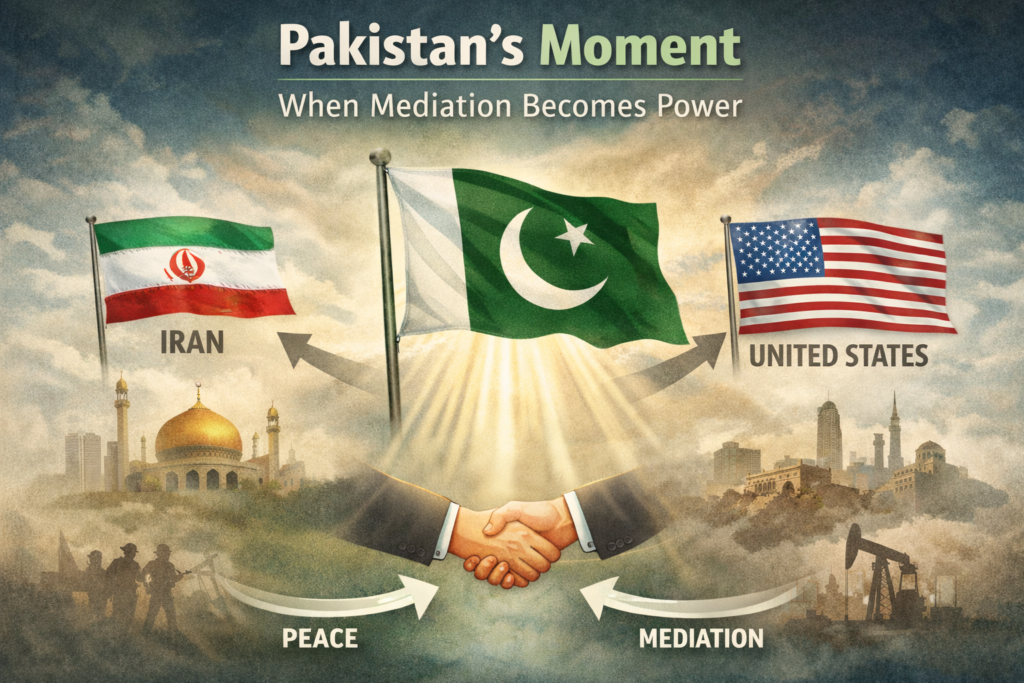
In Islamabad, this is not just a negotiation. It is a moment that captures how power is being redefined.
At one table sit two men shaped by conflict, but in very different ways. JD Vance, a former Marine who witnessed war firsthand in Iraq before rising rapidly through America’s political system, now finds himself tasked with ending a conflict he once approached with caution. His broader worldview has consistently reflected skepticism toward prolonged external military entanglements, including a reluctance to see the United States drawn into volatile regional crises such as those in South Asia, particularly after the tensions witnessed during the 2025 Pakistan-India crisis.
Across from him, Abbas Araghchi, a product of the Iranian Revolution and a veteran of both battlefield and diplomacy, carries decades of strategic experience shaped by conflict and negotiation alike. From the Iran-Iraq war to his central role in negotiating the Joint Comprehensive Plan of Action, he represents a system that is built to absorb pressure, not rush toward compromise.
They do not just represent two countries. They represent two different strategic logics. One seeks outcomes within defined timelines. The other is designed to endure until the terms shift. That is why this negotiation cannot be understood in isolation. It is not simply about ending a war. It is about managing a system under stress. And that is where Pakistan enters the picture.
Pakistan has emerged as one of the most active and effective actors in this crisis, not by accident, but by design. It maintains working relationships with Washington, Tehran, Riyadh, Beijing, and key Gulf states simultaneously. These relationships are not symbolic. They are operational, built over time through security cooperation, diplomatic engagement, and sustained contact even during periods of tension.
In a fragmented system where trust is limited, that access becomes leverage. Pakistan can speak to all sides and still be heard by all sides. This is what makes it uniquely suited to host and facilitate negotiations of this nature. It is not imposing outcomes. It is enabling engagement. It is creating the conditions under which dialogue becomes possible, and then sustaining that dialogue when positions harden.
This is the essence of what can be described as a connector state. Unlike traditional mediators that rely on neutrality, connector states derive influence from relevance. They are embedded across multiple relationships. They have stakes, but not dominance. They carry credibility without control. And in today’s system, that is more valuable than traditional forms of power.
The structure of the Islamabad talks reflects this shift.
This is not a single-track negotiation. It is a layered process. Direct engagement between Washington and Tehran is only one part of it. Parallel consultations with regional actors, backchannel communications, and intelligence-level coordination are all operating simultaneously. Each layer addresses a different dimension of the crisis. This is a network of negotiations. And that network tells you something fundamental. No single actor controls the process anymore. This is where China and Russia come into play.
China’s role is not overt, but it is foundational. Its approach to diplomacy, visible in recent regional engagements including the Pakistan-Afghanistan-China dialogue, emphasises sustained engagement, non-escalation, and regional ownership. It does not seek to impose quick solutions. It seeks to build frameworks that can manage tensions over time.
That same approach is now visible in Islamabad. China provides the framework. Russia, meanwhile, plays a quieter but equally important role. By maintaining engagement with Tehran and signalling support for negotiation rather than escalation, it helps preserve the diplomatic space. It ensures that the process does not collapse under pressure. Russia reinforces the space. Pakistan executes.
It is where these dynamics translate into action. It is where communication is maintained, where engagement is sustained, and where outcomes, however incremental, begin to take shape. This informal convergence between China, Russia, and Pakistan is not an alliance in the traditional sense. There is no formal coordination. But functionally, it is shaping outcomes. It reflects a broader shift in global power practice.
If the system were still unipolar, mediation would look very different. It would be centralised, controlled, and directed by a single actor. Instead, what we see in Islamabad is a distributed system where power is fragmented, and influence is negotiated.
That changes what success looks like. The objective is no longer a decisive settlement that resolves all issues. It is continuity. Keeping the process alive. Preventing escalation. Managing instability rather than eliminating it.
Pakistan’s role fits precisely into this logic. It is also informed by recent experience. The 2025 Pakistan-India crisis demonstrated how quickly escalation in South Asia can carry global consequences. Managing that environment required restraint, communication, and calibrated signalling. Those same capabilities are now being applied at a broader level in Islamabad.
Despite managing pressures on both its eastern and western fronts, Pakistan has sustained engagement across all stakeholders. That builds credibility. And in a fragmented system, credibility becomes a form of power. Looking ahead, even if these talks do not produce a comprehensive agreement, the implications are significant.
This model of multi-actor, process-driven diplomacy is likely to persist. Future crises will increasingly be managed through similar networks rather than singular mediation efforts. China’s framework-based approach will gain traction if it proves effective in sustaining engagement. Russia’s role as a balancer will deepen, allowing it to shape outcomes without direct exposure. For Pakistan, this moment presents a strategic opening.
If it sustains this role, it can move from being a situational mediator to a structural one. A state that is not just called upon during crises, but integrated into how crises are managed. But this role also comes with responsibility. It requires balance, consistency, and delivery. Any perception of alignment or inability to produce outcomes could weaken its position.
At a broader level, what Islamabad represents is a shift in how power is defined. Power is no longer just about who can impose outcomes. It is about who can make outcomes possible. It is about who can connect actors that do not trust each other, sustain engagement in moments of crisis and deliver continuity when systems are under stress. And in this moment, Pakistan is doing exactly that.
If this process holds, even partially, Islamabad will not just shape the outcome of this crisis. It will shape how diplomacy itself is practiced in a world where control is limited, but connection is everything.
Nuzhat Nazar is a journalist and strategic affairs analyst with more than ten years of experience reporting on foreign policy, defence, and economic developments. Based in Islamabad, she focuses on geopolitics, regional security dynamics, and Pakistan’s positioning in a shifting global order.