

By Asif Haroon Raja
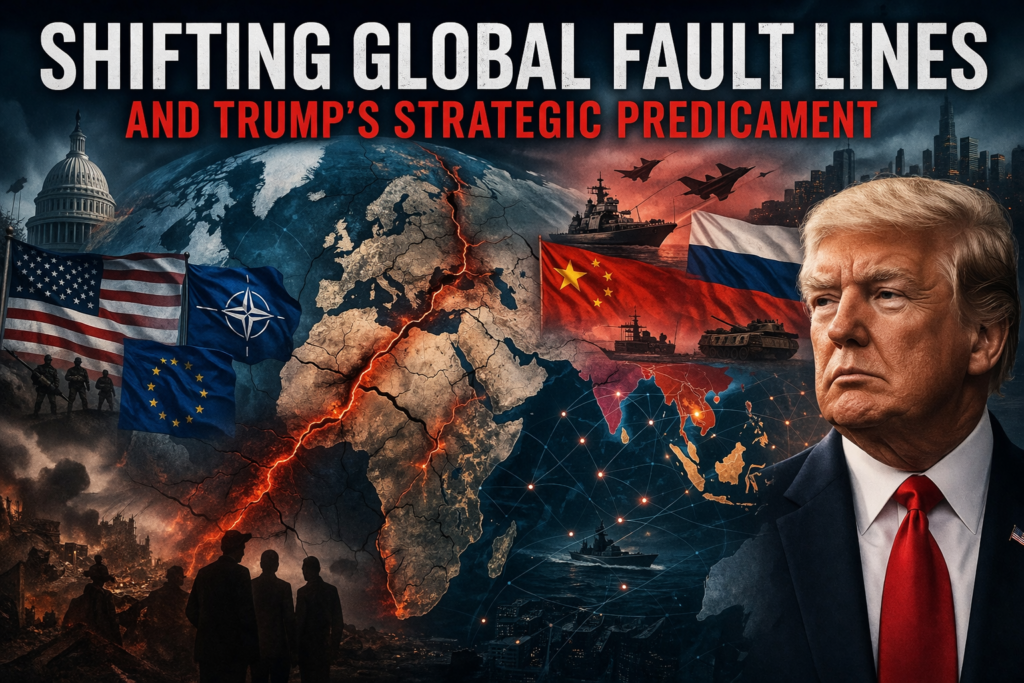
Anti-war protests have spread across all 50 states of the United States, reflecting deep public unease over the widening arc of conflicts and Washington’s interventionist posture. Political polarization between the Republican and Democratic parties has intensified into open hostility, eroding internal cohesion at a time when national unity is most needed. Donald Trump is facing a steady erosion in domestic support as the crucial mid-term elections approach. His administration appears increasingly overstretched abroad and embattled at home.
At the same time, the so-called “rules-based international order” stands discredited in the eyes of the Global South, which now views it as selective, coercive, and structurally biased. On multiple external fronts—Ukraine, Gaza Strip, and Iran—Washington finds itself without a decisive success. The tariff war has also produced diminishing returns, disrupting global supply chains while failing to secure lasting strategic gains.
Policies once branded as “shock and awe” and coercive sanctions have lost both credibility and effectiveness in an increasingly multipolar world. Institutions like the United Nations have been rendered largely ineffective, their authority undermined by selective enforcement and power politics. This erosion has accelerated the fragmentation of global governance.
Unwavering U.S. support for Israel—particularly under Benjamin Netanyahu—has further damaged Washington’s global standing. Israel’s military campaign in Gaza and the humanitarian fallout have fueled widespread resentment, especially across the Muslim world. Likewise, Washington’s earlier strategic tilt toward India has contributed to perceptions of imbalance and selective partnerships.
Trump’s adversaries have grown more assertive, while traditional allies are increasingly uneasy, distancing themselves from what they perceive as erratic and unilateral policymaking. Even within the G7, internal strains are visible as emerging powers led by China and Russia challenge Western dominance and push for a redefined global order. The decision to escalate confrontation with Iran—widely perceived as influenced by Netanyahu—may prove to be a strategic overreach.
The war, initiated on contested premises, continues to lack broad international legitimacy. Rather than isolating Tehran, it has arguably strengthened Iran’s regional posture and strategic resilience. This misadventure could well become a defining turning point—not only for Trump’s political future but also for Netanyahu’s leadership and the long-standing perception of U.S.-Israeli invincibility.
Evolving Geopolitical Alignments
Meanwhile, new geopolitical alignments are rapidly taking shape. The Middle East appears poised for structural reconfiguration, with Iran likely to consolidate its influence, while Israel and segments of the Gulf Cooperation Council may find themselves strategically constrained.
In South Asia, Pakistan has demonstrated notable strategic agility. Its performance during the recent four-day conflict with India, coupled with calibrated military preparedness and proactive diplomacy, has elevated its regional and extra-regional standing.
Pakistan is increasingly being viewed as a stabilizing actor, with outreach extending across the Middle East, Central Asia, the Far East, and even North Africa. Significantly, Pakistan maintains working relationships with major global powers and enjoys a level of trust with Iran that few others command. This positions Islamabad uniquely to play a constructive role in de-escalating tensions in the Persian Gulf.
Emerging Global Realities
Future Trajectories and Emerging Realities
The world is entering a decisive phase of geopolitical transition where the unipolar moment of the United States is steadily giving way to a contested multipolar order. The axis of power is shifting eastward, and the Global South is no longer willing to remain a passive recipient of Western dictates. It is asserting strategic autonomy, economic independence, and political dignity. China and Russia, in concert with other emerging powers, are shaping an alternative framework of cooperation that challenges Western dominance. Non-dollar trade, regional blocs, and connectivity initiatives are gradually eroding Washington’s long-held financial and strategic leverage.
Expected Changes in the Middle East
The Middle East is likely to witness a profound reordering. Iran is poised to emerge as a central pillar of regional influence after demonstrating resilience under sustained pressure. In contrast, Israel may face increasing diplomatic isolation, while internal and external pressures could expose fissures within Gulf alliances.
A critical yet often underestimated factor in this evolving landscape is Afghanistan.
Long treated as a theater of conflict, Afghanistan now holds the potential to transform into a geoeconomic bridge linking Central Asia, South Asia, and the Middle East. Its future trajectory will depend on internal stability and the willingness of regional actors to shift from competition to cooperation. Any renewed attempt to use Afghan territory for proxy warfare will not only destabilize Afghanistan but also derail regional connectivity and economic integration. Stability in Afghanistan is thus not merely a national concern but a regional imperative.
In this context, Pakistan’s role becomes even more pivotal. A peaceful and economically integrated Afghanistan aligns directly with Pakistan’s strategic vision of regional connectivity, trade expansion, and energy transit corridors. Constructive engagement between Islamabad and Kabul will be essential to unlocking this potential.
Looking Ahead
Looking ahead, the coming decade may mark the decline of coercive geopolitics and the rise of pragmatic, interest-driven alignments. Military might alone will no longer guarantee dominance; economic resilience, technological innovation, and diplomatic balance will define global influence.
The United States may be compelled to transition from an enforcer of order to a negotiator within it. Simultaneously, emerging powers will bear greater responsibility in maintaining equilibrium and preventing conflicts from escalating into wider confrontations.
In this unfolding global transformation, nations capable of balancing ambition with restraint and power with prudence will shape the future. Pakistan, if it sustains its current trajectory of strategic maturity and diplomatic outreach, is well-positioned to emerge as a pivotal player—not only in regional stabilization but also in shaping the contours of the emerging world order.
With Yemen’s Houthi rebels entering the war and threatening to close Bab al Mandab, the crucial waterway that links the Suez Canal with the Indian Ocean, Saudi Arabia, alongside the United Arab Emirates, may feel that their defensive posture is no longer sustainable.
If so, the Gulf states, rather than the United States and Israel, could emerge as the players capable of forcing Iran to rethink its strategy of attempting to increase pressure on US President Donald Trump to negotiate an end to the war that does not involve the Islamic Republic’s surrender.
Brigadier (Retd) Asif Haroon Raja is a Patron-in-Chief of CDS Think Tank and regularly appears on national and international media platforms.