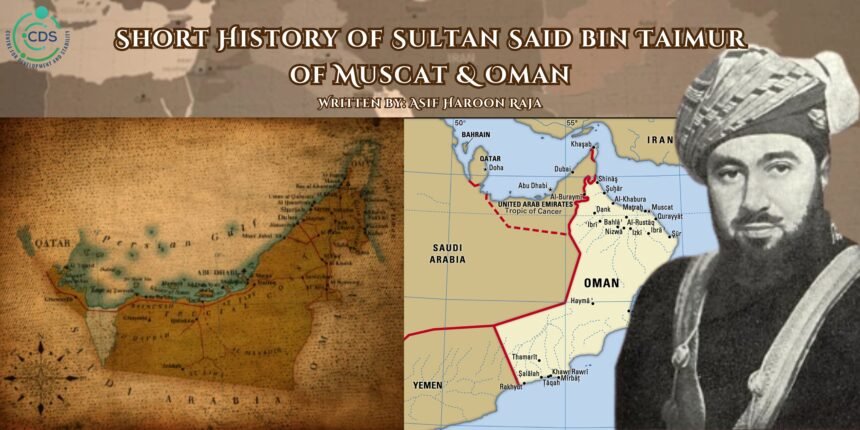

Sultan Said bin Taimur Al Said was born in 1910 and ruled Muscat and Oman from 1932 to 1970. He inherited the throne from his father, Sultan Taimur bin Faisal, at a time when the country was deeply divided, economically backward, and isolated from the outside world.
- Rebellion Against Sultan Said bin Taimur in 1966
- Memoirs of my Father Col M. Sakhi Raja
- Military Career and War Service
- Training, Instructional, and Personal Traits
- Command of Dhofar Force (DF), Oman
- Lack of Entertainment
- Training and Refurbishment of DF
- Sultan’s Trust
- Pangs of Envy
- Assassination Attempt and Heroic Response (1966)
- At the Quarter Guard
- The Scuffle
- Departure of Sultan
- Evacuation of my Father
- Awards Conferred
- Sultan’s Ears Poisoned
- Post-Military Life and Legacy
- The author, Brig (R) Asif Haroon Raja, is a war veteran, defence and security analyst, international columnist, and author of five books. He is war course qualified and holds an MSc degree in War Studies. He served as Directing Staff at the Staff College Quetta, Defence Attaché in Egypt and Sudan, and was appointed Dean of the Corps of Military Attachés in Cairo. He was awarded the Sitara-e-Imtiaz (Military). He currently serves as Chairman of Thinkers Forum Pakistan Think Tank and Patron-in-Chief of the CDS Think Tank.
- *The views and opinions expressed herein, and any references, are those of the author and do not necessarily reflect the editorial policy of the Centre for Development and Stability (CDS).
During his reign, Sultan Said struggled to maintain control over a fragmented state comprising the coastal region of Muscat and the interior region of Oman, which was often rebellious. He relied heavily on the British for political and military support, especially to suppress tribal uprisings and to combat the 1950s–60s Jebel Akhdar rebellion in the interior, led by Imam Ghalib bin Ali and supported by Saudi Arabia and Egypt.
His rule was marked by extreme conservatism, isolationism, and suspicion of modernization. Education, healthcare, and infrastructure were deliberately restricted due to his fear of internal dissent and foreign influence. For instance, there were only a few schools and no proper hospitals in the country by the late 1960s.
Said bin Taimur ruled from Salalah, in the southern province of Dhofar, where he led an austere life and remained disconnected from the rest of his kingdom. His repressive policies and failure to address modern aspirations led to growing dissatisfaction.
Rebellion Against Sultan Said bin Taimur in 1966
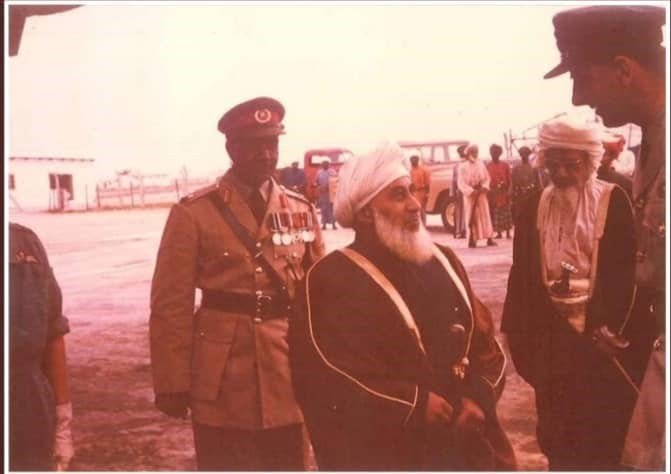

The 1966 rebellion against Sultan Said bin Taimur was a significant uprising that took place in the southern province of Dhofar, and it marked the beginning of the Dhofar Rebellion (1965–1976), which later evolved into a full-fledged Marxist insurgency.
The roots of the rebellion lay in widespread discontent over Sultan Said’s oppressive and regressive rule. The people of Dhofar, like the rest of Oman, lived under strict tribal control, poverty, and neglect. Education and development were practically non-existent, and political dissent was ruthlessly suppressed.
The initial uprising in 1965–66 was led by local tribal leaders and nationalists, supported by exiled Omanis and inspired by the wave of Arab nationalism sweeping the region, especially under Egyptian President Gamal Abdel Nasser. The rebellion was further fuelled by Sultan Said’s refusal to modernize, his ban on schools, radios, and modern medicine, and his habit of punishing dissent with harsh imprisonment or exile.
In 1966, the rebellion gained momentum as the Dhofar Liberation Front (DLF) began organizing attacks on government outposts. The rebels received support from South Yemen (then under a Marxist regime), and later from China, the Soviet Union, and Iraq, which turned the insurgency into a Cold War conflict.
The Sultan, ruling from Salalah, responded with brutal military action, heavily relying on British military and intelligence assistance, including the use of the British Special Air Service (SAS). Despite their help, the rebellion could not be fully contained due to poor governance and lack of popular support for the Sultan.
The 1966 rebellion thus marked a turning point in Oman’s history — highlighting the failure of autocratic rule and setting the stage for national transformation under a new leadership.
The intensifying rebellion in Dhofar was a major factor leading to the 1970 palace coup, when Sultan Said bin Taimur was overthrown by his son Qaboos bin Said, who modernized the country and successfully defeated the insurgents by winning the support of the local population through development programs.
In July 1970, his son, Qaboos bin Said, carried out a bloodless palace coup with British support, deposing him and sending him into exile in London. Sultan Said died there in 1972.
His reign is remembered for maintaining the unity of the sultanate under difficult conditions but also for his severe repression and resistance to progress, which left Oman underdeveloped and backward at the time of his ouster.
Memoirs of my Father Col M. Sakhi Raja
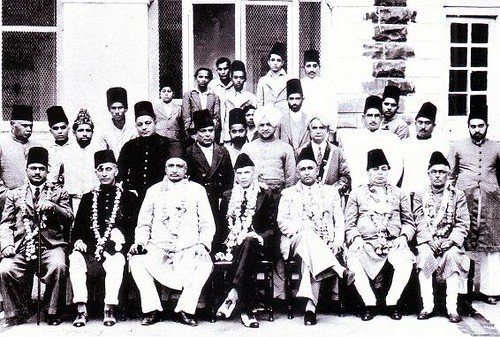
My late father Col Muhammad Sakhi Raja, S Bt, was a legendary footballer and a distinguished military officer. He played for the ‘All India Muhammadan team’, later represented Sandaman team in Baluchistan, and captained Pakistan Army team for many years.
His peers narrated that the ball seemed magnetically attached to his feet when he dribbled and charged forward, impossible to dispossess. Known for his thunderous headers and fearless play, he could stop a fast-moving ball with his chest, and score with unstoppable shots. Famous goalkeeper Ismail Durrani once personally told me these stories.
My late uncle Col Dilawar Shah (Ordnance), a fellow footballer, and a close confidant of my father, recounted how crowds in Calcutta and Bombay, would erupt in chants of “Raja, Raja” as my father entered the football ground.
He was not just a footballer but also an excellent athlete. He won gold medals in high jump and long jump, and received King’s Scouts medal during his college days.
Military Career and War Service
Commissioned into the Ordnance Corps at Jabalpur in 1946, my father had already served in the Second World War on the Burma Front, where he famously snatched a Sumari sword from a Japanese soldier during a hand-to-hand fight. After the war, he presented this sword to 4 FF Regiment, his parent unit post-Partition, and it remains proudly displayed in the Officers’ Mess to this day.
He served as Staff Captain HQ 7 Division Peshawar, where he had the honour of escorting Quaid-e-Azam Muhammad Ali Jinnah. As Adjutant of 4 FF in Bannu in 1952–53 under Brigadier Tor Gul, he became the most admired officer in the garrison.
My father always volunteered for challenging assignments. He led Mehsud Wing during the Dir-Bajaur operations (1960–61) and joined 4 FF when it was earmarked for commando operations in Laos. He served in various paramilitary units including Zhob Militia, South Waziristan Scouts (Wana), Tochi Scouts, and Parachinar Scouts.
A commanding presence with a warm personality, he was immensely popular, especially in Baluchistan and Khyber Pakhtunkhwa, earning the respect and affection of troops and tribes alike.
Training, Instructional, and Personal Traits
He earned AX grades in all professional courses at Infantry School Quetta, where he served as weapons instructor (1954–56). He was decorated for being the best weapon handler and bayonet fighter.
A man of charisma and intellect, he was a Pashto poet and a gifted singer, often reciting his own couplets melodiously. Fluent in Pashto, Persian, and Balochi, he had a deep cultural understanding, owing to his upbringing in Quetta.
His father, Raja Adalat Khan, migrated to Quetta in the 1920s, served as City Inspector, earned the King’s Police Medal, and was revered as the “Sherlock Holmes of Baluchistan” for solving blind murder cases, which others couldn’t.
Command of Dhofar Force (DF), Oman
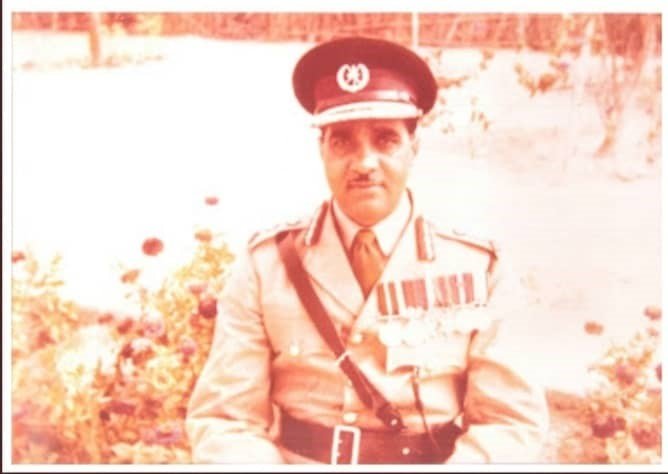
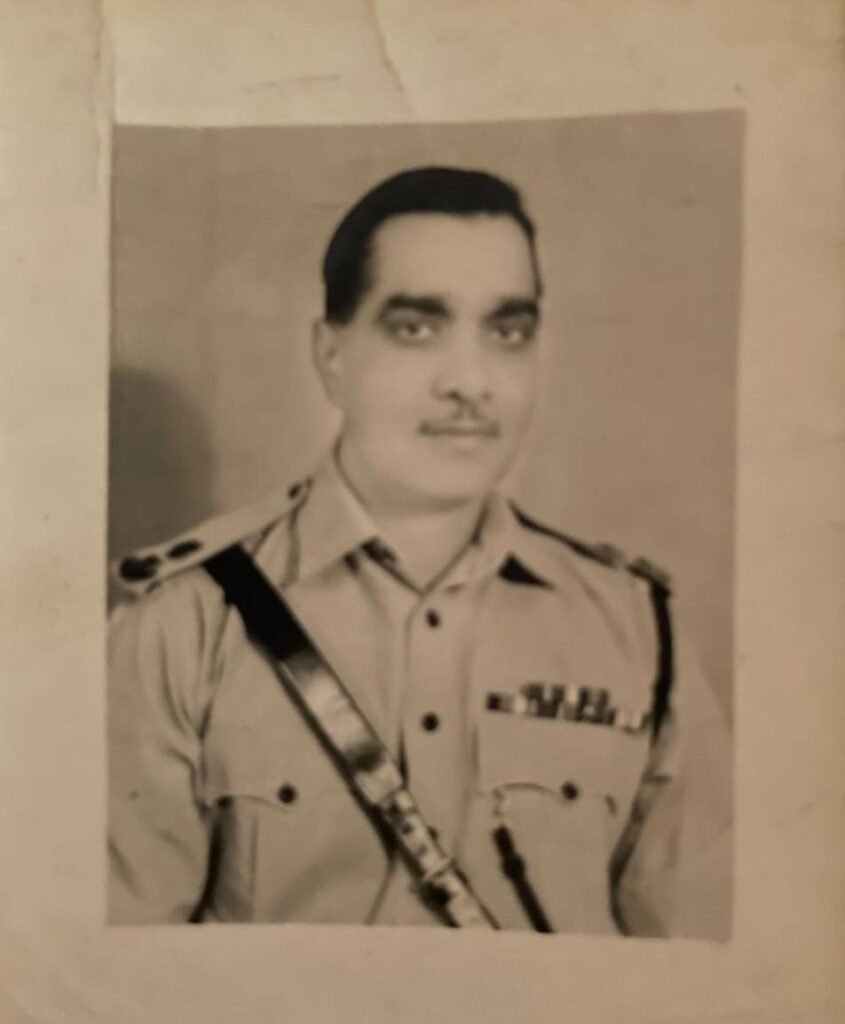
In January 1962, while serving in 15 FF Peshawar, he was selected by Maj Gen Attiqur Rahman (GOC 7 Division) to serve as Commandant of Dhofar Force (DF) in Salalah, Oman—a significant honour. My mother and siblings accompanied him, while I, then in Class IX at Cantt Public School Peshawar, remained in Pakistan. My family thoroughly enjoyed their stay, which they still cherish and fondly recall.
Sultan Said bin Taimur ruled Oman at that time. Salalah, the coastal capital of Dhofar, was beautiful but undeveloped—deprived of schools, hospitals, and modern amenities. Its people, a mix of Arabs and African-origin Khuddams, lived in tribal societies.
There was only one store run by Khemji Ramdas in Salalah town. The Sultan’s Secretary Ibrahim was an Indian Muslim, who also supervised the Sultan’s treasury, financial matters and was his trusted man.
DF had been raised in 1955 to guard the Sultan and the capital. Located in Azrat Camp, it was a battalion-plus force, garrisoned in a traditional fort, 15 km east of Salalah where he resided. There was only one large house of the Commandant within the fort, which had necessary facilities and a well-stocked library.
Initially, soldiers of DF were of Baloch origin, but later on, there was a mix of Salalah Khuddam s (slaves) and Jabbalis from the hill tribes, who were hardy and dexterous.
My father was given the rank of full Colonel, and he served there for six years. He was the first Pakistani officer to command DF. Before him, three British officers had commanded it. None lived with families, and spent most of their time in subsidized armed forces (SAF), in British Royal Air Force (RAF) Base officers’ mess, or Muscat, where several British officers like Brig Waterfield and Col Oldman were residing. They left the affairs of the Force to JCOs and Sergeants.
The DF was kept separated from British commands and the Sultan’s SAF. Lt Col Hugh Sanders was SAF commander based in Salalah at Umm al-Ghawarif.
Lack of Entertainment
The only entertainment for my family was the delightful dishes cooked by my mother, occasional visits to the Sultan’s Mamurah garden for picnics, where no one else was allowed, bird shooting, or yearly two-month vacations. The other entertainment was my father bringing eatables from the Naafe shop in RAF on each weekend, after his official visit to the palace to meet the Sultan. My elder sister took daily classes to teach younger siblings and prepare them for exams in Pakistan.
Training and Refurbishment of DF
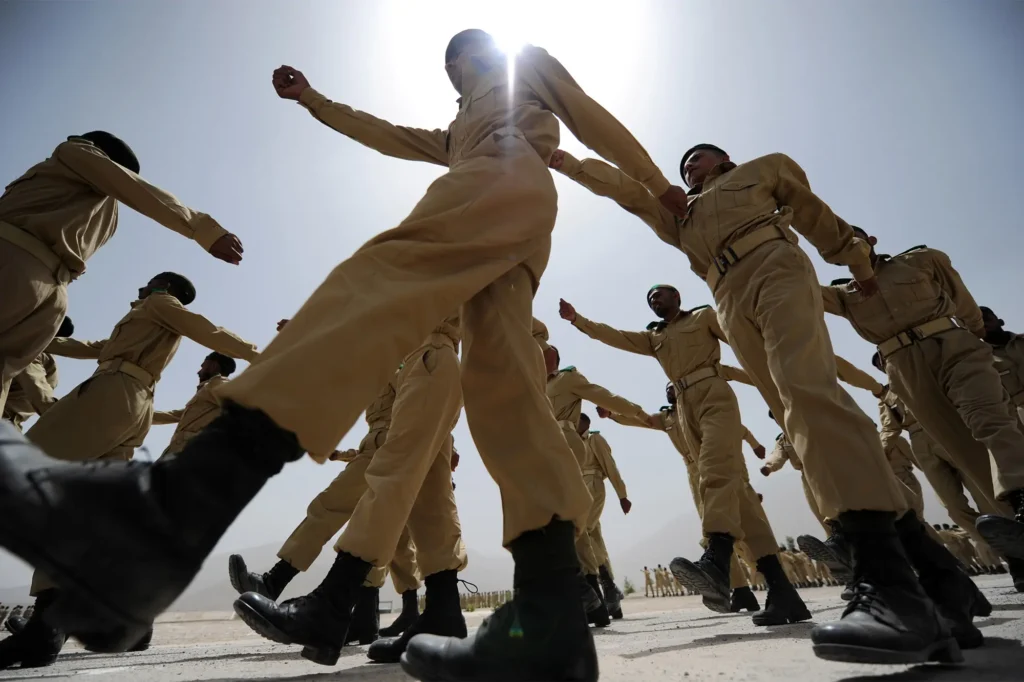
As the first Pakistani officer to command DF, my father revolutionized its discipline, administration, and training. He introduced uniforms, weapons drills, fitness routines, structured SOPs, regular parades, bugle calls, and raised the morale of the troops. Ferret scout cars, modern weapons, and proper messes were added. He raised a military band and organized ceremonial flag marches to the Sultan’s palace, cheered by locals. It was a big entertainment for them.
His rapport with locals and troops was unmatched. Soldiers affectionately called him “Quaid”. Fluent in Arabic, he built bridges between cultures and raised the DF to the professional standards of the Pakistan Army. He also raised a football team, which competed with the RAF team and often won.
Sultan’s Trust
My father earned the Sultan’s trust and respect. The Sultan would often visit DF and have lunch or tea at our house, which he thoroughly enjoyed. He liked the Pakistani dishes cooked by my mother so much that he would at times ask for them.
Pangs of Envy
The British officers in Oman and Muscat, particularly Brig Waterfield, looked at all-round improvements in DF and the Sultan’s closeness with my father with disdain and suffered from pangs of envy.
Assassination Attempt and Heroic Response (1966)
In April 1966, a dramatic turn of events occurred. While preparing to depart for Pakistan on two months annual leave on 01 May 1966, my father hosted Sultan Said bin Taimur at a ceremonial guard event in DF Headquarters on April 26.
At 0830 hours, my father inspected the arrangements and the ceremonial guard at the quarter guard led by staff sergeant Said Suhayl Bayt Qatam. The best nine NCOs and soldiers in drill were selected and were well-rehearsed to present a flawless royal salute. He then went outside the fort to receive the Sultan, who arrived with an armed escort of three vehicles.
He was seated in my father’s jeep and driven to the firing range to witness a firing competition. After returning to the fort, the ceremony started with the reception at the Quarter Guard. The Sultan mounted the saluting dais, with my father standing beside him on his left, 18 feet away from the soldiers lined up in two rows, ahead of the quarter guard room. Sultan’s bodyguards stood 20 feet away from the dais on his left flank, and also outside the gate.
After this event, the Sultan was to be shown weapon handling and drill by the ferret cars, and later on have refreshments at our house.
At the Quarter Guard
As per the account of my father, he keenly watched their drill movements; the first caution and movement of arms and rifles were perfect. In the second motion, he noticed that the bayonet fitted rifles facing upwards, instead of lowering downwards, a few started to move forward. He said that he had a premonition that something was amiss. He instinctively grabbed the left arm of the Sultan and pulled him towards the ground. That was the moment when bullets were fired by the mutinous soldiers, which would have hit the Sultan.
It was a decisive moment for my father, for he knew that if he gave another split second to the mutineers, they would reload their rifles and fire again. Before they could reload, my father jumped into the front row grappled with attackers, lifted the two rifles upwards with his two hands. Their misfires and my father’s dash panicked them and they started to run hither and thither and fired randomly.
At that time, stand-to cautions were given, and exchange of firing took place from both sides including the security guards of the Sultan. Stray bullets were hitting our house, and my siblings could hear bullets wheezing over their heads.
The Scuffle
My father was grappling with one of the soldiers M. Tahir Bani Hashim who was trying to exit from the rear door of the guard room. In their tussle, both moved in the rear of the guard room, my father trying to grab his rifle and he clutching it hard.
When my father floored him and was about to snatch his rifle, the quarter guard commander Suhayl appeared there. Finding his buddy in distress, he raucously charged with his rifle with full force and started stabbing my father. His first stab with the bayonet missed my father’s heart by an inch, but punctured his spleen. His second stab was on his head, which was partly deflected by my father by using his elbow as a shield, and penetration was ½ an inch. After stabbing his abdomen, his next stab pierced 9 inches deep into the left groin of my father. My father fought valiantly and imbalanced him by pulling his two legs.
At that time the Sultan’s bodyguards appeared and shot the two attackers dead. Honorary Lt Sattar Shah was injured by a stray bullet when he was rushing towards the scene of the incident from the firing range.
Departure of Sultan
My father’s uniform was drenched in blood, but unmindful of his wounds, he briskly walked towards the Sultan, who was still lying on the ground stunned. He asked him as to why he took such a big risk, to which my father said that he shouldn’t worry about him and should immediately leave. The Sultan’s departure was arranged with an armed escort.
Evacuation of my Father
Shad Muhammad Khan Khattak, elder brother of my brother-in-law Lt Gen Saranjam Khan, (who in the 1990s became a minister and a deputy speaker in the KP Assembly), had been inducted in the DF as a sergeant. He played a key role in the evacuation of my father and Sattar in an open jeep with a gun in his hand to RAF hospital located 15 miles away. The doctor expressed his inability to treat them, and recommended their immediate evacuation to the British Khormaksar Hospital in Aden, 600 miles away.
It was a dilemma for Shad, but he used his presence of mind and rang up the Secretary of Sultan to make available the Sultan’s plane for evacuation. Permission was granted and the two injured were flown to Aden to the Khormaksar Hospital.
The hospital staff refused to admit them saying that the hospital was meant for the British military patients only. Shad once again used his wits and argued that Pakistan was a member of the Commonwealth and hence admission was legal. When the two were taken to the operation theatre, the doctor operating them declared that Lt Sattar had 95% survival chance, and my father only 5% chance, since all his blood had been drained out and there was not a drop of blood in his body. Sattar died and my father miraculously survived.
Due to his exceptional stamina and willpower, he recovered in 15 days and on his insistence, he was discharged on the 20th day to return to his duty.
Shad Khan, who had given an interview to the media persons, narrated the whole story and said that he never came across such a brave man. He said that with all the tubes inserted in his body and covered with bandages, he asked him to dye his hair and shave him, and he started humming.
Awards Conferred
Soon after returning, he chased the rebels, arrested and punished them. He was awarded Oman’s highest military honor, the Samood Medal by the Sultan, and Sitara-e-Basalat by the Pakistan Army. The international media hailed him as “The Pakistani Colonel who saved the Sultan of Oman at the peril of his life.”
Sultan’s Ears Poisoned
On return from his leave, and his meeting with the Sultan, the latter expressed his consternation over the news splashed in the world media that the Sultan laid stunned. His ears had been poisoned by the British officers that the mutiny could have been planned by the Pakistani Colonel. Lt Col Coldin Maxell, Lt Col Hugh Sanders and Brig Waterfield resented his growing stature and had constantly urged the Sultan to disband DF.
When the Sultan implied suspicion, my father boldly offered to resign. Despite the Sultan’s pleas, he returned to Pakistan with dignity.
Post-Military Life and Legacy
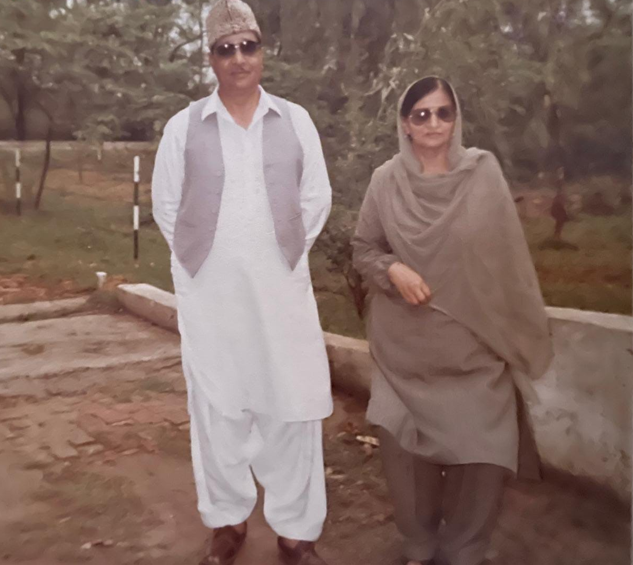
Despite the loss of his spleen and lifelong effects of his injuries, he lived an active life. He worked as Chief Administration Officer with Gammons in Dammam for four years and later served as a First-Class Magistrate for nine years.
My father was a man of honour, discipline, compassion, and integrity—a true legend. He was never idle, remained impeccably groomed, and upheld his principles till his last breath.
He remains my role model, and an inspiration to our entire family. His legacy is immortal.
May Allah grant him the highest place in Jannat-ul-Firdous. Ameen.