
By: Asif Haroon Raja
The June Israel–Iran war marked a critical inflection point in regional geopolitics.
What began as a swift and decisive Israeli offensive appeared, in its early phase, to validate assumptions about Israel’s technological superiority and intelligence dominance.
Israel entered the conflict with unmatched qualitative advantages, including the American-supplied F-35 Lightning II, which it uniquely modifies with indigenous electronic warfare suites.
In contrast, Iran’s air force largely relies on aging platforms, some dating back decades.
Within the first 48 hours, Israeli strikes reportedly degraded Iran’s air defence network and eliminated senior military figures and scientists — a campaign attributed to coordinated operations involving Mossad and India’s Research and Analysis Wing.
The opening phase appeared designed to paralyze Iran’s command-and-control structure and clear the skies for unrestricted Israeli operations.
The Sudden Reversal
Yet, by the third day, the trajectory shifted.
Reports began circulating of Israeli aircraft losses.
Iranian missiles began penetrating Israel’s multilayered air defense system, striking deeper than anticipated.
For a society accustomed to fighting wars beyond its borders, the psychological shock inside Israel was profound.
Civilian panic, shelter migrations, and airport congestion signaled that the war had entered a new and uncomfortable phase.
The speed of this shift raised an inevitable question: What changed?
Speculation grew about a “hidden hand” providing technical, intelligence, or electronic warfare assistance to Iran.
While conjecture ranged from China to Russia to North Korea, increasing commentary pointed toward Pakistan as the most plausible source of quiet but decisive support.
Strategic Consequences Beyond the Battlefield
The post-war diplomatic shifts were telling.
Iran’s ties with India visibly cooled.
In contrast, Tehran’s rhetoric toward Pakistan warmed up.
Iranian border forces took firmer action against anti-Pakistan militants operating from Iranian territory.
The Balochistan Liberation Army network suffered significant disruption.
If Pakistan did indeed provide critical support during the conflict, the consequences were profound:
It demonstrated that Israel’s technological edge is not absolute.
It exposed vulnerabilities in the Israeli defense shield.
It signaled the emergence of a Pakistan–Iran strategic understanding.
It complicated India’s regional calculus.
The Wider Encirclement Strategy
From a broader perspective, the war fits into a larger pattern.
Israel’s strategic doctrine — often interpreted through the prism of “Greater Israel” — views Iran as its principal regional obstacle.
A nuclear-armed Pakistan represents a secondary but consequential strategic variable.
Weakening both through economic pressure, political destabilization, and proxy conflict serves long-term objectives.
Since 2022, terrorism resurged in Khyber Pakhtunkhwa and Balochistan.
Cross-border sanctuaries, hybrid warfare tactics, and political agitation formed a multidimensional pressure matrix.
Coordinated timing of regional crises — Afghanistan’s posture, unrest inside Iran, BLA mass attacks — suggests a synchronized destabilization strategy.
The objective appears less about direct invasion and more about:
Economic strangulation.
Political fragmentation.
Internal polarization.
Strategic exhaustion.
The Emerging Counter-Alignment
Yet the outcome may have backfired.
Rather than isolating Iran, the war nudged Tehran closer to Islamabad, Beijing, and Moscow.
China and Russia have reportedly accelerated defensive cooperation with Iran.
The strategic triangle linking Pakistan, China, and Saudi Arabia has also gained depth.
Pakistan’s own position has stabilized in several domains:
Military preparedness remains high.
New Chinese-origin systems have enhanced deterrence.
Relations with Saudi Arabia and the GCC have strengthened.
Engagement channels with Washington have reopened.
The idea of a broader Islamic security alignment — sometimes loosely termed a “Muslim NATO” — continues to circulate, though structural divergences make formalization uncertain.
Hormuz, Nuclear Calculus, and the Next Flashpoint
Iran’s warnings regarding the Strait of Hormuz, its missile arsenal, and its enriched uranium reserves raise the stakes dramatically.
Any escalation would not remain localized.
American bases across the Gulf would become immediate targets, and the global energy market would convulse.
The region now stands in a condition of armed pause — not peace.
Conclusion: The Illusion of Superiority and the Reality of Balance
The June war exposed a fundamental truth of modern geopolitics: technological superiority does not guarantee strategic immunity.
If Pakistan indeed acted as the unseen stabilizer in the conflict, it altered the regional equation without firing a public shot.
It signaled that the Muslim world’s strategic fragmentation is not irreversible.
It reminded adversaries that deterrence operates not only through visible arsenals but through quiet alignments.
Israel may dominate tactically.
The United States may dominate financially and militarily.
India may aspire to regional preeminence.
But the emerging axis of necessity — Iran, Pakistan, China, possibly Turkiye, and potentially Russia — suggests that balance, not hegemony, will define the next phase of West and South Asian geopolitics.
The 12-day war was not merely a clash of missiles.
It was a test of alliances, resilience, and the durability of regional power structures.
And it may have marked the beginning of a new strategic alignment — one that will shape the region for years to come.
The Current US-Iran Standoff
The U.S.–Iran standoff in 2026 has evolved into a tense mix of diplomatic engagement and military brinkmanship rather than an outright declared war.
After the U.S. struck Iranian nuclear facilities in June 2025, dramatically damaging three sites, Tehran retaliated with missile attacks on U.S. bases in the region — actions that underscored the real risk of escalation.
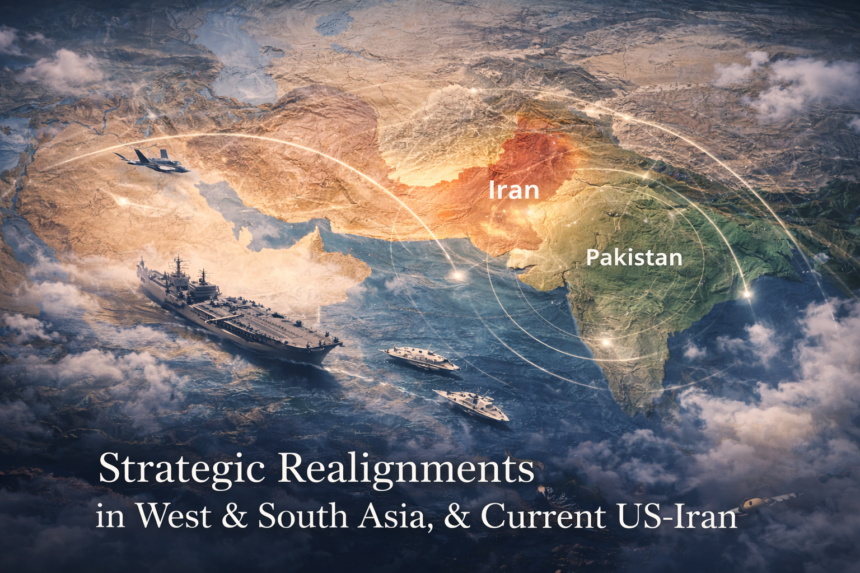
In early 2026, the U.S. responded to Iran’s domestic turmoil and hardened rhetoric by massively reinforcing its military presence across the Middle East, deploying an aircraft carrier, strike groups, fighters, and air-defense systems to the Arabian Sea and Gulf — a clear signal intended to deter further Iranian aggression and coerce Tehran back to negotiations. The 2nd aircraft carrier is on its way.
At the same time, Iran’s military has conducted naval drills in the Strait of Hormuz and warned it could disrupt critical oil shipping routes and strike U.S. forces if attacked, highlighting Tehran’s continued resolve to resist coercion.
Diplomatically, both sides have agreed to indirect nuclear talks (in Oman and Geneva), with Washington pushing to include Iran’s missile program and regional behavior on the agenda, and Tehran insisting that negotiations remain focused on its nuclear activities and sanctions relief.
Outcome Prospects:
Diplomacy remains the primary, though fragile, pathway — intensive talks are ongoing, and both capitals publicly express interest in avoiding full-scale conflict.
Military escalation is still possible if negotiations collapse or an incident — intentional or accidental — triggers direct hostilities; markets and analysts assign a significant risk to this scenario.
Regional stability depends on the interplay between U.S. deterrence posture, Iranian domestic pressures (including public unrest), and third-party mediation.
In sum, while a hot war has not broken out, the standoff remains one of the most dangerous flashpoints in Middle Eastern geopolitics — a delicate equilibrium of force projection, negotiating tables, and high-stakes signalling that could tip toward confrontation or managed conflict resolution.
About the Author
Brigadier (Retd) Asif Haroon Raja is a war veteran who fought in the Battle of Hilli in former East Pakistan and recovered the body of Major Akram Shaheed, NH. He is Command and Staff Course and War Course qualified, holds an MSc in War Studies, and served as Defence Attaché in Egypt and Sudan, as well as Dean of the Corps of Military Attachés in Cairo.
He served as the Pakistan Army’s spokesperson in 1992 and later as Honorary Colonel of the battalion he commanded for eight years. He is a defence, security, and geopolitical analyst, international columnist, author of five books, former Chairman of Thinkers Forum Pakistan, Patron-in-Chief of CDS Think Tank, Director of Meesakh Research Centre, and regularly appears on national and international media platforms.