

By Asif Haroon Raja
Introduction
The ongoing war against Iran, launched by the United States on February 28 in concert with Israel, has triggered a profound geopolitical transformation across the Middle East. What was initially conceived as a short, decisive campaign has instead evolved into a protracted conflict with far-reaching strategic consequences.
Contrary to claims of an imminent threat, even senior American officials such as John Brennan had previously acknowledged that Iran posed no immediate danger to the United States. The war, therefore, appears rooted more in geopolitical ambitions—particularly Israel’s long-standing vision of regional dominance—than in defensive necessity.
Misplaced Assumptions and Strategic Miscalculations
The architects of the war operated on flawed assumptions. It was believed that a politically, economically, and militarily strained Iran would collapse quickly under the weight of a high-intensity air campaign. Assurances reportedly given by David Barnea reinforced this perception. However, these expectations have proven to be overly optimistic. Iran has demonstrated resilience, adaptability, and the capacity to retaliate effectively, thereby nullifying the notion of a swift victory.
Failure of the Air Campaign
The joint air offensive by U.S. and Israeli forces, supported indirectly by certain Gulf States, has failed to achieve its principal objectives. Neither regime change nor Iranian capitulation has materialized.
Instead, Iran has mounted a robust counteroffensive, targeting military bases, strategic installations, and critical infrastructure across the region. The anticipated psychological and military dominance of advanced Western systems has been challenged, raising questions about their effectiveness in high-intensity conflict against a determined adversary.
Regional Diplomacy and Iran’s Strategic Posture
Iran has simultaneously combined military resistance with calibrated diplomacy. Foreign Minister Abbas Araghchi has emphasized Tehran’s intent to avoid regional escalation, particularly with Gulf neighbors, while framing Iran’s actions as defensive. Tehran has rejected U.S. peace proposals as “unrealistic,” yet it continues to retain diplomatic flexibility—particularly in maritime domains—to maintain leverage.
Economic and Strategic Fallout
The war has produced significant global and regional repercussions:
Oil prices have surged dramatically, crossing the $100 per barrel mark. Global financial markets have suffered major losses, with trillions wiped out. The strategic aura of advanced Western military platforms has been dented. U.S. national debt has surged further, intensifying economic strain. Simultaneously, countries like Russia and China appear to be deriving economic and geopolitical advantage from the crisis.
Pitfalls of a Ground Invasion
Speculation regarding a potential ground invasion of Iran has sparked intense debate. While discussions reportedly involve elite U.S. formations, the feasibility of such an operation remains highly questionable.
A ground war in Iran would entail enormous political, military, and economic costs. It would also raise fundamental questions about the extent to which American forces should bear the burden of a conflict widely perceived as aligned with Israeli strategic objectives.
Expansion of the Conflict: Proxies Reawakened
The war has reignited Iran’s network of regional allies:
Hezbollah has intensified operations along Israel’s northern front. Iraqi Shia militias have become increasingly active. The Houthis have threatened to disrupt the Bab al-Mandab Strait. This widening arc of conflict underscores the risk of a broader regional war.
The Strait of Hormuz
The Theatre Control over the Strait of Hormuz has emerged as the central strategic objective. Iran’s ability to influence maritime traffic through this critical choke point has significantly enhanced its leverage. Rather than ensuring freedom of navigation, the conflict has elevated Iran’s control over one of the world’s most vital corridors, fundamentally altering the strategic balance.
Shifting Regional Alignments
The war is accelerating a major geopolitical realignment:
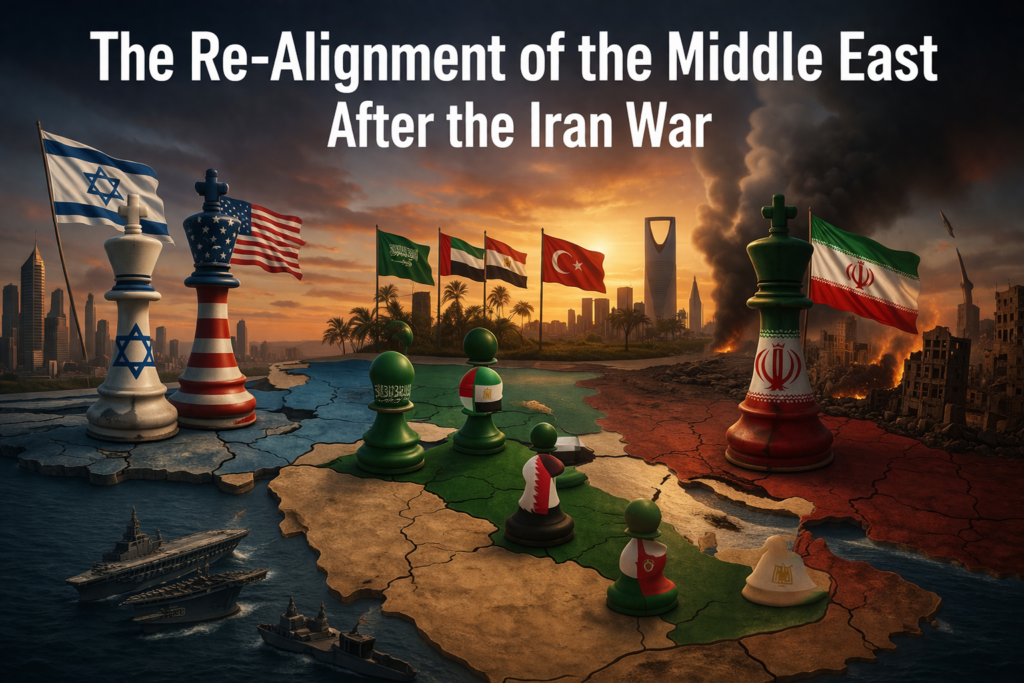
Gulf Cooperation Council (GCC) states are reassessing their reliance on the U.S. security umbrella. Alternative security arrangements involving Türkiye and Pakistan are gaining traction. Discussions around an “Islamic NATO” involving key Muslim states have gained momentum.
A countervailing axis comprising the U.S., Israel, and certain regional actors like UAE is also emerging. Simultaneously, the gradual shift from the petrodollar to alternative currencies, particularly the Chinese yuan, reflects deeper structural changes in the global world order.
Narratives Versus Ground Realities
Despite repeated assertions of victory by Donald Trump, ground realities suggest otherwise. Claims of the destruction of Iran’s military capabilities and regime collapse remain unsubstantiated and seemingly a pipedream. Instead, the conflict increasingly resembles a war of attrition in which strategic overreach may lead to long-term setbacks for the United States and its allies.
Emerging Scenarios
Several possible trajectories can be identified:
Managed Escalation: Limited maritime reopening, continued military pressure, and slow calibrated progress. Renewed Escalation: Intensified strikes and attempts to forcibly reopen maritime routes. Regional Spillover: Expansion of hostilities across multiple fronts, increasing global instability. A large-scale ground invasion remains the least likely option in the near term due to its prohibitive costs.
Post-War Regional Order
If and when the conflict subsides, several outcomes appear likely:
Iran will emerge with enhanced strategic leverage, particularly over Hormuz. Regional powers such as Iran and Türkiye will play a more decisive role. U.S. military presence in the Gulf may face sustained challenges. The concept of a “Greater Israel” may face serious setbacks amid shifting realities. Arab states, despite massive military expenditures, may be compelled to rethink their security doctrines and alliances.
New Diplomatic Openings
Amid escalating tensions, diplomatic efforts are gaining momentum. A notable initiative is the five-point peace framework jointly proposed by Pakistan and China, aimed at de-escalation and long-term stability. This initiative, supported potentially by countries such as China, Russia, and key Muslim States, offers a viable pathway toward a negotiated settlement.
Conclusion
The Iran war has not only reshaped the battlefield but is also redrawing the geopolitical map of the Middle East. What began as an attempt to impose strategic dominance may ultimately accelerate the decline of established power structures and give rise to a more multipolar regional order. The decisive question remains whether the principal actors will choose escalation or diplomacy. The answer will determine not only the future of the Middle East but also the stability of the global system.
Brigadier (Retd) Asif Haroon Raja is a Patron-in-Chief of CDS Think Tank and regularly appears on national and international media platforms.