

Asif Haroon Raja
The confrontation between the United States and Iran entered a critical phase in early April, when Donald Trump issued a 48-hour ultimatum on April 5, warning Tehran that failure to reopen the Strait of Hormuz would invite devastating strikes on Iran’s critical infrastructure.
Iran responded with defiance, refusing to comply unless compensated for war damages and warning of a far more severe retaliation.
Given that nearly one-fifth of global oil and gas supplies transit through the Strait of Hormuz, the stakes were not merely regional but global.
On the eve of the deadline, Trump escalated rhetoric dramatically, hinting at catastrophic consequences.
Simultaneously, significant U.S. forces—including special operations units, marines, and airborne troops—were deployed to the region, signalling preparation for escalation rather than de-escalation.
Pakistan’s Diplomatic Intervention
At this critical juncture, Pakistan emerged as a pivotal intermediary. Through intensive diplomatic engagement on April 6–7, including direct communication between Field Marshal Asim Munir and President Trump, a pathway to de-escalation was carved out.
The United States, facing operational setbacks and rising internal dissent, showed readiness to consider a negotiated pause.
Washington conveyed a 15-point framework through Islamabad, demanding sweeping concessions from Iran—ranging from nuclear rollback and missile restrictions to disengagement from regional allies.
Iran countered with a 10-point proposal focused on sanctions relief, access to frozen assets, recognition of its right to peaceful nuclear enrichment, and a central demand: strategic control over the Strait of Hormuz.
Diverging Visions and Strategic Distrust
The core divergence between the two sides reflects a deeper strategic mistrust. While Washington seeks to curtail Iran’s regional and nuclear capabilities, Tehran aims to secure regime survival, deterrence credibility, and economic normalization.
Despite earlier rejection, the U.S. signalled conditional acceptance of Iran’s framework as a basis for negotiation—an implicit acknowledgment of shifting ground realities.
However, this did not amount to full agreement, leaving key issues unresolved.
The Israel Factor
A major complicating factor has been the opposition of Benjamin Netanyahu, who rejected the “two-sided ceasefire” model.
Israel’s exclusion from the negotiation process created friction, and its subsequent military actions in Lebanon threatened to derail the fragile pause.
Israel’s large-scale strikes on Lebanese targets shortly after the ceasefire announcement underscored its intent to retain strategic autonomy.
Confusion over whether Lebanon was included in the ceasefire further complicated matters, with Washington and Islamabad offering differing interpretations.
Iran, for its part, linked its continued participation in talks to the inclusion of Lebanon, raising a critical question: how far is Tehran willing to go in defence of its regional allies?
Islamabad Talks: Progress Without Breakthrough
Direct talks between U.S. and Iranian delegations in Islamabad on April 11 marked a historic development. The U.S. side, led by JD Vance, and the Iranian delegation headed by Foreign Minister Abbas Araghchi engaged in intensive discussions.
Despite the significance of face-to-face engagement, the 21-hour dialogue ended without a breakthrough. The two principal sticking points remained:
- The future of Iran’s Nuclear Program
- Control and status of the Strait of Hormuz
Reports suggest that external pressures, including Israeli concerns, may have influenced the abrupt conclusion of talks.
Strategic Assessment
Recent developments indicate a shift in the regional balance:
The U.S. appears constrained in its ability to impose outcomes through military force alone.
Iran’s resilience, asymmetric warfare capabilities, and strategic depth have enhanced its deterrence posture.
The quiet backing of China and Russia has further altered the strategic calculus.
Pakistan’s role as a mediator has elevated its diplomatic standing and demonstrated its capacity to influence high-stakes geopolitical outcomes.
The erosion of the long-held perception of U.S.-Israeli military invincibility has been a defining outcome of this confrontation.
Future Prospects: Between Fragility and Opportunity
The current ceasefire represents not a resolution, but a temporary pause in a volatile confrontation. Its sustainability will depend on several critical factors:
- Nuclear Compromise or Deadlock
A durable agreement will require a middle ground on Iran’s nuclear program—possibly involving limited enrichment under strict monitoring. Failure to reach such a compromise could quickly reignite hostilities.
- Strait of Hormuz
Control and security of the Strait will remain the most sensitive issue. Any attempt by Iran to assert exclusive control, or by the U.S. to militarize its security, could trigger immediate escalation.
- Israel as a Potential Spoiler
Israel’s independent military posture and opposition to concessions toward Iran pose a persistent risk. Without its accommodation, the peace process will remain vulnerable to disruption.
- Role of Regional and Global Powers
The coordinated roles of Pakistan, China, and Russia could evolve into a stabilizing diplomatic axis.
Their continued engagement will be essential in preventing relapse into conflict.
- Evolution of Gulf Security Architecture
Emerging defence alignments—particularly involving Pakistan and key Gulf states—may reshape regional security frameworks. However, their success will depend on inclusivity and avoidance of bloc politics.
- Risk of Escalation Through Proxies
Conflicts in Lebanon, Yemen, and elsewhere remain interconnected flashpoints. Any escalation in these theatres could unravel the ceasefire.
Conclusion
The events of April 2026 may well mark a turning point in Middle Eastern geopolitics. The transition from direct confrontation to cautious dialogue reflects both the limits of military power and the necessity of diplomacy.
Pakistan’s mediation has opened a narrow but significant window for peace. Whether this opportunity evolves into a lasting settlement or collapses into renewed conflict will depend on the political will of the principal actors—and their ability to move beyond maximalist positions toward pragmatic compromise.
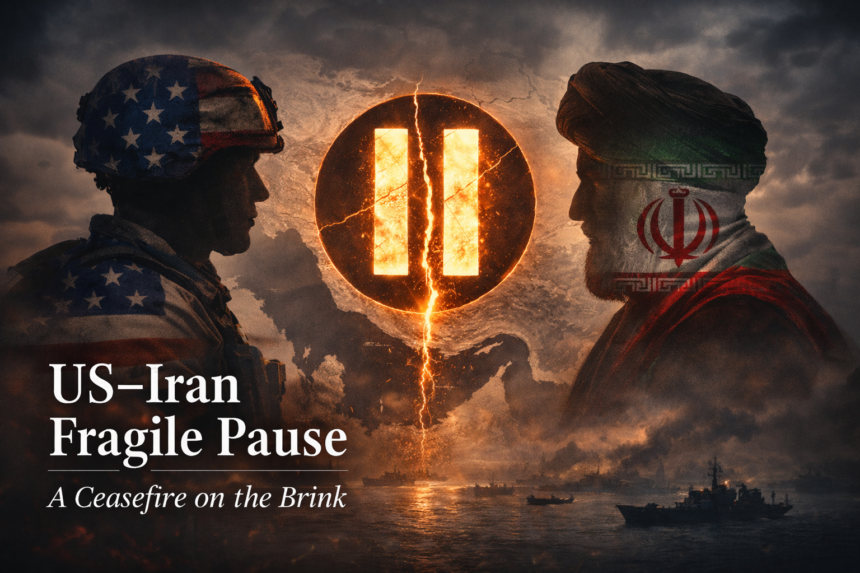
At present, the region stands not at peace, but at pause—poised between escalation and reconciliation.
About the Author
Brigadier (Retd) Asif Haroon Raja is a war veteran who fought in the Battle of Hilli in former East Pakistan and recovered the body of Major Akram Shaheed, NH. He is Command and Staff Course and War Course qualified, holds an MSc in War Studies, and served as Defence Attaché in Egypt and Sudan, as well as Dean of the Corps of Military Attachés in Cairo.
He served as the Pakistan Army’s spokesperson in 1992 and later as Honorary Colonel of the battalion he commanded for eight years.
He is a defence, security, and geopolitical analyst, international columnist, author of five books, former Chairman of Thinkers Forum Pakistan, Patron-in-Chief of CDS Think Tank, Director of Meesakh Research Centre, and regularly appears on national and international media platforms.