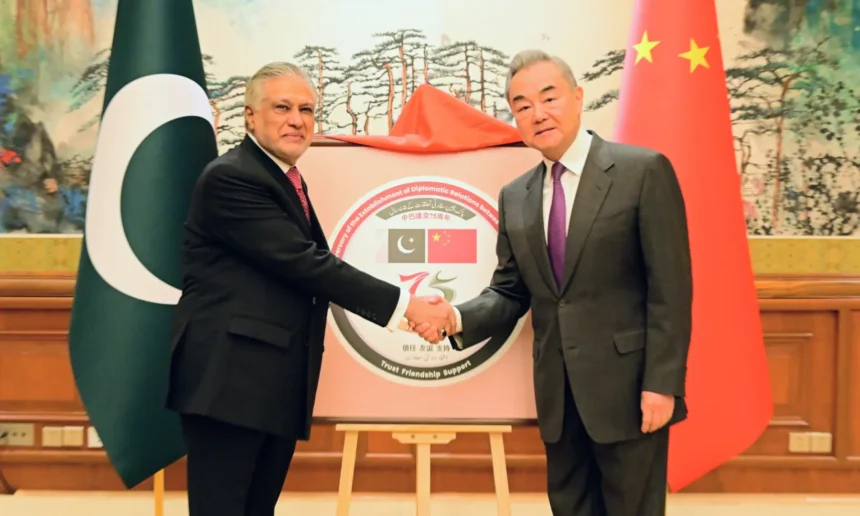

When Deputy Prime Minister and Foreign Minister Mohammad Ishaq Dar arrived in Beijing on January 4 to co-chair the seventh Pakistan China Foreign Ministers’ Strategic Dialogue with Wang Yi, the visit appeared familiar on the surface. Pakistan China relations are accustomed to warm language, frequent high-level exchanges, and references to an all-weather partnership, particularly in milestone years such as this one, which marks seventy-five years of diplomatic ties.
Yet beneath the familiar optics, the Beijing meetings reflected something more serious and consequential. This was not a visit shaped by ceremony or slogans. It was an exercise in recalibration, driven by economic constraint, heightened security sensitivities, and a more demanding global environment. What changed in Beijing was not the strength of the relationship, but the way trust is now defined, measured, and sustained.
A Different Moment and a Different Conversation
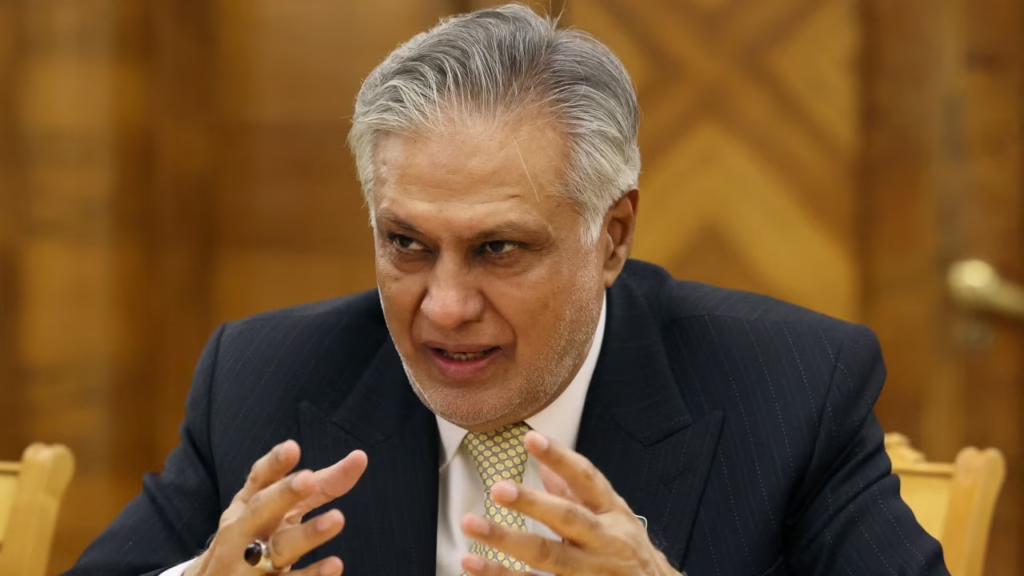
Timing matters in foreign policy, and the timing of Ishaq Dar’s visit was revealing. Pakistan is navigating a fragile phase of economic stabilization, where predictability and consistency matter more than ambitious announcements. China, meanwhile, is reassessing how it engages abroad, becoming increasingly cautious about exposure, delivery risks, and the security of its overseas interests.
The regional context has also grown more complex. Afghanistan remains unstable, conflicts in the Middle East are reshaping energy and security calculations, and major power competition continues to intensify. In this environment, Beijing was not looking for reaffirmations of friendship alone. It wanted clarity on implementation capacity, internal security, and the long term sustainability of cooperation.
For Islamabad, the visit was about reassurance and continuity. For Beijing, it was about responsibility and risk management. That difference in emphasis explains why the dialogue felt more grounded and pragmatic than celebratory.
Trust Is No Longer Automatic
The strategic dialogue covered the full spectrum of bilateral relations, including political coordination, economic cooperation, security collaboration, and multilateral alignment. Official statements emphasized stability and long-term partnership. From an analytical perspective, however, the more important signal lay in what was implied rather than explicitly stated.
China’s approach to partnerships has evolved. Political goodwill still matters, but it is no longer sufficient on its own. Trust is now closely tied to institutions that function, commitments that are honored, and environments that can be secured. This reflects lessons Beijing has drawn from its broader overseas engagement, particularly under the Belt and Road Initiative.
Pakistan remains one of China’s closest and most strategically valuable partners, but the relationship has matured. Trust is no longer assumed by default. It is increasingly managed through systems, coordination mechanisms, and performance.
CPEC Enters a More Demanding Phase
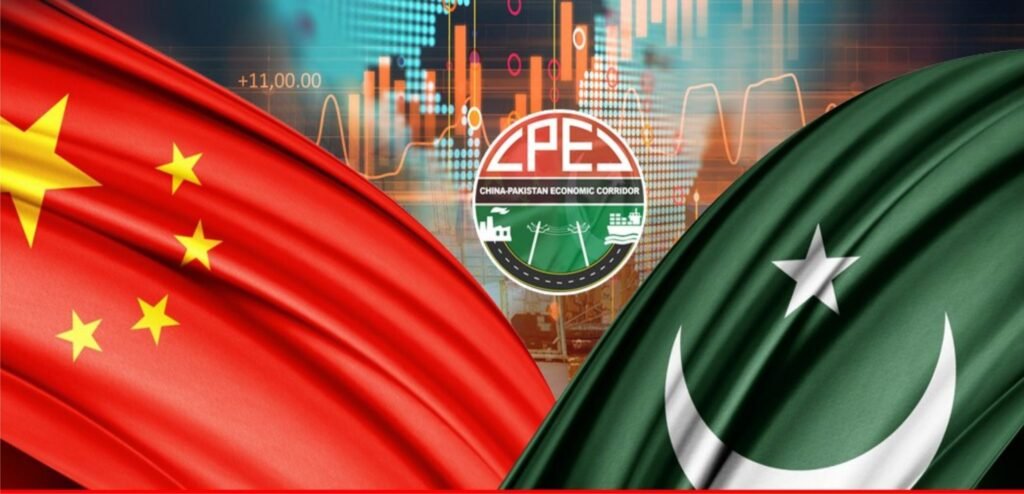
The China–Pakistan Economic Corridor remains the central pillar of bilateral cooperation, with total planned investments estimated at around sixty-four billion dollars. Its first phase delivered visible gains in infrastructure and energy, areas where political backing and financing could compensate for institutional weaknesses.
The second phase is far more demanding. Industrial zones, export growth, agriculture modernization, and technology transfer require policy coherence, regulatory stability, and administrative capacity. These are precisely the areas where Pakistan’s performance has been uneven.
Chinese officials reiterated support for Pakistan’s development priorities, but there was a noticeable shift in emphasis toward outcomes rather than intent. Analysts interpret this as a quiet but firm message that future cooperation will be judged by delivery. For Pakistan, aligning CPEC with domestic economic reforms is no longer optional if the corridor is to remain credible and central to the partnership.
Security Moves from Background to Center Stage
Perhaps the most telling development came after Dar’s departure from Beijing. Pakistan’s Interior Minister Mohsin Naqvi traveled to China soon afterward for talks focused entirely on security, explicitly framed as a follow up to the foreign minister’s strategic engagements.
This sequencing mattered. It signaled that security concerns discussed at the diplomatic level were being addressed through operational and institutional channels. During meetings with China’s public security leadership, discussions focused on counterterrorism coordination, protection of Chinese nationals, and the security of joint development projects.
China’s concerns are no longer limited to isolated militant attacks. They increasingly include insider facilitation risks, cyber vulnerabilities, and the broader stability of the environment in which Chinese personnel and investments operate. Pakistan’s decision to establish a special protection unit in Islamabad and to institutionalize regular security coordination reflects an understanding that trust today is built through continuity and systems, not ad hoc responses.
For Beijing, credible security assurances have become a prerequisite for sustained economic engagement. For Islamabad, security delivery has emerged as a central pillar of strategic credibility.
The Economic Imbalance That Will Not Go Away

Despite the closeness of political ties, economic asymmetry remains a structural challenge. Bilateral trade stands at roughly twenty-three billion dollars, but Pakistan continues to run a significant and persistent trade deficit with China.
This imbalance is rarely highlighted in official narratives, yet it is well understood in policy circles. Without export diversification, improved competitiveness, and better market access, deeper economic integration risks reinforcing dependency rather than mutual benefit. From an expert perspective, this represents one of the most serious long-term vulnerabilities in the relationship.
China also has an interest in addressing this imbalance. A partnership that delivers visible economic dividends for Pakistan is more stable politically and socially. However, meaningful progress will depend primarily on Pakistan’s ability to implement difficult reforms at home.
A Partnership in a Harder World
The Beijing dialogue took place against a backdrop of intensifying global competition and regional uncertainty. China is managing strategic rivalry with the United States. Pakistan is navigating a complex external environment while facing domestic economic and security pressures.
In this context, both sides appear intent on making their partnership more resilient and less dependent on sentiment. China values Pakistan for strategic continuity in a volatile region. Pakistan values China as a stabilizing anchor when options are constrained.
This mutual reliance explains the tone of the talks. They were calm, candid, and focused on managing risk rather than projecting inevitability.
A More Realistic Phase of Trust
As Pakistan and China mark seventy-five years of diplomatic relations, the central question is no longer endurance. It is adaptability. What changed in Beijing was the operating logic of the relationship.
Trust remains fundamental, but it is now expressed through institutions, coordination mechanisms, and accountability. It is a harder, more realistic form of trust, shaped by experience rather than sentiment.
Ishaq Dar’s visit did not produce dramatic announcements, and that may be its most telling feature. It reflected a shared recognition that in today’s international environment, even the strongest partnerships survive not on declarations of friendship, but on the ability to deliver, protect, and adjust.
That, ultimately, is what changed in Beijing.