
Asif Haroon Raja
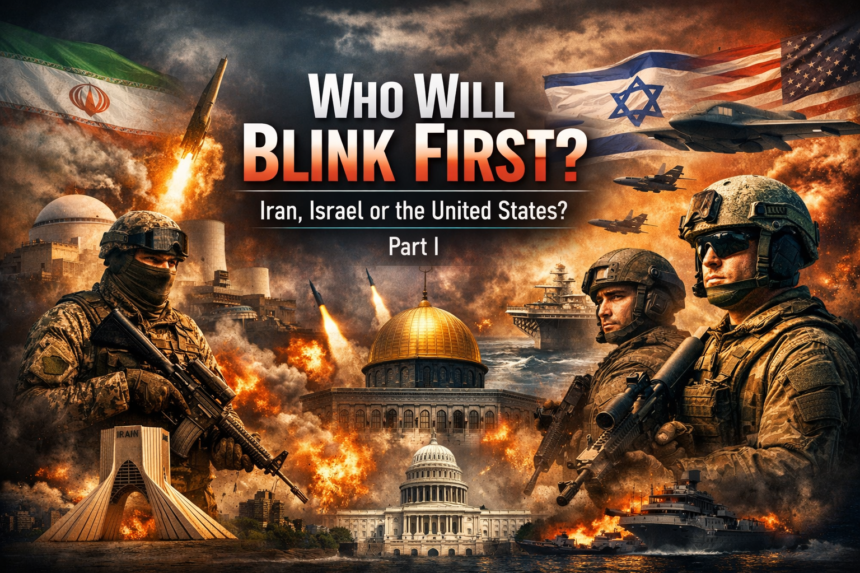
The war initiated by the United States and Israel against Iran has now entered its seventeenth day, and the central question dominating global strategic discourse is simple yet profound: who will blink first?
Washington justified the attack on the familiar doctrine of pre-emption. American officials claimed that Iran was moving toward developing long-range ballistic missiles capable of striking the United States and that Tehran stood on the threshold of producing nuclear weapons.
Iran categorically rejected these accusations. Tehran maintained that it had neither the intention nor the strategic requirement to develop nuclear weapons or missiles capable of reaching the American mainland.
Iranian officials further argued that negotiations had already produced unprecedented concessions, including willingness to roll back uranium enrichment to extremely low levels. The only issue never placed on the negotiating table was Iran’s missile program.
For Israel, however, the missile issue has long been the core concern. Iranian ballistic and hypersonic missiles now represent a far more immediate threat to Israel than Tehran’s still-developing nuclear capability.
Israeli Prime Minister Benjamin Netanyahu had been pressing Washington since the signing of the Joint Comprehensive Plan of Action to dismantle the agreement and compel Iran to eliminate both its nuclear and missile programs entirely.
The deal was ultimately withdrawn by Donald Trump in 2018, and economic sanctions were reinstated. Following Trump’s return to office in 2025, pressure on Iran intensified significantly, largely under Israeli urging.
The Strategic Context After 7 October
The regional landscape shifted dramatically after the October 7, 2023 Hamas Attack. Israel, strongly backed by the United States and Western powers, launched a series of military operations across the region.
Israel systematically weakened what it considered Iran’s “axis of resistance” — Hezbollah in Lebanon, pro-Iranian elements in Syria and Iraq, Hamas in Gaza, and the Houthis in Yemen.
With this defensive arc partially disrupted, Tel Aviv concluded that Iran itself had become vulnerable.
Confident of Iranian weakness, Israel initiated direct military action in June 2025 following covert preparatory operations carried out by Mossad networks inside Iran.
The United States formally entered the war on the eleventh day, targeting Iran’s nuclear facilities at Natanz, Isfahan and Fordow using strategic bombers and bunker-busting munitions.
Washington declared the facilities destroyed. Tehran denied the claim.
A War That Did Not Go According to Plan
The initial strikes inflicted significant damage on Iran. In the opening hours, Iran lost a large portion of its senior military leadership and nuclear scientists due to coordinated intelligence operations involving foreign intelligence networks.
Yet Iran succeeded in preserving its most critical strategic assets, including the leadership of Supreme Leader Ali Khamenei.
More importantly, Iran quickly regained operational momentum.
Iranian missile and drone strikes penetrated Israeli air defences and inflicted notable damage, challenging the long-standing perception of Israel’s defensive invulnerability.
Soon after the initial phase of the war ended, Iran reportedly accelerated its nuclear program, replenished missile and drone stockpiles, and upgraded its defence systems with assistance from Russia and China.
These developments alarmed both Washington and Tel Aviv.
Failed Political Engineering
Unable to secure strategic gains through military pressure alone, the United States and Israel attempted to engineer political instability inside Iran.
Iran’s currency was targeted through economic pressure while protests were encouraged in major cities during the winter months. The exiled son of the former Shah, Reza Pahlavi, was projected as a possible alternative to the Islamic Republic.
The attempt backfired.
Rather than weakening the regime, the crisis strengthened national cohesion. A large majority of Iranians rallied behind the existing leadership.
Escalation and Strategic Miscalculation
The war escalated further after renewed American and Israeli strikes on 28 February despite ongoing diplomatic talks in Oman and Geneva.
Many observers now believe that negotiations were used primarily to buy time while Washington completed a major military buildup in the Persian Gulf.
The expectation was clear: a short, decisive war that would compel Iran to capitulate quickly.
Instead, Iran’s resistance transformed the conflict into a strategic stalemate.
The war now resembles a spinning wheel of chaos, lacking a clear end-game strategy for any of the participants.
Major powers such as China and Russia have adopted a cautious wait-and-see approach, while global economic anxiety continues to grow.
At the heart of the conflict lies a single question:
Who will blink first — Iran, Israel, or the United States?
To be continued
About the Author
Brigadier (Retd) Asif Haroon Raja is a war veteran who fought in the Battle of Hilli in former East Pakistan and recovered the body of Major Akram Shaheed, NH. He is Command and Staff Course and War Course qualified, holds an MSc in War Studies, and served as Defence Attaché in Egypt and Sudan, as well as Dean of the Corps of Military Attachés in Cairo.
He served as the Pakistan Army’s spokesperson in 1992 and later as Honorary Colonel of the battalion he commanded for eight years. He is a defence, security, and geopolitical analyst, international columnist, author of five books, former Chairman of Thinkers Forum Pakistan, Patron-in-Chief of CDS Think Tank, Director of Meesakh Research Centre, and regularly appears on national and international media platforms.