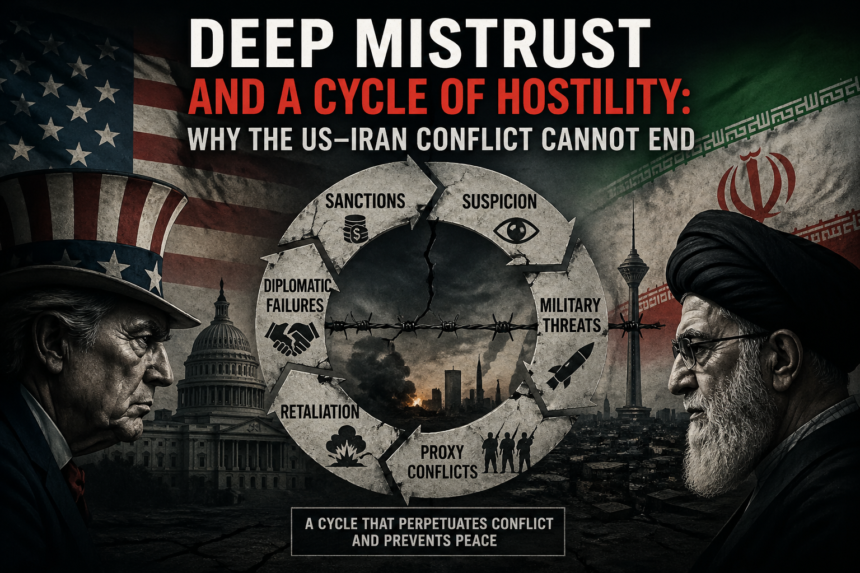

The roots of deep mistrust between the United States (US) and Iran can be traced back to the 1979 Islamic Revolution and the subsequent Iran hostage crisis. Since then, the US has imposed extensive restrictions on trade and travel to Iran, which deteriorated diplomatic ties between the two countries in 1980.
Over the decades, this antagonism hardened through successive policies and confrontations, including sanctions imposed by Bill Clinton in 1995 over Iran’s alleged support for militant groups such as Hezbollah, Hamas, and Palestinian Islamic Jihad, as well as the “axis of evil” designation given by George W. Bush in 2002.
Concerns over Iran’s nuclear ambitions further intensified tensions, particularly after disclosures of undeclared facilities and a critical 2011 report by the International Atomic Energy Agency (IAEA). Although the 2015 Joint Comprehensive Plan of Action (JCPOA) offered a brief diplomatic opening. However, its collapse following Donald Trump’s withdrawal in 2018 reignited hostilities, leading to renewed sanctions and escalating brinkmanship.
The assassination of General Qasem Soleimani in 2020 marked a sharp turning point and triggered direct military retaliation by Iran. By 2025–2026, the relationship had deteriorated and converted into an open confrontation, with US strikes on Iranian nuclear facilities, the targeted killing of Ali Khamenei, the former Supreme Leader of Iran, and Iran’s retaliatory missile campaigns and disruption of the Strait of Hormuz.
This is showing a deep-rooted cycle of hostility, where decades of sanctions, ideological rivalry, and security fears have coagulated a persistent and dangerous historical mistrust. As time passes, new dimensions of this conflict are emerging. What we are witnessing on the ground shows that things are not as simple as they appear.
Therefore, it’s not as simple as it seems; it is multifaceted. Iran has reached a point where it has nothing left to lose, while the US is trying to secure everything in one sweeping deal. States need not just physical security, but identity stability.
As of April 2026, Iran estimates that the country has sustained approximately 270 billion dollars in damage following the start of the conflict with the US and Israel on February 28, 2026. Iran was already under maximum pressure sanctions, and now views this conflict from a different perspective. For Iran, the end point of this war is to end these sanctions. Therefore, Iran’s primary objective in negotiating with the US would be to lift economic sanctions and allow greater integration into the global economy.
Given the back-to-back wars in June 2025 and February 2026, and the unresolved core disputes, it is highly doubtful that the current fragile ceasefire will prevent another outbreak of conflict. It would be unrealistic to assume that war cannot break out again because everything we are seeing actually suggests the opposite.
Even as negotiations continue, neither the US nor Iran appears willing to compromise. The persistence of conflict is not a failure of diplomacy but a reflection of deeper insecurities that diplomacy alone cannot resolve. Moreover, throughout these efforts and the entire negotiating process, it is crucial not to overlook that Israel also pursues its own agenda. Their agenda is not one of reconciliation, and Iran understands this very well.
During the Iran–US talks, one of Iran’s conditions was that Israel should stop its attacks on Lebanon. But did Israel stop? No. In fact, it continued its military operations despite the ceasefire. Moreover, recent developments show that the Israeli military has imposed a military zone in southern Lebanon and occupied the area from the border to the Litani River. Israel explicitly maintained that its operations in Lebanon were separate from the agreement.
In a statement on X (formerly Twitter) on April 8, Netanyahu said the two-week ceasefire “does not include Lebanon.” The reality is that the ceasefire itself did not fully cover all fronts, highlighting the fragility of any such deal. The desire of Israel in this region is to make a Greater Israel. Since 1949, Israel has increased its territory by 30-40 km every 5-6 years.
This raises a fundamental question. What guarantee is there that if Iran accepts the conditions proposed by the US, it will remain safe from Israel’s actions? Israel poses a serious existential threat not only to Iran but to the entire region.
In this context, Israel represents not just a strategic challenge for Iran but an acute and ongoing security threat for the entire region. The persistence of military actions despite diplomatic efforts reinforces the perception of a big existential risk not only for Iran but for broader regional stability.
The strikes by the US and Israel demonstrated a shared willingness to use military force when strategic conditions were supposed to be favourable. However, their strategic goals are not identical; there are visible differences in how far each wants to go.
At the same time, both the US and Iran are still engaging in diplomacy, even during conflict, which suggests neither side wants uncontrolled escalation. While none of the actors openly seek a full-scale war, Israel appears more willing to sustain and expand military confrontation, whereas the US and Iran continue to balance between escalation and negotiation.
After enduring such heavy losses, Iran is not ready to trade away its remaining sovereignty through negotiated deals. Rather, it is more likely to leverage this war as a strategic lifeline to reshape the balance of power. Therefore, any settlement to this war would be to provide Iran with an economic lifeline. Israel and the US have caused a lot of destruction to Iran in the 58-day war.
It is important for Iran to rebuild itself and to remove the 47 years of sanctions imposed. Because they can only rebuild if they are allowed to do free economic activity. Thus, rebuilding is important for Iran.
This war has significantly impacted the global economy and has generated existential challenges for regions including the Middle East, the Asia Pacific, Africa, and Europe. Because the disruption in the Strait of Hormuz affected 25–30% of the global seaborne oil trade.
The Asia-Pacific region is heavily impacted, as it relies on the strait for over 80% of its crude and Liquefied Natural Gas (LNG) imports. China, India, Japan, and South Korea are the top importers of Gulf energy passing through the Strait.
India experienced significant fertilizer shortages and skyrocketing Liquefied Petroleum Gas (LPG) prices, with 60% of its LPG imports passing through the strait. Pakistan faces severe fuel and electricity shortages due to blocked supplies.
African countries that rely on imported fertilizer from the Persian Gulf, such as Sudan, Tanzania, Somalia, Kenya, and Mozambique, are severely affected by rising fertilizer costs following supply chain disruptions, impacting food production.
The energy security of Europe has been severely hit, with tanker traffic for Qatari/Emirati LNG and oil delayed since early March 2026. European markets are vulnerable to acute supply shortages of diesel and jet fuel. So, the game is bigger than the Iran-US war.
It is not just a political war; it is also an economic war. The emerging next superpower of the world is China. Because of its economic strength, China seeks to promote a new world order in the world, which will be very different from the order that has existed over the past three to four centuries. Therefore, the US’s biggest objective is to halt the Chinese economy in the next 20-25 years. Now, the lifeblood that runs that economy is oil.
Since President Trump took office, he has targeted the two largest suppliers of oil to China. First, he challenged the sovereignty of Venezuela, which was a major oil supplier to China, and now Iran is being targeted
The US perspective of hegemony and fear of decline is not just managing Iran, but it is protecting its identity as a global power. Due to the fear of nuclear proliferation, the US wants to curb Iran’s nuclear capabilities. Another fear is losing credibility in the Middle East and maintaining the alliance system. For the US, any compromise with Iran risks being perceived as a weakness. Therefore, the US strategy reflects a desire for control, not coexistence.
On the other side, Iran does not see compromise as peace; it sees it as surrender. Iran insists on deterrence tools, i.e., missiles and enrichment. Iran considers them essential for survival. Iran believes that it can endure pressure and sanctions. Historical memory of external intervention and the fear of regime collapse shape Iran’s behaviour as a resistant state. That is why each side’s attempt to secure itself produces insecurity in the other, creating a security dilemma.
Additionally, this conflict has strengthened the Iranian resistance narrative. Each escalation confirmed the fears; therefore, this war has hardened positions. Iran is now less willing to accept. That is why talks failed because the US could not negotiate away a state’s sense of security and sovereignty. Deep mistrust remains a dominant obstacle.
Until both sides move beyond sovereignty driven insecurities, diplomacy will remain limited to crisis management. The US–Iran conflict, therefore, is unlikely to end not because peace is impossible, but because neither side is ready to redefine who they are without the conflict. This conflict cannot be de-escalated through one or two rounds of talks alone; rather, it requires sustained and credible diplomatic engagement.
For any meaningful and lasting peace in the region, the US must acknowledge and respect the sovereignty of Iran. Because durable stability depends not just on agreements, but on mutual recognition, restraint, and trust building measures.
The author is a senior researcher at the Centre for Development and Stability (CDS)