
Asif Haroon Raja
As the war drags on, President Donald Trump faces an increasingly difficult strategic dilemma.
Despite overwhelming military superiority, the United States has not achieved decisive results. Eighteen days of bombing have caused extensive destruction of infrastructure but have failed to force Iran into submission.
Meanwhile, Iranian retaliation against American bases and regional energy infrastructure has broadened the conflict.
The closure of the Strait of Hormuz has further complicated the situation, disrupting global energy flows and raising fears of a worldwide economic crisis.
Options Available
Trump now faces three possible strategic options — each fraught with serious consequences.
Option One: Declare Victory and Withdraw
The first option would be to declare the operation successful and disengage militarily.
Such a move could allow Washington to avoid deeper entanglement in another prolonged Middle Eastern conflict.
However, the geopolitical consequences would be profound. A withdrawal could weaken American credibility, embolden Iran, and leave Israel strategically exposed.
For Trump personally, critics would likely compare such an outcome to the American withdrawal from Afghanistan.
Option Two: Ground Intervention
The second option involves deploying American troops for limited ground operations aimed at seizing key nuclear sites or strategic locations. Or making use of Iranian and Iraqi Kurds.
Yet Iran presents a far more formidable challenge than previous American adversaries.
With a population of roughly ninety million and a mountainous terrain roughly comparable in scale to Alaska, Iran possesses the geographic and demographic depth necessary for prolonged resistance.
Millions of fighters affiliated with the Islamic Revolutionary Guard Corps and the Basij militia could wage sustained guerrilla warfare.
The experience of the U.S. and NATO in Afghanistan remains a stark reminder of the risks associated with such campaigns.
The Kurds have expressed their inability and refuse to jump into the death trap.
Option Three: Nuclear Escalation
The most alarming possibility is the consideration of nuclear weapons if conventional operations fail to achieve decisive results.
Although neither Washington nor Israel has publicly suggested such a step, the longer the war continues without clear victory, the greater the pressure for extreme measures may become.
History offers a sobering precedent in the Atomic Bombings of Hiroshima and Nagasaki during the final phase of World War II.
Such an escalation today would carry catastrophic global consequences.
Russia and China could be drawn directly into the conflict, and radioactive fallout would affect the entire region — including Israel itself.
Use of tactical nuclear bombs at selected places could impel Iran to make use of dirty bombs against the American naval armada and the US facilities in the region.
Strategic Realities Emerging
Several important realities are now becoming visible.
First, Iranian missile and drone strikes have challenged Israel’s defensive systems.
Second, Iranian society has demonstrated unexpected resilience, with widespread public support for the government.
Third, the war is becoming increasingly unpopular within the United States.
Even among American strategists, there is growing concern that the conflict lacks a clear strategic objective.
Economic and Global Consequences
The economic costs of the conflict are rapidly mounting.
Energy supplies passing through the Strait of Hormuz have been severely disrupted, pushing oil prices sharply upward and threatening global economic stability.
Meanwhile, many American allies have shown little enthusiasm for joining the conflict. European states and NATO members have largely avoided direct involvement.
Washington increasingly finds itself diplomatically isolated.
A War Without a Clear Endgame
Reports indicate that the United States has quietly explored ceasefire options through intermediaries including Oman, Turkey and Russia.
Iran, however, has attached sweeping conditions to any potential settlement — including sanctions relief, security guarantees and reductions in American military presence in the region.
What began as a regional confrontation has therefore evolved into a strategic contest capable of reshaping the geopolitical balance of West Asia.
If the war continues without resolution, it could drain American power, transform regional alliances, and accelerate the emergence of a new geopolitical order.
The central question remains unresolved:
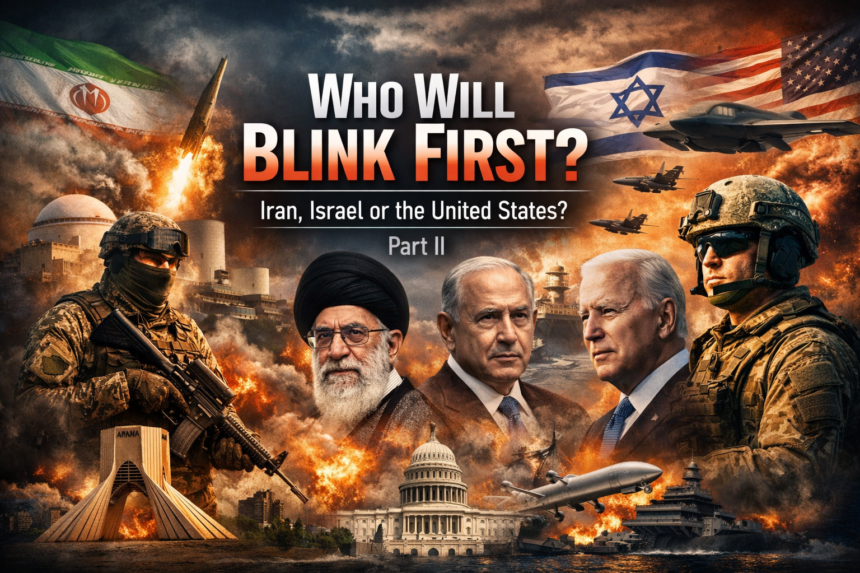
In this dangerous contest of endurance, who will ultimately blink first — Iran, Israel, or the United States?
What Next?
Given the trajectory of current developments, it appears increasingly likely that the United States and Israel may be compelled to de-escalate and eventually terminate the conflict.
Such an outcome would carry far-reaching implications, not only for the Middle East but for the global balance of power as a whole.
A forced pause or retreat by Washington and Tel Aviv would mark a significant inflection point, accelerating the shift toward a multipolar world order.
In its wake, new alignments and power blocks are likely to take shape, reshaping regional and international geopolitics.
The Global South—galvanized and strategically steered by China and Russia—may find an unprecedented opportunity to challenge and potentially restructure what is widely perceived as a decaying, West-dominated international order.
About the Author
Brigadier (Retd) Asif Haroon Raja is a war veteran who fought in the Battle of Hilli in former East Pakistan and recovered the body of Major Akram Shaheed, NH. He is Command and Staff Course and War Course qualified, holds an MSc in War Studies, and served as Defence Attaché in Egypt and Sudan, as well as Dean of the Corps of Military Attachés in Cairo.
He served as the Pakistan Army’s spokesperson in 1992 and later as Honorary Colonel of the battalion he commanded for eight years. He is a defence, security, and geopolitical analyst, international columnist, author of five books, former Chairman of Thinkers Forum Pakistan, Patron-in-Chief of CDS Think Tank, Director of Meesakh Research Centre, and regularly appears on national and international media platforms.