
Ceasefire Extension, Hormuz Tensions, and the Emerging Strategic Deadlock
Asif Haroon Raja
Background
Full-scale war broke out on February 28, 2026, following years of escalating tensions. Key triggers included the collapse of nuclear diplomacy after the U.S. withdrew from the JCPOA in 2018, failed Trump-era negotiations, joint U.S.-Israel strikes on Iranian nuclear facilities in June 2025 (the “12 Days War”), and longstanding U.S.-Israeli ambitions for regime change in Tehran.
Competing Post-War Objectives
Each actor pursues fundamentally incompatible goals.
The U.S. demands complete dismantlement of Iran’s nuclear and missile programs.
Israel seeks permanent neutralization of Iran’s capabilities and a security zone in Lebanon.
Iran prioritizes regime survival, sanctions relief, and retention of its Axis of Resistance.
Gulf States demand Hormuz stability and energy flow.
mediator Pakistan has emerged as the critical mediator, hosting the first direct U.S.-Iran talks in 47 years.
Ceasefire Extended by Trump
President Donald Trump has agreed to extend the ceasefire, following a diplomatic outreach involving Field Marshal Asim Munir and PM Shehbaz Sharif.
These engagements underscore Pakistan’s evolving role as a facilitator in high-stakes regional diplomacy.
At the same time, rejection of the ceasefire extension proposal and to take part in negotiations by some hard-line Iranian leaders — describing it as a tactical pause designed to enable future military action, has tensed the atmosphere.
Their hardened posture reflects inner division and highlights internal scepticism towards the US intentions. Effects of this have begun to fall upon Pakistan, and some are expressing doubts about its intentions.
U.S. Military Expenditure: Signals and Uncertainties
Media reports suggest that the United States may have expended a significant portion of certain precision-guided munitions during the recent conflict.
It is estimated that the stocks of munitions of THAAD and Patriot interceptors, along with cruise missiles like Tomahawk might have depleted.
An important strategic question is as to what extent has the conflict temporarily affected U.S. surge capacity in other theatres, particularly in the Indo-Pacific?
Even a perception of depletion can influence adversarial calculations, especially in relation to China.
The Strait of Hormuz: Leverage, Not Control
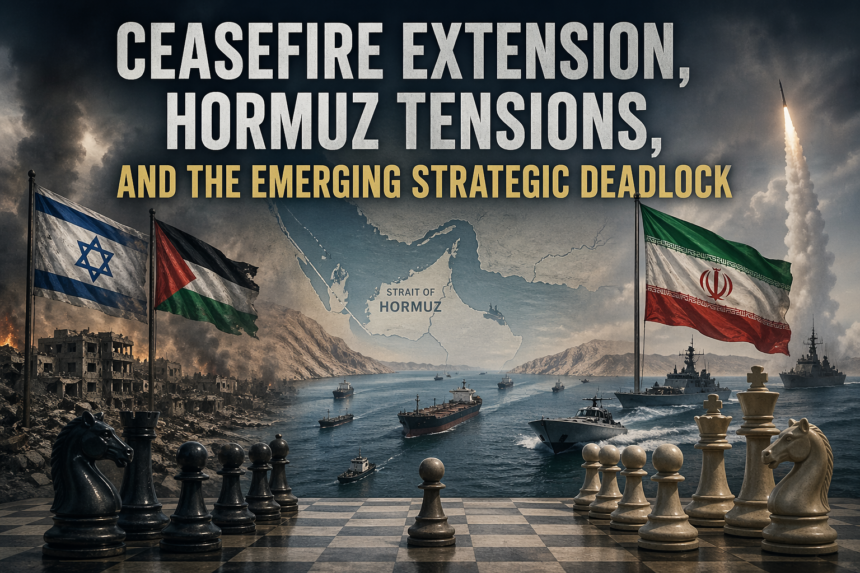
The centrality of the Strait of Hormuz in this crisis cannot be overstated. Iran’s move to disrupt or threaten maritime traffic has demonstrated its ability to exert asymmetric pressure on global energy flows.
However, rather than conferring absolute control, this has created a situation of contested leverage. Iran can disrupt, but sustaining a prolonged closure carries significant economic and political costs—not only for global markets but for Iran itself.
The initial disruption arguably dented U.S. prestige and exposed vulnerabilities in ensuring uninterrupted maritime flow.
Yet, the broader impact has been shared across multiple stakeholders, particularly energy-dependent economies in the Gulf and beyond.
From Disruption to Counter-Containment
In response, the United States appears to have shifted from direct confrontation to a strategy resembling maritime counter-containment—seeking to restrict Iranian economic maneuverability beyond its immediate territorial waters.
While comparisons to classical siege warfare are conceptually useful, the modern maritime domain introduces legal and operational complexities.
Sustaining such measures in international waters would likely require tacit or explicit support from allied naval forces and could raise questions under international law.
Nevertheless, the strategic intent is evident: to convert Iran’s tactical disruption into a longer-term economic liability.
Iran’s Strategic Dilemma
Iran now appears to face a multidimensional constraint:
- Escalation risks international isolation and possible retaliation.
- Restraint risks economic strangulation.
- Negotiation risks domestic backlash.
- The role of the Islamic Revolutionary Guard Corps is particularly significant in this context, as it embodies both military capability and ideological resistance.
- Any diplomatic compromise would need to navigate internal political sensitivities as well as external pressures.
Pakistan’s Emerging Position
Pakistan’s diplomatic engagement in facilitating dialogue and diplomatic relevance reflects a growing niche role as a mediator, and carries its own strategic weight, especially in a fluid regional environment.
The Negotiation Paradox
A paradox has emerged. The United States is signaling willingness for negotiations, while Iran insists on preconditions—particularly the removal of economic and maritime constraints.
This deadlock reflects a classic bargaining problem:
- Washington seeks concessions before relief
- Tehran seeks relief before concessions
- With each passing day, the economic costs for Iran may increase, potentially shifting the balance toward eventual engagement.
Conclusion: Drift Toward Inevitable Engagement
Despite the current impasse, historical patterns suggest that crises of this nature tend to move—gradually but decisively—toward negotiated outcomes.
Iran is unlikely to indefinitely sustain a position that combines economic pressure, military restraint, and diplomatic isolation.
At the same time, the United States may also prefer a controlled de-escalation over prolonged instability in a critical energy corridor.
The most probable trajectory, therefore, is not immediate resolution, but delayed convergence—where both sides, after posturing and pressure, find a pathway to negotiations under mutually face-saving terms.
About the Author
Brigadier (Retd) Asif Haroon Raja, SI (M) is a war veteran. He is Command and Staff Course and War Course qualified, holds an MSc in War Studies, and served as Defence Attaché in Egypt and Sudan, as well as Dean of the Corps of Military Attachés in Cairo.
He is a defence, security, and geopolitical analyst, international columnist, author of five books, former Chairman of Thinkers Forum Pakistan, Patron-in-Chief of CDS Think Tank, Director of Meesakh Research Centre, and regularly appears on national and international media platforms.