
By: Nuzhat Nazar
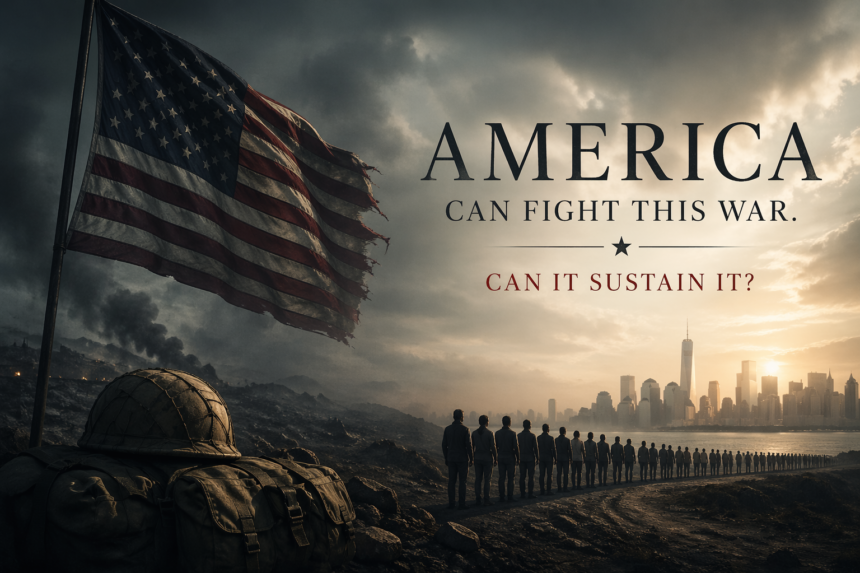
The question is not whether the United States can fight a war with Iran. It clearly can. The more relevant question is whether it can afford to sustain it over time without weakening its own position.
History suggests caution. In his seminal work The Rise and Fall of the Great Powers, historian Paul Kennedy argued that great powers decline not from a single defeat but from what he called “imperial overstretch,” when military commitments begin to exceed economic strength. That framework is increasingly visible in the current crisis.
According to the International Monetary Fund, the war is already feeding directly into global inflation and slowing growth. IMF Managing Director Kristalina Georgieva warned that the conflict is pushing the world toward “higher prices and slower growth,” a rare and explicit signal from a body that typically avoids alarmist language. Reuters and PBS reporting based on IMF data show that global growth projections have already been revised down to around 3.1 percent, with downside risks moving closer to recession territory if disruption continues.
The pressure point is energy. Analysts across Reuters and multiple energy consultancies note that roughly 15 to 20 percent of global oil flows move through the Strait of Hormuz. Any sustained disruption in this corridor has immediate global consequences. Estimates cited by policy analysts indicate that oil prices could move toward the 130 to 200 dollar per barrel range in a prolonged disruption scenario, levels historically associated with recessionary pressure. The IMF has separately noted that such shocks tend to transmit quickly into inflation, particularly in import dependent economies, but the spillback eventually reaches the United States through higher fuel costs, tighter financial conditions, and weaker global demand.
On paper, the United States can absorb the direct cost of war. According to estimates referenced by institutions such as the Center for Strategic and International Studies and cited across major outlets including Reuters and Fortune, operational costs in the current phase range in the billions of dollars per day, with cumulative projections potentially crossing into the hundreds of billions if the conflict extends. For an economy exceeding 25 trillion dollars, this is not immediately destabilizing. The United States retains deep capital markets, borrowing capacity, and the structural advantage of issuing the world’s reserve currency.
But the more consequential cost is not fiscal, it is systemic. The IMF has warned that prolonged conflict in the Middle East risks creating a stagflationary environment, where growth slows even as prices rise. This is far more difficult to manage than a standard downturn because policy tools begin to conflict with each other. Tightening monetary policy to control inflation suppresses growth further, while stimulus risks fueling additional inflation.
At the same time, the geopolitical balance begins to shift. China continues to secure discounted energy flows and expand non dollar settlement mechanisms in trade. Russia benefits from elevated oil prices and reduced Western strategic focus elsewhere. Europe, as multiple Reuters and Financial Times analyses highlight, absorbs disproportionate economic stress due to its energy exposure. The United States, by contrast, carries the burden of stabilizing the system while also financing the conflict.
This dynamic reflects a long standing observation by Henry Kissinger, who noted that the more a state dominates the international system, the greater the cost it must bear to sustain it. In practical terms, this means that even when the United States is not the primary victim of physical destruction, it becomes the primary absorber of systemic shocks.
The critical distinction, therefore, is between short term affordability and long term sustainability. In the short term, the United States can manage the financial cost of war. Inflationary pressure, while politically sensitive, remains within a range that can be addressed through monetary and fiscal adjustments. Markets adjust, supply chains reroute, and alternative producers respond to price signals.
But if the war prolongs, the nature of the cost changes. Inflation becomes embedded rather than temporary. Debt servicing becomes more expensive in a higher rate environment. Global growth weakens further, reducing demand for American exports. Allies face deeper economic strain, reducing their capacity to align strategically. At the same time, competitors gain relative advantage without bearing equivalent costs.
This is why the IMF and multiple global institutions are now framing the conflict not as a regional crisis but as a potential global economic turning point. The risk is not immediate collapse, but gradual erosion.
Iran, despite being under far greater immediate stress, is operating under a different logic. Its economy was already constrained, and the war compounds that damage. The United States, by contrast, enters the conflict from a position of strength. But that strength is precisely what is being drawn upon to sustain the system.
The real question, therefore, is not whether the United States can afford the war today. It is whether it can afford what the war becomes if it continues.
Wars test military capability in the short term. Over time, they test economic endurance. And in prolonged conflicts, endurance is where even the strongest powers begin to feel the strain.