
(By: Nuzhat Nazar)
With Abbas Araghchi now in Islamabad, and American envoys Steve Witkoff and Jared Kushner arriving in parallel, the optics suggest diplomatic momentum. But that impression does not hold up under scrutiny.
What is unfolding is not a negotiation. It is a struggle over the terms under which a negotiation can even begin.
Washington continues to signal progress. Tehran insists there are no direct talks. Both positions are deliberate. The United States needs to show movement. Iran cannot afford to be seen negotiating under pressure. The result is a process that looks active but remains structurally stuck.
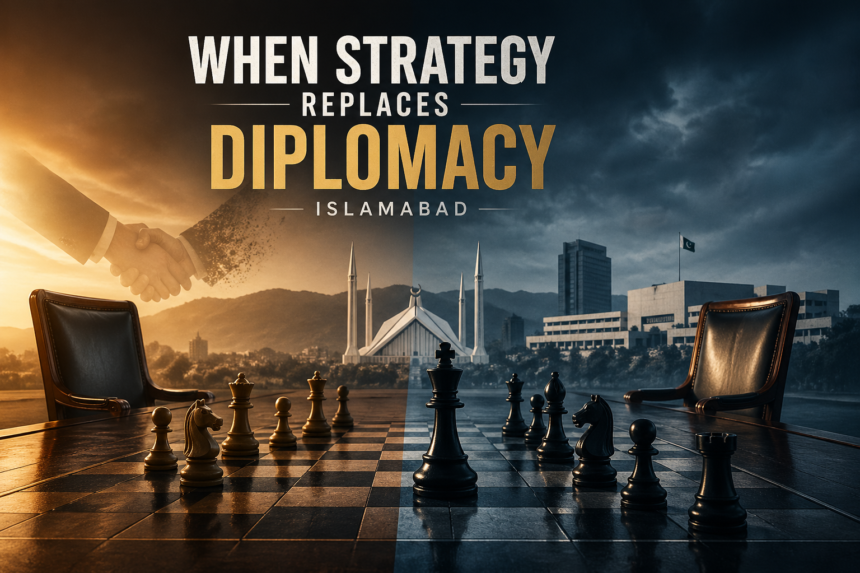
That is where Islamabad becomes important. Not as a traditional venue for talks, but as a space where both sides can engage without formally acknowledging each other. It allows proximity without political cost and communication without visible concession.
To understand this moment, it helps to look at the strategic thinking behind it.
The United States is relying on what is often described as the madman theory, a concept associated with Richard Nixon and echoed in the approach of Donald Trump. The idea is to project unpredictability and keep escalation risks open so the other side feels compelled to concede early.
Iran is responding differently. It is playing a classic chicken game, reinforced by deterrence. It refuses to enter direct talks under pressure while keeping indirect channels alive. The message is straightforward. It will not be the first to give in, and any escalation will carry costs for both sides.
This is not diplomacy in the conventional sense. It is two different strategic approaches colliding.
The United States increases uncertainty to force movement.
Iran slows the process to raise the cost of that uncertainty.
At the center of this is a disagreement over sequence. Washington wants talks to begin while pressure continues. Tehran wants pressure reduced before talks can be justified. Until that gap is bridged, movement will remain circular.
For Pakistan, this situation is not abstract. A prolonged US–Iran confrontation has direct implications, from stability along the western border to the future of regional connectivity. A weakened Iran could also shift regional alignments in ways that narrow Pakistan’s strategic space.
This is why Islamabad is doing more than hosting. It is keeping the channel open.
There is a difference between a failed negotiation and a broken channel. A failed process can restart. A broken one removes the possibility of controlled engagement and increases the risk of escalation.
What we are seeing now, with overlapping visits and conflicting narratives, is an attempt to avoid that outcome. Both sides remain engaged without stepping back from their core positions.
But this balance is fragile. The strategy of unpredictability pushes tensions higher. The strategy of resistance delays compromise. Together, they create a situation that moves without resolving.
For now, Islamabad will remain central. Diplomats will continue to arrive, statements will continue to diverge, and the appearance of progress will persist.
But this is not yet about peace. It is about forcing the other side to blink without being seen as the one who backed down first.