
The extension of the US–Iran ceasefire has brought relief but not clarity. While the official narrative from Washington presents the move as a necessary de-escalation, the reality in the Persian Gulf suggests a more complex dynamic: a pause that appears to operate without full mutual consent. As Iran continues to navigate the pressures of a naval blockade and Pakistan’s mediation reaches its structural limits, the fundamental question of this standoff has shifted. We are no longer merely asking if peace is possible, but rather, who is actually in control of the current atmospheric quiet.
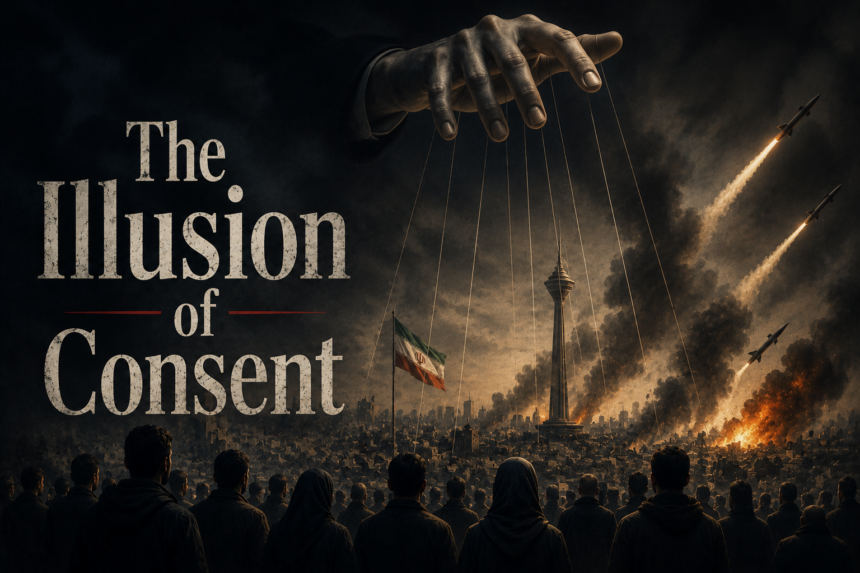
In diplomacy, a ceasefire implies a shared decision to lower the temperature. However, the current state of affairs feels less like a bilateral accord and more like a unilateral suspension of hostilities. By extending the pause while maintaining a rigorous military and economic posture, the United States has effectively established the parameters of the silence. For Tehran, this is less a reprieve and more a strategic challenge. This is stability without agreement. At some level, this ceasefire is not agreed upon and it is being endured. And that is the illusion of control.
In Washington, the extension is viewed as a demonstration of diplomatic leverage. The logic is that by holding the line on economic pressure while pausing kinetic action, the US retains the initiative. It compels Tehran to navigate between a difficult status quo and the risk of a broader confrontation. Yet, this control is nuanced. While the US dictates the formal parameters, regional volatility remains a variable that no single actor can fully dominate. Through its maritime positioning and strategic signaling, Iran continues to remind the world that even under pressure, it retains the capacity to influence the regional order.
This imbalance has transformed the Persian Gulf into a theater of asymmetric quiet. The US possesses the conventional weight to enforce a pause, but the regional environment remains susceptible to the asymmetric choices of other actors. This creates a challenging paradox. The more one side attempts to manage the conflict through unilateral frameworks, the more it may incentivize others to engage in brinkmanship to reassert their own agency. This is not a final resolution; it is a sophisticated form of conflict postponement.
Pakistan’s role as a mediator in this environment has become an exercise in high-stakes diplomatic management. While the mission of the Chief of Army Staff to Tehran has been vital in keeping backchannels functional, Islamabad operates without the enforcement power to turn a temporary pause into a permanent settlement. We are the connectors in a conflict where the protagonists communicate through military maneuvers. Pakistan provides the atmosphere for dialogue, but it cannot provide the security guarantees that both sides require. In a region defined by the maximalist ambitions of external powers, our influence remains a tool for communication rather than a lever for absolute enforcement. And that is where the margin for error disappears.
For the average person in the region, this managed tension is far from abstract. In Pakistan, the fallout is felt in the persistent volatility of energy prices and the relentless pressure on the national economy. A ceasefire that lacks the full, active consent of its primary actors keeps global markets on edge. Every time the blockade is challenged, the cost of oil reflects the risk of a sudden collapse. The human cost of this standoff is a state of permanent economic uncertainty, a reality where the signals sent by global powers are paid for by vulnerable populations in the form of rising inflation.
There is also the reality that this pause may serve the immediate survival of the actors involved more than it serves a global outcome. For the US, it provides a reprieve during a complex political cycle; for Iran, it offers a window to recalibrate regional defenses. Both sides are using the silence to prepare for the eventual noise. This is the inherent danger of a forced peace: it does not resolve the underlying grievances; it merely provides the time for them to persist. The risks remain substantial. There is the danger of strategic fatigue among the mediating states and the risk of overexposure. If Pakistan continues to exhaust its diplomatic capital simply to secure temporary extensions, it risks being seen as a permanent buffer rather than a strategic partner. Furthermore, a ceasefire operating under these conditions is highly susceptible to miscalculation. Without a shared framework for de-escalation, a single technical error or a midlevel misjudgment can trigger an escalation that neither leadership intended. And that is where it becomes dangerous.
One must consider whether this state of affairs represents a deliberate strategy of leverage or a simple lack of political appetite for finality. Signaling allows both leaderships to maintain their domestic standing while avoiding the catastrophic consequences of an actual war. It is a method of deferring the inevitable, hoping that the other side will eventually blink. But as the strategic stakes rise, the road for such deferment is narrowing. The bridge is standing, but the weight of the traffic crossing it may soon prove too much for the structure to bear.
Ultimately, the visit of the COAS to Tehran serves as a reminder that the world still requires the human element to navigate military noise. While Washington and Tehran may communicate through carrier groups and drone positioning, the risk of a misread signal remains an existential threat to regional peace. Pakistan’s mission is to ensure that these signals do not become a selffulfilling prophecy. In a region defined by brinkmanship, Pakistan’s neutrality is not a position of comfort, it is a necessity forged under pressure, where even success carries a cost.
As we look toward the expiration of the current extension, uncertainty remains the defining characteristic. The US–Iran conflict has settled into a state of managed tension that appears designed to persist. Both sides have mastered the art of the signal, but neither seems willing to undertake the heavy lifting of a final decision. This ambiguity is becoming the new normal. We are entering an era where regional peace is not the absence of conflict, but the successful management of its symbols. In the final analysis, the greatest risk is not that our diplomacy fails, but that we mistake our ability to manage the fallout for an ability to change the weather. In a conflict governed by signals, the greatest risk is that one of them is finally taken at face value. A ceasefire without consent is not stability it is suspension. And in the Persian Gulf, suspension rarely lasts long.
Author: Rimsha Saleem