
Asif Haroon Raja
In the last few days, several deadly terrorist attacks have rocked Khyber Pakhtunkhwa, particularly in Bannu and Lakki Marwat. Pakistan agencies gathered concrete evidence that the dastardly attacks were planned and masterminded in Afghanistan. A strong demarche was handed over by Pakistan to the Afghan ambassador in Islamabad.
In another alarming incident, a female suicide bomber was apprehended by Pakistan intelligence agencies in Baluchistan who had been brainwashed and indoctrinated to detonate herself. Islamabad.
These heinous acts appear aimed at undermining the spirit and celebrations associated with Maarka-e-Haq.
Owing to Pakistan’s extensive diplomatic engagement in efforts to contain the escalating US-Iran conflict that has been raging since 28 February, Operation Ghazab Lil-Haq, launched on 12 February, was temporarily assigned lower operational priority.
Another contributing factor was the apparent willingness shown by the Afghan Taliban regime to recalibrate its policies and adhere more strictly to the commitments and conditions of the Doha Agreement.
China reportedly played an important role in counselling and influencing Kabul in this regard.
Despite the operational pause, Pakistan’s cross-border campaign has achieved considerable success. The operation significantly degraded the operational capacity of the TTP and BLA, targeted their sanctuaries and hideouts, weakened segments of Afghanistan’s defence infrastructure, and collectively pushed the de facto Kabul regime onto the defensive through sustained proactive measures.
Pakistan has unequivocally conveyed that Afghanistan will be held accountable for any attack launched by Fitna al-Hindustan or Fitna al-Khawarij from Afghan soil against Pakistan.
India, Afghanistan, and the Escalating Proxy War Against Pakistan
India, meanwhile, remains unable to reconcile with what Pakistan views as New Delhi’s humiliating setback in the four-day conflict.
The Hindutva-driven Modi regime appears eager for revenge, yet constrained by military limitations, operational shortcomings, and an apparent lack of appetite within its armed forces for another direct confrontation.
Consequently, proxy warfare and disinformation campaigns have emerged as the most viable instruments through which India seeks to inflict damage upon Pakistan and destabilise its internal security environment.
India, which is a strategic partner of Israel since 1992, has deepened its strategic alignment with Afghanistan. The duo is using Afghanistan as their master proxy to destabilise Pakistan.
RAW and Mossad are exploiting Afghan territory to facilitate cross-border terrorism against Pakistan.
The objective appears to be the creation of a persistent twin-front security challenge for Pakistan.
Every act of terrorism, every death, and every injury inflicted upon Pakistan through these proxies serves to soothe the frustrations of the Indian leadership and provides psychological and political gratification to its hardline elements.
Proxy War from Afghan Soil: Pakistan’s Emerging Security Doctrine
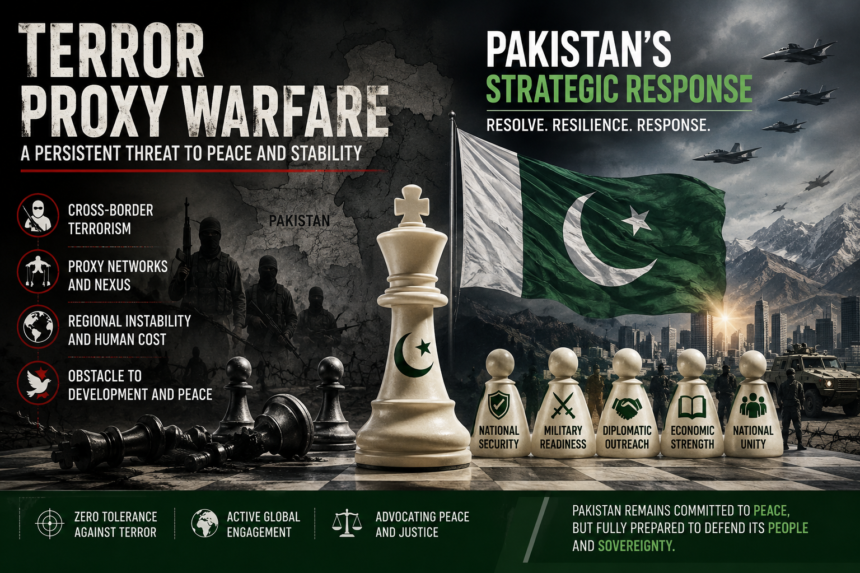
Failing to convince the Afghan Taliban regime to stop sponsoring and supporting TTP and BLA, and to abide by the 2020 Doha Agreement, Pakistan changed its security doctrine from defensive to offensive. Operation Ghazab-Lil-Haq launched in February 2026 across the western border substantially degraded the operational capacities of the terrorist groups and their supporters.
Although the de facto Kabul regime is seeking peace and seems ready to agree to Pakistan’s demands, practically it has done little to rein in TTP and stop cross border terrorism. Heavy funding by the USA, Israel and India has kept the irresponsible Kabul regime in their loop.
In line with its declared security doctrine, Pakistan is now considering responding more decisively to unprovoked hostile actions emanating from Afghan territory. The defence minister Khawaja Asif warned that Pakistan will treat Kabul like Delhi if proxy war persisted.
The possibility of cross-border air operations by Pakistan air force targeting terrorist networks involved in recent attacks inside Pakistan cannot be ruled out.
Pakistan should ensure that any such action decisively dismantles the leadership structures of the TTP and BLA operating from Afghan sanctuaries.
Irreconcilable Taliban regime cannot be relied upon
These terrorist groups remain irreconcilable and the Afghan Taliban regime is increasingly acting in alignment with Indian and Israeli interests.
Kabul’s calls for ceasefire and restraint are tactical manoeuvres intended to buy time for regrouping and the revival of terrorist activities.
Favourable Environment to be Capitalised
Having strengthened ties and earned the confidence of Central Asian States, the Far East, China, Russia, Iran, the Arab world, Europe, Africa, and even the United States, Pakistan should work closely with the international community to press the Afghan authorities to prevent the use of their soil for terrorism and regional destabilisation.
Pakistan should capitalise on the evolving geopolitical environment in which its diplomatic standing has improved considerably, while India and Afghanistan face growing distrust in several quarters.
Conclusion
Afghanistan has emerged as a hub for more than 20 terrorist groups, posing a growing threat not only to the region but to global security. Recent UN assessments have warned that several militant organisations continue to operate from Afghan soil despite official denials by the Kabul regime.
In this challenging environment, Pakistan remains the frontline state and the last major bulwark against the spread of terrorism.
Alongside Pakistan’s sustained kinetic and intelligence-based operations against terrorist networks, there is an urgent need for a coordinated regional and international response.
The ruling regime in Kabul must be collectively pressured and held accountable by the six Central Asian Republics, as well as China, Russia, Iran, the United Nations, and the United Nations Security Council to ensure that Afghan territory is no longer used as a sanctuary for transnational terrorist organisations.
About the Author
Brigadier (Retd) Asif Haroon Raja, SI (M) is a war veteran. He is Command and Staff Course and War Course qualified, holds an MSc in War Studies, and served as Defence Attaché in Egypt and Sudan, as well as Dean of the Corps of Military Attachés in Cairo.
He is a defence, security, and geopolitical analyst, international columnist, author of five books, former Chairman of Thinkers Forum Pakistan, Patron-in-Chief of Centre for Development Studies Think Tank, Director of Meesakh Research Centre; he regularly appears on media platforms.
Lorem ipsum dolor sit amet, consectetur adipiscing elit. Ut elit tellus, luctus nec ullamcorper mattis, pulvinar dapibus leo.