

By Maimona Saleem
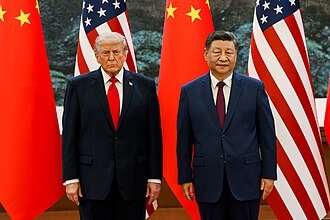
The visit of President Donald Trump to China on 14 May 2026 is more than a diplomatic spectacle filled with handshakes, military ceremonies, and carefully staged symbolism. At a time when the international order is increasingly unstable, President Trump’s visit to China indicates a deeper geopolitical reality. The two global powers can compete aggressively, but neither can afford a complete confrontation. Trump’s official visit comes as the U.S. and China seek to manage rivalry without allowing it to spiral into crisis.
However, much of the attention is paid to the optics, such as grand receptions, state banquets, and the personal chemistry between President Trump and President Xi Jinping of China. Nonetheless, diplomacy between great powers is rarely about appearances alone. On the sly, the agenda reflects the real concerns shaping global politics: trade, artificial intelligence, Taiwan, technology restrictions, and regional conflicts, including the instability created by the Iran-U.S. conflict.
President Trump’s 2026 visit to China is not just symbolic diplomacy; it reflects an effort by the U.S. and China to manage growing strategic rivalry while avoiding confrontations. The visit highlights how global stability depends on balancing competition with cooperation between the World’s two major powers. Essentially, this visit is about managing strategic competition.
The U.S. and China are no longer simply economic partners because they are strategic rivals competing for influence in technology, military capability, global trade, and political leadership. However, unlike traditional Cold War rivalries, the U.S. and China remain deeply economically interconnected. Neither side can fully disengage without harming its own economy. This creates a paradox, where competition is unavoidable, but cooperation is necessary.
For President Trump, the visit offers an opportunity to project strength while stabilising relations at a difficult moment. With global markets under pressure and regional conflicts affecting economic confidence, the U.S. understands that prolonged hostility with China could further damage supply chains and financial stability.
Since competition and hostility may exist between the states, they cannot ignore the importance of economic relations, especially at this point, when stable economic relations are most needed. Therefore, President Trump is in search of progress on trade and economic cooperation while also pressing China on issues like market access and technology competition.
However, China also has strategic reasons for welcoming Trump. It wants predictability in relations with the U.S., particularly at a time when geopolitical uncertainty is growing. China’s leaders comprehend that confrontation with the U.S. risks slowing economic recovery and increasing regional insecurity.
During the summit, President Xi welcomed a “new positioning” of ties with the U.S. that foresees cooperation with measured competition. According to the Ministry of Foreign Affairs of the People’s Republic of China, President Xi stated that both leaders agreed that building a constructive, strategically stable relationship would guide ties in the next three years and beyond.
Possibly the most important message of this visit is that global politics is increasingly defined not by cooperation or conflict alone, but by managed rivalry. The U.S. and China may disagree on almost everything from technology restrictions to military strategy. But they are learning that a complete breakdown assists neither side.
The importance of this visit extends beyond improving China—U.S. relations. For middle powers like Pakistan, Gulf states, and countries in Southeast Asia, stability between the two states shapes economic and security outcomes.
Likewise, a breakdown in U.S. and China relations would disrupt trade routes, investment, energy markets, and global growth. On the other hand, even limited diplomatic engagement creates room for economic predictability. Still, no summit can erase years of mistrust. Deep disagreements over Taiwan, artificial intelligence, trade barriers, and regional influence are unlikely to disappear after one visit. Although President Xi talked about cooperation, he also emphasized “utmost caution” by the U.S. in handling the issue of Taiwan.
Nevertheless, this visit remains highly significant despite the existing challenges and differences. What this trip may achieve is not transformation, but stabilisation, reducing the risks of miscalculation between two powers whose decisions increasingly affect the rest of the world.
Therefore, Trump’s China visit should not be judged by the visible protocols or ceremonial speeches. Its real importance lies in whether it can establish protective barriers for competition in an increasingly fragmented world. In the current global power structure, international dynamics are increasingly defined by uncertainty, competition, and shifting alliances, where diplomacy itself has become a strategic necessity.
The author is a senior researcher at CDS and a PhD scholar in Peace and Conflict Studies. Her research focuses on terrorism and extremism. Her work also focuses on peace-based approaches to economic development, growth, and regional cooperation. She also writes on geopolitics, regional security, and global power dynamics.