
(By: Nuzhat Nazar)
Pakistan’s latest IMF review should be read less as a routine financing update and more as a moment of strategic pause. For a country that has spent years managing one economic emergency after another, the completion of the third review under the Extended Fund Facility and the second review under the Resilience and Sustainability Facility offers something more valuable than another tranche: it offers breathing space.
The IMF Executive Board’s approval allows Pakistan to draw around $1.1 billion under the EFF and about $220 million under the RSF, taking total disbursements under the two arrangements to nearly $4.8 billion. But the larger message is political and economic. The Fund has acknowledged that Pakistan’s programme implementation has remained strong despite a difficult external environment, including the fallout from the Middle East war, pressure on commodity prices and uncertainty in global financing conditions.
This is not a declaration of victory. Pakistan’s economy is still exposed, its fiscal space remains narrow, and its reform fatigue is real. But the direction of travel has improved. Growth has picked up, inflation has been contained better than expected for much of the review period, the current account has remained broadly balanced, and foreign exchange reserves have strengthened. The report notes that reserves reached $16 billion by end-December 2025, up from $14.5 billion at end-June 2025. In a country where reserve pressure has often translated into political panic, this improvement matters.
The next challenge is to avoid wasting this stability. Pakistan’s recurring problem has never been the absence of reform plans; it has been the inability to sustain them once immediate pressure eases. The IMF report again points to familiar areas: broadening the tax base, improving public financial management, reforming state-owned enterprises, restoring energy sector viability, strengthening governance and protecting vulnerable citizens. These are not abstract donor conditions. They are the unfinished architecture of a functional economy.
Tax reform is perhaps the most politically difficult but strategically unavoidable part of this agenda. Pakistan cannot keep relying on a narrow group of compliant taxpayers, petroleum levies and repeated borrowing. The report highlights that while tax revenues have improved, the base remains narrow and uneven. Sectors such as agriculture, retail, real estate and services remain under-taxed compared with their economic weight. A state that cannot tax fairly cannot spend effectively, and a state that cannot spend effectively cannot build schools, hospitals, infrastructure or resilience.
At the same time, reform must not be confused with blind austerity. The IMF’s own assessment recognises the need to expand social protection and human capital spending. This is important. Pakistan’s adjustment cannot be made durable if ordinary households experience reform only as higher bills and lower purchasing power. The planned strengthening of BISP and Kafaalat support, along with higher health and education spending, should therefore be treated as central to reform, not as a side concession.
Energy remains the hardest test of credibility. Pakistan has made progress in aligning power and gas prices with costs and improving DISCO performance, but circular debt and inefficiencies continue to weaken the economy. The report rightly stresses cost recovery while protecting vulnerable consumers through targeted support. This is the balance Pakistan must maintain: it cannot subsidize inefficiency forever, but it also cannot allow reform to become socially punishing. The real solution lies in reducing losses, improving governance, modernizing distribution companies and making energy affordable through efficiency rather than distortion.
The same logic applies to SOEs and privatization. Pakistan should not frame privatization as a distress sale forced by lenders. It should frame it as a governance correction. Loss-making entities have consumed fiscal space that could have gone into education, health, climate resilience and productive investment. The report’s emphasis on SOE reform, privatization, better monitoring and public service obligation frameworks is therefore significant. If handled transparently, entities such as PIA and selected DISCOs can become test cases for whether Pakistan is serious about reducing the state’s burden while improving service delivery.
The RSF component adds another layer that Pakistan should not overlook. Climate vulnerability is no longer a future risk; it is already a macroeconomic reality. Floods, water stress and disaster-related spending shocks directly affect growth, fiscal planning and external stability. Reforms on disaster response, water-use efficiency, climate budgeting and climate-risk disclosure can help Pakistan turn vulnerability into an investment case for climate finance.
The IMF review, therefore, offers a cautiously positive story. Pakistan has gained some stability and international credibility at a difficult time. But credibility is perishable. It must now be converted into domestic reform ownership, better governance and investment-led growth.
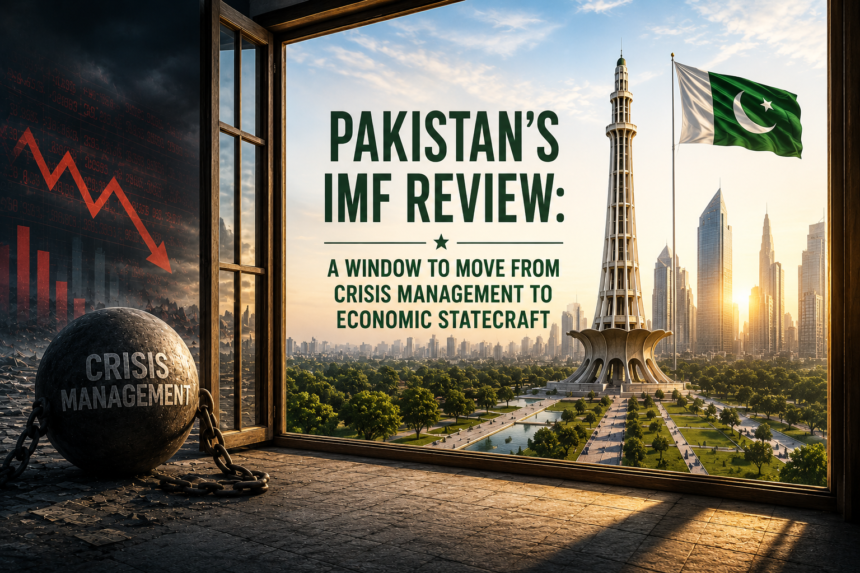
The real measure of success will not be the next IMF disbursement. It will be whether Pakistan uses this window to finally move from crisis management to economic statecraft.