
Nuzhat Nazar
Can a terrorist organisation survive without money?
History suggests it cannot.
No armed movement fights on ideology alone. Weapons must be bought. Vehicles need fuel. Fighters need to move across difficult terrain. Safe houses have to be maintained. Someone has to transport explosives, arrange logistics and keep money flowing. Every insurgency, regardless of where it operates, eventually develops an economy.
ISIS relied heavily on oil smuggling. FARC financed itself through Colombia’s cocaine trade. The Taliban generated revenue from narcotics, taxation and cross border commerce. Around the world, the pattern is remarkably similar. Terrorist organisations survive because they find ways to embed themselves within existing criminal and informal economies.
Perhaps it is time to examine Balochistan through the same lens.
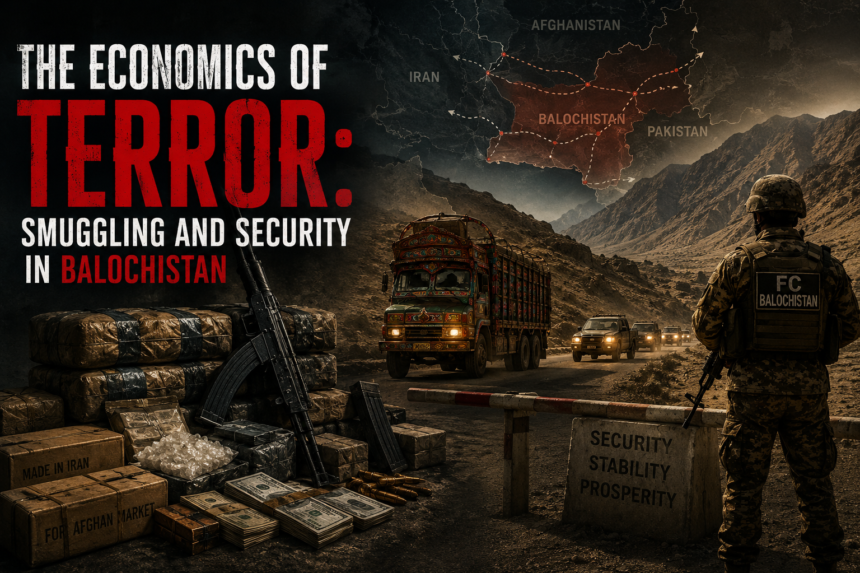
For decades, Pakistan’s debate on Balochistan has focused on insurgency, separatism and military operations. Comparatively little attention has been paid to another dimension of the conflict. The province’s shadow economy. Fuel smuggling, narcotics trafficking, human smuggling, extortion and undocumented cross border trade have long existed across one of the region’s most difficult terrains. The more important question is whether these activities merely coexist with terrorism or whether, in some cases, they help sustain it.
The recent press conference by Director General Inter Services Public Relations Lieutenant General Ahmed Sharif Chaudhry suggests Pakistan’s security establishment increasingly believes the latter.
That shift in thinking deserves attention.
According to figures presented during the briefing, Pakistan has conducted 40,348 intelligence based operations during 2026, including 31,080 in Balochistan alone. Security forces have killed 2,084 terrorists, while 819 Pakistanis, including soldiers, police personnel and civilians, have lost their lives.
Yet some of the most revealing figures had nothing to do with military operations.
Anti smuggling recoveries increased from Rs13.6 billion in 2025 to Rs24.4 billion this year. Anti narcotics recoveries rose from Rs15.8 billion to Rs17.4 billion. Arrests linked to human trafficking jumped from 1,527 to 4,595. The military also claimed that fuel smuggling into Pakistan had declined from around 20.5 million litres per day in 2023 to approximately 1.19 million litres today.
Taken individually, these are enforcement statistics. Taken together, they point towards something much larger.
They suggest Pakistan increasingly sees the battle against terrorism as inseparable from the battle against the shadow economy.
That argument is not without logic.
Large terrorist organisations do not manufacture their own economies from scratch. They usually exploit systems that already exist. Smuggling routes used for fuel can also transport weapons. Networks that facilitate undocumented migration can move militants. Criminal financiers can launder money regardless of whether it originates from narcotics, extortion or terrorism. Once these systems become deeply embedded, the line separating organised crime from terrorism becomes increasingly blurred.
This does not mean every smuggler finances terrorism.
That would be an unfair and dangerous conclusion.
For generations, many border communities in Balochistan have relied on informal trade because formal economic opportunities remained limited. Geography, weak infrastructure and long distances from major markets pushed many families towards cross border commerce.
But there is a clear difference between a family surviving through informal trade and organised criminal syndicates controlling multimillion rupee smuggling networks.
The former reflects an economic challenge.
The latter represents a national security challenge.
That distinction matters because organised smuggling requires financiers, transport fleets, storage facilities, protection networks, corrupt facilitators and cross border logistics. Those same networks can become highly attractive to terrorist organisations seeking money, mobility and operational freedom.
This perhaps explains why Pakistan’s security strategy appears to be changing.
Alongside military operations, authorities have introduced the One Document Regime, strengthened border management, established 25 joint check posts and repatriated approximately 2.6 million undocumented foreign nationals since September 2023.
Whether every one of these measures succeeds remains open to debate. But the strategic direction is evident. The objective is no longer simply to stop terrorists. It is to reduce the economic and logistical space within which they operate.
Equally significant was another point repeatedly emphasised during the briefing.
Good governance.
The DG ISPR noted that only one of the National Action Plan’s fourteen pillars deals directly with kinetic operations. The remaining measures concern governance, policing, judicial reforms, financial regulation and institutional capacity.
That observation deserves serious consideration.
Military operations can eliminate individual terrorists. They cannot eliminate corruption, weak policing, poor border management or organised criminal economies. Unless those structural weaknesses are addressed, new networks will continue to emerge.
Balochistan illustrates this challenge better than anywhere else.
The province covers almost 347,000 square kilometres, nearly 44 percent of Pakistan’s territory. It shares extensive borders with Afghanistan and Iran and has a coastline stretching around 745 kilometres. Securing such a vast landscape through force alone is neither practical nor sustainable.
The long term answer lies elsewhere.
It lies in creating legal alternatives to illegal economies.
Border communities need regulated trade, functioning markets, banking access, transport infrastructure and investment. Police institutions need greater professional capacity. Customs enforcement must become both stronger and more transparent. Development projects must deliver visible improvements rather than remain confined to official announcements.
Ultimately, this is not simply a debate about terrorism.
It is a debate about governance.
It is about whether the state can gradually replace an informal economy with a formal one. Whether legal trade can become more profitable than smuggling. Whether institutions can become stronger than criminal networks. Whether governance can become more persuasive than extremist narratives.
Pakistan’s latest security briefing suggests the country increasingly understands that terrorism is as much an economic challenge as it is a military one.
The real question now is not whether intelligence based operations will continue.
The real question is this.
Can Pakistan dismantle the economic ecosystem that sustains violence before that ecosystem simply rebuilds the next generation of militancy?
Nuzhat Nazar is a journalist and strategic affairs analyst with more than ten years of experience reporting on foreign policy, defence, and economic developments. Based in Islamabad, she focuses on geopolitics, regional security dynamics, and Pakistan’s positioning in a shifting global order.