

Asif Haroon Raja
India’s Miscalculations and Weakly Planned Pahalgam False Flag Operation
India’s strategic miscalculation stemmed from a flawed assessment of Pakistan’s internal situation.
Convinced that political polarisation, economic challenges and internal security pressures had weakened Pakistan and constrained its ability to respond, India appears to have overestimated the dividends of a carefully planned coercive move.
The Pahalgam incident, conceived as a false-flag operation to create a pretext for punitive action against Pakistan, instead exposed serious weaknesses in its planning, execution and narrative management.
Rather than isolating Pakistan, the episode triggered a chain of events that ultimately challenged India’s assumptions and demonstrated the dangers of basing strategic decisions on wishful thinking, manipulated perceptions and faulty intelligence assessments.
Faulty Assumptions and Overconfidence Led to India’s Setback in May 2025
India’s principal mistake was not merely a failure of execution; it was a failure of strategic assessment. New Delhi appears to have entered the conflict with several assumptions that proved deeply flawed.
First, India appears to have underestimated Pakistan’s political resolve and the willingness of its armed forces to respond decisively.
The assumption that Pakistan would absorb limited strikes, avoid escalation and seek de-escalation at any cost proved erroneous.
Second, India appears to have overestimated the effectiveness of its airpower and air-defence architecture while underestimating Pakistan’s integrated air-defence, electronic-warfare and combat aviation capabilities.
The expectation that stand-off weapons and technological superiority would provide India with uncontested freedom of action did not materialise.
Third, India appears to have assumed that numerical superiority would automatically translate into battlefield superiority.
Modern warfare, however, is determined not simply by numbers but by the quality of command and control, situational awareness, sensor integration, electronic warfare, weapons employment, training, morale and the ability to make rapid decisions under pressure.
Fourth, India seems to have underestimated Pakistan’s ability to conduct offensive counter-strikes.
The assumption that escalation would remain one-sided — that India could strike Pakistani targets while Pakistan would be constrained to defensive action — proved particularly dangerous.
Fifth, India appears to have misread the strategic environment. It may have expected international diplomatic pressure to restrain Pakistan more than India itself.
Instead, escalation created pressure for both sides to halt hostilities, demonstrating that military action cannot be divorced from its wider geopolitical consequences.
Most importantly, India appears to have confused military capability with political freedom of action.
Possessing sophisticated platforms does not guarantee strategic success when the adversary possesses the capability and resolve to impose unacceptable costs.
Pakistan’s Military Strengths and India’s Vulnerabilities
The four-day conflict demonstrated that Pakistan’s principal advantage was not any single weapon system but the integration of its military capabilities into a coherent operational response.
Pakistan’s strengths included an integrated air-defence network, effective employment of airborne early-warning and surveillance assets, combat-tested pilots, rapid command-and-control decision-making, electronic warfare capabilities, precision stand-off weapons and the ability to combine defensive and offensive operations.
Equally important was the Pakistan Air Force’s ability to maintain situational awareness and engage Indian aircraft without necessarily exposing its own platforms to unnecessary risk.
The employment of long-range air-to-air and precision weapons demonstrated the growing importance of beyond-visual-range warfare and network-centric operations.
Pakistan also demonstrated an ability to transition rapidly from defensive operations to offensive counter-strikes.
This created an important psychological and operational dilemma for India: every additional escalation carried the possibility of a Pakistani response against military targets inside India.
India, meanwhile, appears to have encountered weaknesses in several areas.
Its numerical superiority did not produce the expected operational advantage.
There were also questions surrounding the effectiveness of its air-defence architecture against a complex combination of aircraft, missiles and drones.
The conflict further exposed the risks of relying heavily on expensive platforms without ensuring seamless integration between sensors, command networks, electronic warfare and weapons systems.
Another vulnerability was the danger of political objectives outrunning military planning.
Once a military operation becomes primarily a demonstration of political resolve, commanders may be placed under pressure to achieve visible results within politically determined parameters.
The four-day conflict therefore offered a broader lesson: technology matters, but the integration of technology, doctrine, training, intelligence, leadership and morale matters even more.
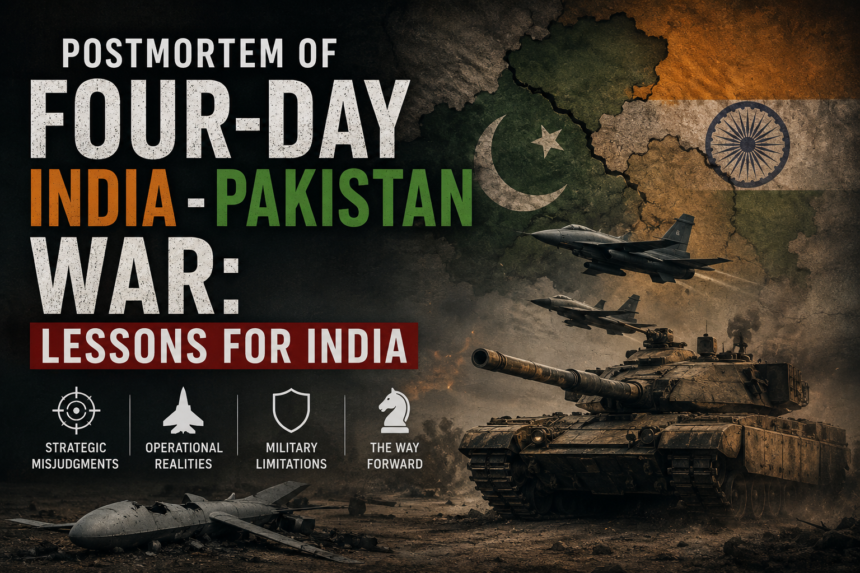
Lessons for India
India’s foremost lesson should be that Pakistan cannot be coerced through limited military action without accounting for the possibility of escalation.
Any future assumption that Pakistan will accept a punitive strike without responding could prove costly.
Second, India needs to distinguish between tactical claims and strategic outcomes.
Destroying selected targets, however impressive the imagery, does not by itself constitute victory if the adversary retains its military capability, responds effectively and forces termination of the conflict on mutually agreed terms.
Third, India needs a more realistic assessment of Pakistan’s military capabilities.
Underestimating an adversary is one of the most dangerous errors in military planning. Intelligence assessments must be based on capabilities rather than political expectations or preconceived narratives.
Fourth, India should recognise that airpower alone cannot guarantee escalation dominance.
Modern conflict is increasingly multi domain, involving airpower, missiles, drones, electronic warfare, cyber capabilities, space-based surveillance, information warfare and precision fires.
Superiority in one domain can be neutralised by an adversary’s strengths in another.
Finally, India should understand that propaganda cannot substitute for strategy.
A nation may shape a domestic narrative through documentaries, selective interviews and cinematic reconstructions, but it cannot alter the actual sequence of military events.
Professional militaries learn from wars by objectively analysing what happened, including failures and miscalculations.
Turning setbacks into victories for public consumption may provide temporary political comfort, but it deprives a military establishment of the most valuable product of war: lessons learned.
The enduring lesson of May 2025 is therefore not that one side possessed every advantage and the other possessed none.
It is that misperception, overconfidence and faulty assumptions, that can turn military superiority on paper into strategic disappointment on the battlefield.
For India, the wisest response would be to study the four-day conflict objectively, correct its assumptions and pursue mechanisms that prevent another confrontation between two nuclear-armed neighbours.
About the Author
Brigadier (Retd) Asif Haroon Raja, SI (M) is a war veteran. He is Command and Staff Course and War Course qualified, holds an MSc in War Studies, and served as Defence Attaché in Egypt and Sudan, as well as Dean of the Corps of Military Attachés in Cairo.
He is a defence, security, and geopolitical analyst, columnist, featured columnist of IntelDrop magazine Washington, author of five books, former Chairman of Thinkers Forum Pakistan, Patron-in-Chief of Centre for Development Studies Think Tank, Director of Meesakh Research Centre; he regularly appears on media platforms.