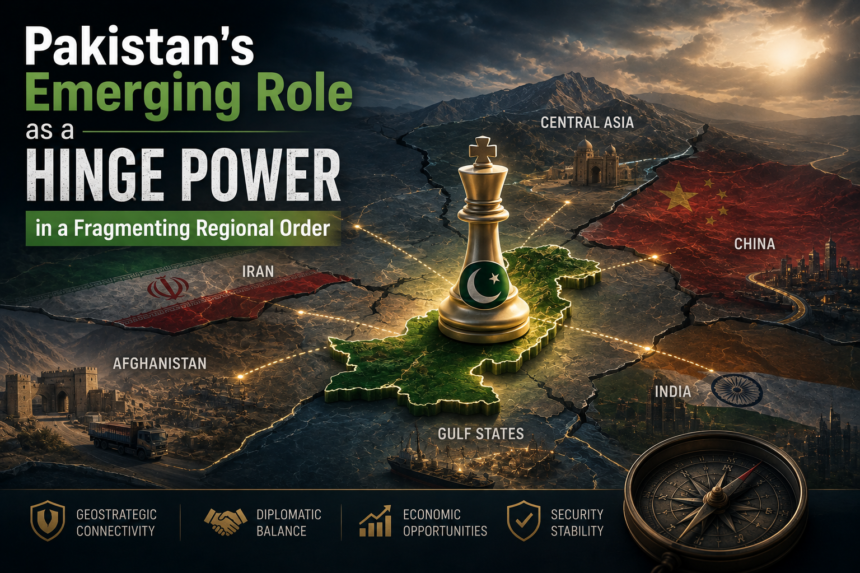

The geopolitical landscape across the Middle East and South Asia is undergoing a structural shift. As traditional security frameworks fray under the weight of escalating US-Iran tensions, great power competition, and maritime volatility, regional capitals are actively seeking alternative hedging strategies. Within this fluid architecture, Pakistan has re-emerged as a central diplomatic actor. By maintaining simultaneous operational channels with Washington, Beijing, Tehran, Riyadh, and Ankara, Islamabad is increasingly described as a “hinge power”. However, geopolitical pivotality does not inherently guarantee strategic authority, and immediate relevance does not automatically translate into sustainable influence.
Pakistan’s Expanding Diplomatic Space
Islamabad’s current foreign policy posture relies on its ability to navigate deeply adversarial fault lines. Despite structural friction, Pakistan maintains security-level engagement with the United States, particularly regarding counterterrorism and Indian Ocean security. Concurrently, it remains firmly anchored to China through the China-Pakistan Economic Corridor, preserving its core economic and technological partnership. To its west, Pakistan has leveraged its proximity to act as an essential diplomatic conduit during the US-Iran friction and surrounding maritime crisis in the Strait of Hormuz, keeping open channels with Tehran. Simultaneously, Islamabad has deepened its security links with Riyadh and Ankara, establishing a multifaceted diplomatic footprint that few middle powers in Eurasia can replicate.
The Mecca Defence Agreement
The signing of the Mecca Joint Defence Agreement on August 7, 2026, marked a formal institutionalization of this multi-vector strategy. Concluded between Pakistan, Saudi Arabia, and Türkiye, the accord creates a mutual defense and collective deterrence framework centered on joint military planning, intelligence sharing, and defense-industrial cooperation. For Riyadh and Ankara, incorporating Pakistan’s military infrastructure and defense capacity provides regional depth amidst a volatile security climate. For Islamabad, the pact solidifies a triad with two of the Muslim world’s most influential political and military states. Crucially, by framing the arrangement as a defensive instrument rather than an anti-Western or anti-Iranian bloc, Pakistan seeks to gain collective security leverage without surrendering its broader non-aligned posture.
Opportunities for Islamabad
This expanding strategic footprint offers Pakistan notable diplomatic and economic leverage. On the diplomatic front, operating as an intermediary between competing power centers enables Islamabad to resist external pressure to join restrictive alliances, preserving its strategic autonomy. In the defense sector, trilateral cooperation with Türkiye and Saudi Arabia opens avenues for joint manufacturing, technology transfers, and foreign capital infusion into Pakistan’s domestic defense industry. Furthermore, as maritime disruptions in the Strait of Hormuz threaten global supply chains, Pakistan’s geography along the Arabian Sea enhances its standing as a key contributor to regional maritime security. This positioning elevates Islamabad’s standing across the broader diplomatic landscape.
Risks and Constraints
Yet, acting as a hinge of power entails severe vulnerabilities and the risk of strategic overextension. Managing the conflicting demands of Washington and Beijing requires a delicate balance that could collapse under intensified great-power confrontation. Similarly, deepening military ties with Saudi Arabia while maintaining stable relations with neighboring Iran requires constant diplomatic calibration, especially if Gulf defense initiatives trigger Iranian security concerns. Domestically, Pakistan’s persistent economic fragilities characterized by debt pressures, low foreign direct investment, and fiscal imbalances severely limit its capacity to project sustained outward influence. If external commitments outpace domestic economic foundations, foreign policy risks deteriorating into short-term transactionalism rather than coherent strategy.
What Pakistan Should Do
To convert temporary geopolitical relevance into durable strategic capital, Islamabad must execute a deliberate shift toward economic diplomacy. Strategic autonomy cannot rely on military utility alone; it requires a self-sustaining national economy. Pakistan’s diplomatic apparatus must prioritize regional trade, transport corridors, and foreign direct investment over tactical security rents. Furthermore, Islamabad should institutionalize its diplomatic engagement through rule-based multilateral frameworks rather than relying solely on ad-hoc crisis mediation. By establishing clear institutional mechanisms and avoiding involvement in zero-sum bloc rivalries, Pakistan can ensure its position as a hinge power directly serves long-term domestic development.
Conclusion
Pakistan’s current geopolitical prominence reflects a calculated adaptation to a fragmenting regional order. However, history demonstrates that leverage derived strictly from geographic location and military capacity is perishable. Unless Islamabad translates its present diplomatic momentum into structural economic resilience, institutional depth, and domestic stability, its role as a hinge power will remain a transient position rather than a permanent foundation for regional authority.
Author
I am an independent researcher with a passion for exploring global affairs through the lens of critical thinking and evidence-based analysis. My writing examines contemporary political, economic, and strategic issues, with the aim of presenting balanced perspectives that inform, engage, and encourage meaningful discourse.