

Nuzhat Nazar
The United Nations occupies a peculiar place in the modern international system. Every time a major war breaks out, the world looks towards New York. Every time the Security Council fails to stop it, the same world begins asking whether the UN has become irrelevant.
Perhaps that is the wrong question.
The more important issue is not whether the United Nations still matters. It clearly does. The real question is whether governments expect the organisation to perform functions for which they have never actually given it sufficient political authority.
That contradiction is becoming harder to ignore.
The world entered 2026 carrying an extraordinary burden of conflict. According to the Uppsala Conflict Data Program, 65 armed conflicts involving states were active in 2025 — the highest number recorded since its dataset began in 1946. Thirteen reached the intensity level classified by UCDP as wars, while roughly 244,600 people were killed in organised violence.
These numbers show that the international security system is under enormous pressure. But they do not, by themselves, prove that the United Nations has failed.
They reveal something more uncomfortable: international institutions remain strongest where major powers agree, and weakest precisely where their strategic interests collide.
That distinction matters.
Much of the criticism directed at the United Nations eventually arrives at one place: the Security Council.
Its structure still reflects the world of 1945. The United States, Russia, China, Britain and France retain permanent membership and veto power. Eight decades later, those five states still possess the ability to prevent substantive Council action even when most other members support it.
The numbers show that this problem has become more visible. According to official Security Council data, permanent members exercised 19 vetoes between 2006 and 2015. Between 2016 and 2025, the number increased to 49.
Yet describing the veto merely as a design flaw misses its original purpose.
The Security Council was deliberately built around great-power consent. The architects of the post-war order understood that an international institution attempting to impose security decisions directly against the world’s strongest states might simply collapse.
In other words, the veto was both the price of bringing major powers into the system and the mechanism that would later limit that system.
That contradiction is visible today from Gaza to Ukraine.
When permanent members or their strategic allies are directly involved in a conflict, expectations of decisive collective action collide with geopolitical reality.
The Security Council can debate. It can expose disagreements. It can create diplomatic pressure. But where the interests of veto-holding powers diverge fundamentally, the institution cannot manufacture political consensus that does not exist.
This does not make the deadlock less serious. It simply identifies where the paralysis originates.
Another important change is also taking place outside New York. International diplomacy is becoming increasingly multi-layered.
Regional states, middle powers and ad hoc coalitions are playing larger roles in conflicts where formal multilateral institutions struggle to produce breakthroughs.
Türkiye’s role alongside the United Nations in negotiating the Black Sea Grain Initiative is one of the clearest examples. The arrangement enabled nearly 33 million metric tonnes of grain and food products to leave Ukrainian ports before it ended in July 2023, demonstrating that the UN can still produce concrete outcomes when institutional legitimacy is combined with regional political access.
That episode offers an important lesson.
The future of diplomacy may not be a competition between the United Nations and regional powers. It may increasingly depend on cooperation between them.
The UN possesses something few individual governments can reproduce: international legitimacy, convening power, humanitarian infrastructure and the ability to bring adversaries into an internationally recognised framework.
Regional actors, however, often possess something the UN does not: direct relationships, geographic proximity, security leverage and channels of communication with parties to a conflict.
This means judging the United Nations only by whether it independently negotiates peace settlements may already be an outdated test.
Its future role may increasingly be that of platform, mediator, legitimiser and coordinator rather than the sole centre of global diplomacy.
There is also a tendency to romanticise the UN’s past when judging its present.
The organisation’s history was never a continuous story of successful conflict prevention.
Rwanda remains among its darkest failures. Srebrenica followed in 1995. The organisation could not prevent the Iraq war in 2003.
But this is only one side of the record.
UN-supported operations and peace processes contributed to political transitions and conflict resolution in countries including Namibia, Mozambique, Sierra Leone and Liberia.
That mixed history matters because it demonstrates that the United Nations has never possessed an independent switch capable of turning war into peace.
Its effectiveness has always depended on several conditions aligning: international political support, cooperation from parties to a conflict, adequate resources and a realistic mandate.
Remove those conditions, and even a large UN operation can struggle.
Provide them, and comparatively modest international engagement can sometimes produce significant results.
Political fragmentation is not the UN’s only challenge.
Its financial capacity is also shrinking.
Under the UN80 reform initiative, the organisation estimates that its overall resource base could decline by approximately $16 billion between 2024 and 2026 – nearly 25 per cent.
The consequences are already becoming visible in peace operations.
In April 2026, UN peacekeeping chief Jean-Pierre Lacroix warned that budgetary constraints were limiting missions’ ability to implement political and civilian-protection mandates and affecting the safety of UN personnel.
That creates a remarkable contradiction.
The number of conflicts is rising while the resources available to the institution expected to help manage many of them are shrinking.
The UN is therefore being asked to do more precisely when it may have less capacity to do it.
Administrative reform is necessary in such circumstances.
UN80 is designed to reduce duplication, review mandates and make the organisation more efficient.
But efficiency should not be confused with geopolitics.
Moving offices, consolidating departments or reducing administrative costs may improve the organisation.
None of those reforms can resolve a Security Council confrontation between major powers.
A political crisis cannot be solved entirely through bureaucratic restructuring.
This leads to the uncomfortable conclusion at the centre of the debate.
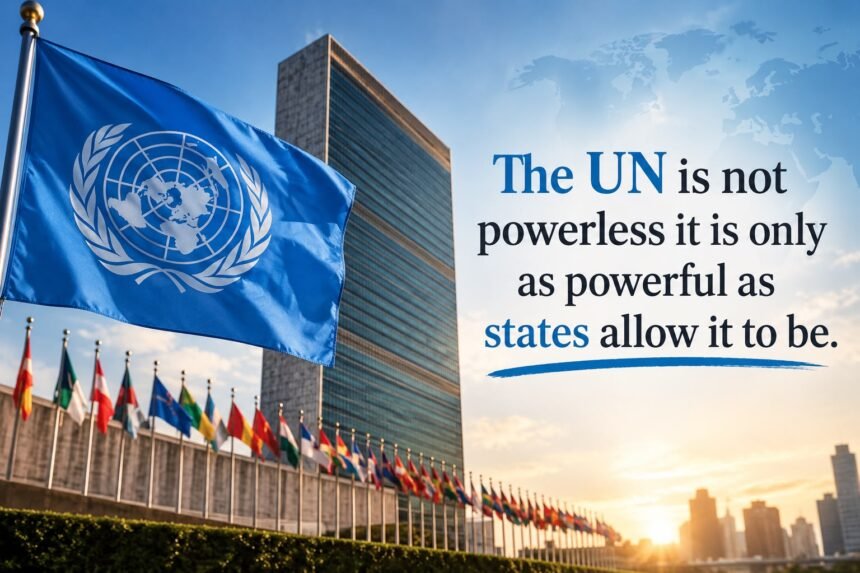
The world often talks about the United Nations as though it were a government above governments.
It is not.
It cannot independently deploy military force wherever it chooses. It cannot compel permanent Security Council members to abandon their strategic interests. Its budget comes from states. Its peacekeepers come from states. Its resolutions depend heavily on states for implementation.
The UN is therefore simultaneously powerful and constrained.
It can feed millions of people, coordinate humanitarian responses, monitor conflicts, deploy peacekeepers, negotiate agreements, establish international norms and provide a diplomatic platform that almost every recognised state continues to use.
But it cannot remove power politics from international relations.
Perhaps that is where expectations need recalibration.
The question facing the United Nations at 81 is not whether it can create a world without geopolitical rivalry.
No international institution can.
The more realistic question is whether it can prevent that rivalry from becoming completely unmanaged.
Can it keep diplomatic channels open when governments stop talking directly?
Can it provide neutral space when regional powers attempt mediation?
Can it protect civilians when political settlements remain distant?
Can it turn temporary agreements into longer processes of de-escalation?
And, above all, can states reform the system enough to preserve its legitimacy without destroying the great-power compromise on which the institution was originally built?
These questions are far more difficult than simply declaring the United Nations successful or failed.
Because the UN’s biggest weakness may also reveal the central truth about the international order.
The organisation ultimately reflects the behaviour of the governments that created it.
When they cooperate, it can deliver.
When they compromise, it can mediate.
When they provide resources, it can act.
And when the world’s most powerful states choose confrontation over consensus, the institution inevitably reflects that division.
So perhaps the real test of the United Nations is not whether it can save the international system from its members.
It is whether those members still believe that, despite all its limitations, managing their differences through one imperfect global institution remains preferable to managing them without one.