
Rimsha Saleem
A economic analysis exploring how Middle Eastern conflict-driven energy shocks directly transmit into higher bond yields, inflation, and sovereign borrowing costs globally.
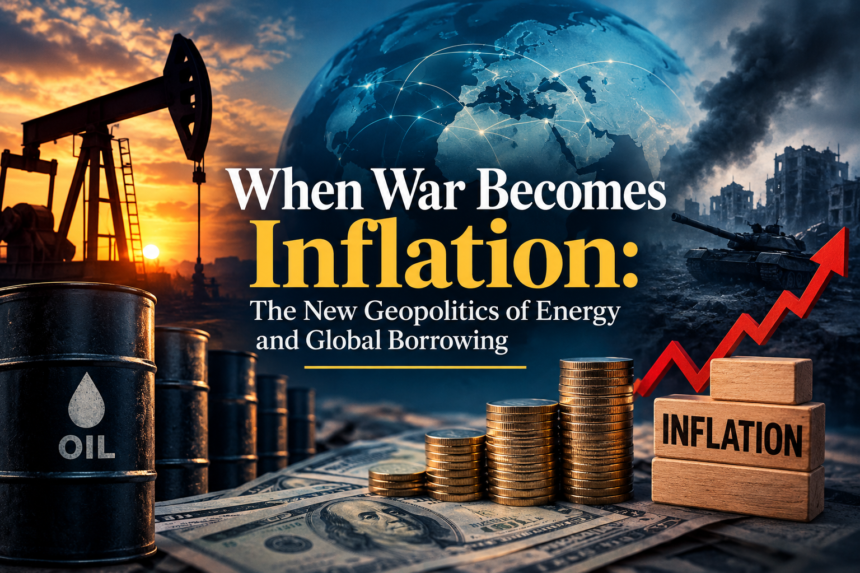
When War Becomes Inflation: The New Geopolitics of Energy and Global Borrowing
The global economy is witnessing a fundamental transformation in how geopolitical conflict reshapes financial markets. In October 2026, the International Monetary Fund issued a stark assessment of global capital markets as the 10-year US Treasury yield surged to 5.34% its highest level since 2002. This benchmark, which acts as the foundational price of risk for global capital, reflects more than domestic American fiscal dynamics. It underscores a transmission mechanism where regional military conflicts immediately convert into global inflationary pressures, rising interest rates, and escalating sovereign borrowing costs. As Middle Eastern security crisis drives price spikes across refined fuels with diesel, gasoline, and jet fuel rising significantly above pre-conflict baselines geopolitics has re-emerged as a direct driver of global monetary conditions.
The economic path from regional conflict to global monetary tightening follows a clear sequence. When hostilities threaten critical maritime corridors such as the Strait of Hormuz or the Bab el-Mandeb, energy markets build in a persistent risk premium. Beyond crude oil, modern disruptions severely hit refined petroleum products and liquefied natural gas, driving up transit costs, industrial overhead, and agricultural inputs. As higher energy costs filter into consumer price indices, central banks are forced to delay planned interest rate cuts or resume monetary tightening to anchor long-term inflation expectations. This dynamic elevates government bond yields in major economies, effectively exported worldwide as higher borrowing costs for developing and frontier nations.
This mechanism explains why economies geographically distant from Middle Eastern conflict zones suffer severe financial spillovers. A country with no direct involvement in regional disputes must still purchase energy at elevated spot prices, settle shipping invoices laden with war-risk premiums, and pay higher yields on its sovereign debt. Because global capital flows seek the safety of high-yielding US Treasuries, capital flees emerging markets, depreciating local currencies against the US dollar. This currency depreciation creates a secondary compounding effect: it makes dollar-denominated energy and food imports even more expensive in local currency terms, reigniting domestic inflation and forcing local central banks to maintain elevated policy rates that stifle domestic growth.
South Asia, and Pakistan in particular, exemplifies this structural vulnerability. Structurally reliant on imported oil and gas to meet basic power and transportation demands, Pakistan faces immediate pressure on its current account balance whenever energy benchmarks spike. Higher fuel import bills drain foreign exchange reserves, exerting downward pressure on the rupee and increasing domestic fuel and electricity tariffs. Concurrently, as global interest rates remain higher for longer, the cost of refinancing external debt or accessing international capital markets becomes increasingly prohibitive. With tight domestic fiscal room and strict structural adjustment parameters under multilateral programs, external energy shocks directly restrict state spending on development, infrastructure, and social safety nets.
While current conditions echo the oil shocks of 1973 and 1979, the economic landscape of 2026 presents distinct structural challenges. Unlike the 1970s, today’s global economy is far more interconnected through complex, just-in-time supply chains and highly integrated financial markets, meaning price shocks propagate across borders within hours rather than months. Furthermore, sovereign debt levels across both advanced and developing economies are historically elevated following years of pandemic-era fiscal expansion and inflation management. In 2026, global bond markets are constrained not only by energy-driven inflation but also by high global sovereign debt loads, leaving financial markets far less capable of absorbing geopolitical shocks.
The structural reality of 2026 demonstrates that military conflict and global finance are inextricably linked. For policymakers in developing economies, managing national economic stability no longer permits treating geopolitical crises as external diplomatic events. When localized wars instantly transform into higher inflation, currency depreciation, and prohibitive borrowing costs, economic resilience requires proactive strategy. Shielding national economies requires building robust foreign exchange buffers, diversifying energy supply chains, transitioning toward domestic renewable energy generation, and maintaining strict fiscal discipline to lessen reliance on volatile international debt markets.
Author
I am an independent researcher with a passion for exploring global affairs through the lens of critical thinking and evidence-based analysis. My writing examines contemporary political, economic, and strategic issues, with the aim of presenting balanced perspectives that inform, engage, and encourage meaningful discourse.