
Rimsha Saleem
An evaluation of Afghanistan’s commercial pivot toward Iranian ports and Central Asian trade routes in response to recurring regulatory and security closures along the Pakistani border.
Afghanistan’s Geography Is Changing: Is Pakistan Losing Its Transit Advantage?
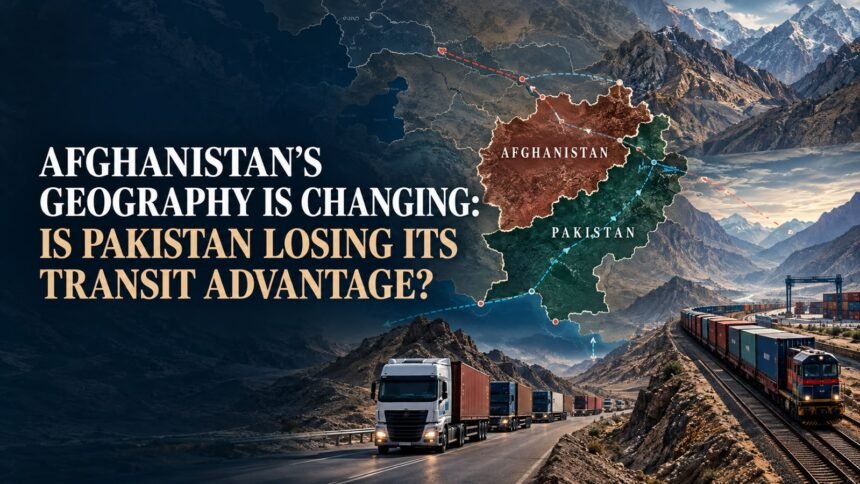
For decades, geographic reality dictated that Pakistan served as Afghanistan’s primary commercial gateway to international markets. Anchored by the Afghanistan–Pakistan Transit Trade Agreement (APTTA), the ports of Karachi and Qasim handled the overwhelming majority of landlocked Afghanistan’s sea-bound container traffic. However, the economic geography of the region is undergoing a structural transformation. A compounding cycle of border closures, regulatory friction, security distrust, and counter-smuggling measures has steadily eroded Pakistan’s traditional status as Kabul’s indispensable trade route. As the Taliban administration in Kabul actively diversifies its transit corridors toward Iran and Central Asia, Pakistan faces a critical strategic question: Is it losing its long-standing transit advantage?
The decline in bilateral transit trade volume highlights the extent of this shift. Official data released by Pakistan’s customs authorities in mid-2026 revealed that Afghan transit cargo moving through Pakistani ports plunged dramatically, falling to just 11,592 containers valued at $367 million in the preceding fiscal year—down from over $6 billion in fiscal year 2023. This contraction was driven by recurring operational disruptions at key border crossings such as Torkham and Chaman, stricter bank guarantee requirements, negative lists aimed at curtailing illegal re-exports, and heightened cross-border security tensions. In response to unpredictable border status and high demurrage charges at Pakistani ports, Afghan importers and logistics firms have systematically transferred their commercial supply lines to alternative transit routes.
Iran has emerged as the primary beneficiary of this commercial realignment. Through the southern port of Chabahar and the established route through Bandar Abbas, Tehran now facilitates a significant share of Afghanistan’s containerized trade. Supported by Iranian customs concessions and expanding road networks connecting Chabahar to Nimroz province, Afghan businesses increasingly favor Iranian ports for their predictability, even when overland transit distances are longer. Simultaneously, Kabul has deepened trade and transit links with Central Asian states, particularly Uzbekistan and Turkmenistan. The signing of trilateral road-transit arrangements with regional neighbors and investments in northern border infrastructure have enabled Afghanistan to source industrial goods, fuel, and food directly from Central Asia and China, diminishing its dependence on Pakistani supply chains.
The strategic implications of this shift extend beyond lost transit fees and port revenues for Pakistan. Historically, controlling Afghanistan’s primary maritime access point provided Islamabad with economic leverage to balance political and security disagreements with Kabul. As Afghanistan builds alternative trade channels, that leverage weakens. The decline in transit traffic also destabilizes the domestic commercial ecosystem in Pakistan’s border regions. Transport fleets, clearing agents, warehousing hubs, and local wholesale markets in Khyber Pakhtunkhwa and Balochistan have suffered severe revenue contraction, threatening local livelihoods and industrial supply chains dependent on bilateral commerce.
The broader regional landscape reinforces this changing economic geography. Beijing, while heavily invested in the China–Pakistan Economic Corridor (CPEC), continues to encourage multi-directional connectivity across Central and South Asia. If Pakistan’s border points remain prone to frequent closures, regional logistics flows—including potential CPEC extensions into Central Asia—risk becoming fragmented or diverted through northern and western corridors. While alternative corridors through Chabahar or Central Asia face their own infrastructural and financial constraints, their rapid utilization demonstrates that transit trade naturally flows along paths of least regulatory resistance.
To protect its position as a regional trade hub, Pakistan requires a clear policy pivot from restrictive management to strategic trade facilitation. Modernizing border infrastructure at Torkham, Chaman, and Kharlachi through automated clearance systems, integrated transit tracking, and expanded joint customs facilities would significantly reduce clearance times. Establishing a predictable, rules-based transit framework—insulated from daily political and security disputes—is essential to restoring commercial trust among Afghan traders. Furthermore, adapting the APTTA framework to incorporate digital customs integration and transparent counter-smuggling mechanisms would address Pakistan’s legitimate revenue concerns without shutting down commercial transit.
Ultimately, geography continues to offer Pakistan the shortest and most cost-effective maritime route for Afghan trade. However, geography alone is no longer a guaranteed monopoly in an era of expanding regional infrastructure. Unless Islamabad pairs its legitimate security imperatives with modern border management, commercial predictability, and trade facilitation, alternative regional corridors will continue to consolidate, permanently altering the economic map of South and Central Asia.
Author
I am an independent researcher with a passion for exploring global affairs through the lens of critical thinking and evidence-based analysis. My writing examines contemporary political, economic, and strategic issues, with the aim of presenting balanced perspectives that inform, engage, and encourage meaningful discourse.