
Asif Haroon Raja
Pakistan is a nuclear-armed state with highly trained, battle-hardened and combat-experienced armed forces.
For the past 25 years, they have fought and defeated a wide range of foreign-sponsored terrorists and militant proxies.
Pakistan was also among the few countries to mount a comprehensive and successful campaign against terrorism, particularly through the decisive operations that broke the back of the terrorist infrastructure by 2015.
Pakistan is once again making concerted efforts to eliminate the menace of terrorism in Khyber Pakhtunkhwa and Balochistan, where terrorist groups continue to receive external support.
Its security forces are determined to dismantle the networks responsible for destabilising the country.
Pakistan’s armed forces have also demonstrated their conventional military prowess under the nuclear overhang during the four-day war with India in May 2025.
Pakistan has since emerged as an increasingly consequential security partner and regional stabiliser, with its strategic outreach extending well beyond South Asia.
Pakistan’s security forces have effectively countered aggression emanating from Afghanistan through a proactive and increasingly offensive strategy, placing considerable pressure on the de facto Afghan regime.
While Kabul has sought to destabilise Pakistan, its own internal contradictions, economic difficulties and political strains have left it facing serious challenges. Its boat is, in fact, increasingly rocking.
Pakistan’s three armed services are continuously enhancing their defensive and offensive capabilities to meet emerging threats.
They possess the capacity to deter and, if necessary, thwart aggression from either a single adversary or multiple adversaries acting in concert.
Pakistan has developed substantial indigenous capacity in defence production, technical expertise and military technology.
It therefore does not depend upon external support for its basic defence requirements, particularly in dealing with the conventional threat from India.
At the same time, Pakistan is a strategic partner of time-tested China. Beijing has consistently demonstrated its commitment to Pakistan’s security and development.
China is helping Pakistan further strengthen its conventional defence capabilities while also supporting economic development through the acceleration of the second phase of CPEC.
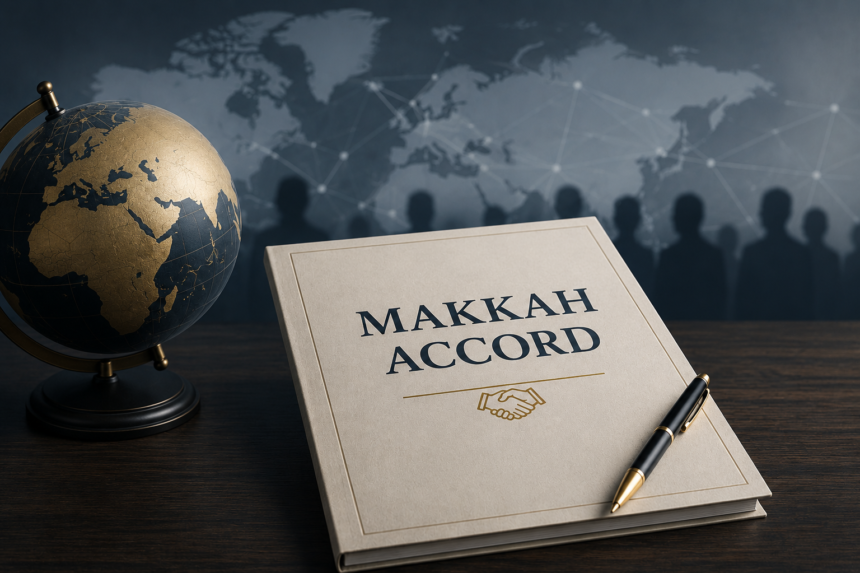
Against this backdrop, the Makkah Accord signed by Saudi Arabia, Türkiye and Pakistan is a historic development.
It has brought together Türkiye’s advanced technological and industrial capabilities, Saudi Arabia’s formidable economic strength and Pakistan’s military and nuclear capabilities under a common strategic framework.
The Accord represents a small but potentially strong foundation for an Islamic NATO.
Its emergence has already generated interest among other GCC and Muslim States and could provide a framework through which the deeply fragmented Muslim world can gradually move towards greater strategic unity—a long-cherished aspiration of the Muslim Ummah.
The Agreement can also help Pakistan expand and modernise its defence-industrial base and, equally importantly, strengthen its economy.
At a time when Pakistan continues to grapple with economic difficulties, enhanced defence cooperation, investment and strategic partnerships could create new opportunities for industrial and economic growth.
Saudi Arabia has compelling reasons to seek a stronger indigenous and collective security framework.
Its concerns include the threat posed by the Houthis, the potential expansion of Iranian influence, the continuing threat from ISIS and Al-Qaeda, internal security challenges, tensions with the UAE, Israel’s expanding strategic footprint in the Middle East, and uncertainty over the long-term reliability of the American security umbrella.
Türkiye, too, faces serious security challenges. The Kurdish militant issue, particularly the activities of armed Kurdish groups operating from Northern Syria, remains a major concern for Ankara.
Türkiye is also increasingly conscious of the possibility that shifting regional dynamics could eventually expose it to greater pressure from the United States and Israel.
Ankara also recognises that, in the event of a direct confrontation involving the United States and Israel, NATO’s response cannot simply be taken for granted.
These strategic realities have strengthened Türkiye’s incentive to develop additional security partnerships outside the traditional Western framework.
The ongoing Iran-US conflict has further compelled the GCC States to reassess the reliability of the American security umbrella.
They increasingly recognise that American military protection in the region has its own limitations and that dependence on external security guarantees can also become a strategic liability.
The Kuwait-Pakistan bilateral defence pact likewise reflects the growing security concerns of the Gulf States.
The UAE, despite its present alignment with Israel, may sooner or later find greater value in associating itself with an emerging regional security architecture centred on Muslim States.
The trilateral defence pact should therefore be viewed as a step towards preparing Muslim States to assume greater responsibility for the security of the Middle East, rather than continuing indefinitely to depend upon foreign military deployments.
This does not necessarily require the immediate departure of American forces from the region; rather, it creates an alternative security capability that can gradually assume greater responsibility.
Significantly, all three partners maintain important relations with the United States, and the signatories have made it clear that the Accord is not directed against any particular country.
It is therefore essentially defensive in character, designed primarily to strengthen deterrence and protect the sovereignty and territorial integrity of its members.
An emerging Islamic security bloc could ultimately serve the interests of the United States, China and Russia alike by contributing to greater regional stability and reducing the prospect of prolonged conflicts.
Iran has also welcomed the development and has not expressed fundamental reservations. Its eventual participation, if mutually agreed upon, could further strengthen the collective security architecture of the Muslim world.
Israel and India, however, are likely to view the prospect of greater Muslim strategic unity with considerable concern.
Both may be expected to employ political, diplomatic, informational and covert means to obstruct or weaken efforts aimed at bringing the Muslim world closer together.
Anti-state and destabilising elements within individual Muslim countries could potentially be exploited to undermine this emerging unity and perpetuate the historical pattern of keeping the Muslim world divided, weak and dependent.
The answer, therefore, is neither confrontation nor adventurism, but unity, strategic patience, institutional coordination and sustained vigilance.
The Muslim States must remain focused and mentally and physically prepared to counter overt and covert attempts to derail their collective security aspirations.
The Makkah Accord should not be judged merely by what it is today, but by what it can become tomorrow.
If nurtured with political will, mutual trust and sustained institutional cooperation, it could evolve from a trilateral defence arrangement into the nucleus of a broader Muslim security architecture—and perhaps, in time, the long-awaited foundation of an Islamic NATO.
About the Author
Brigadier (Retd) Asif Haroon Raja, SI (M) is a war veteran. He is Command and Staff Course and War Course qualified, holds an MSc in War Studies, and served as Defence Attaché in Egypt and Sudan, as well as Dean of the Corps of Military Attachés in Cairo.
He is a defence, security, and geopolitical analyst, columnist, featured columnist of IntelDrop magazine Washington, author of five books, former Chairman of Thinkers Forum Pakistan, Patron-in-Chief of Centre for Development Studies Think Tank, Director of Meesakh Research Centre; he regularly appears on media platforms.