
Part Four
Asif Haroon Raja
The Gulf States Reconsider Their Security Architecture
The Israeli strike on Doha in September 2025 reportedly shocked the Gulf States and highlighted the limitations of relying exclusively upon external security guarantees.
For the first time, many Gulf policymakers were compelled to reassess the assumption that the American security umbrella alone could guarantee their territorial security.
This strategic awakening accelerated interest in indigenous defence capabilities and closer security partnerships with regional powers.
Saudi Arabia subsequently moved towards a strategic defence arrangement with Pakistan, while other GCC States began exploring alternative and complementary security arrangements.
Kuwait also strengthened defence cooperation with Pakistan, while several Muslim countries have shown growing interest in acquiring Pakistani defence equipment and developing defence-industrial partnerships.
Israel’s strategic ambitions, including concerns surrounding the concept of a “Greater Israel”, together with the potential regional consequences of an expanding US-Iran confrontation, have increased insecurity among Arab States.
Turkey has also recognised that regional strategic equations are changing rapidly and that reliance upon external powers cannot provide an absolute guarantee of security.
Trilateral Defence Pact: The Emergence of a Formidable Islamic Strategic Bloc
A new powerful strategic bloc has emerged in the region. It is a mega bloc with more than 2.5 million troops, 3.8 million square kilometres of territory and nuclear capability
The “Mecca Joint Defence Pact” concluded between Pakistan, Türkiye and Saudi Arabia has sent shockwaves through global politics and the military balance of the region.
Born out of the principle that “an attack on one is an attack on all,” this new defence bloc has emerged as the region’s largest military and strategic power.
Turkish Foreign Minister Hakan Fidan explicitly compared the provision technically to NATO’s Article 5.
Key Facts about the New Defence Bloc
More than 2.5 million military personnel:
Combining the active armed forces, reserve forces and paramilitary personnel of the three countries, the bloc has become one of the largest and most capable military groupings in the world.
Stretching from South Asia to Europe and the Middle East:
Combined territorial areas of about 3.8 million sq km — Pakistan (~881,000), Saudi Arabia (~2.15 million) and Türkiye (~783,000) together come to roughly 3.81 million sq km.
The area extends from the mountains of South Asia to the deserts of the Middle East and the strategic crossroads between Europe and Asia.
Command of the World’s Most Important Maritime Routes:
The new bloc has the potential to possess strategic geographical positions and naval influence over the key maritime corridors of the Arabian Sea, Red Sea, Strait of Hormuz and Mediterranean Sea—waterways through which a substantial portion of global trade and energy supplies passes.
Nuclear and Advanced Technological Capabilities of the Trio
Pakistan’s defence capability, comprising approximately 170 nuclear warheads, combined with Türkiye’s advanced defence-industrial capabilities—including its fifth-generation KAAN fighter aircraft and sophisticated drone technology—and Saudi Arabia’s vast financial resources and access to advanced weapon systems, could make this bloc a formidable power across multiple domains.
Türkiye is also likely to receive 35 F-35 fighter aircraft from the United States in the near future.
The Potential Combined Strength of Pakistan, Saudi Arabia and Türkiye
If Pakistan, Saudi Arabia and Türkiye were to develop a comprehensive strategic alliance, their combined strength would include approximately:
*170 nuclear weapons
*A combined economy of around $3 trillion
*More than 2 million military personnel
*Approximately 7,000 tanks
*Around 1,000 fighter aircraft
*Nearly 90,000 armoured vehicles
*34 submarines
*Around 500 naval and combat platforms
Such a combination could constitute an extraordinary military, strategic and economic power in the region.
Pakistan’s 14 August Parade: A Possible Strategic Surprise
Pakistan is reportedly preparing to display capabilities at the 14 August Independence Day parade that could generate an even greater strategic impact than the Mecca Pact itself.
Director General ISPR Lieutenant General Ahmed Sharif had remarked in his last press conference in May, in reference to Pakistan’s emerging defence capabilities, that if anyone had doubts, they should wait for 14 August, adding that Pakistan would show only “a little spice” that could leave observers astonished.
A New Chapter from Makkah
The new chapter written in Makkah is not merely another defence agreement. It could mark the emergence of a strong and increasingly self-reliant Islamic strategic bloc capable of reshaping the regional balance of power and significantly influencing the wider global order.
China’s full support for the Makkah Accord would further strengthen the emerging architecture of collective security in the Muslim world and enhance its strategic credibility.
Beijing’s backing also signals that the Accord enjoys support beyond the Islamic world, adding a significant dimension to regional peace, stability and strategic autonomy.
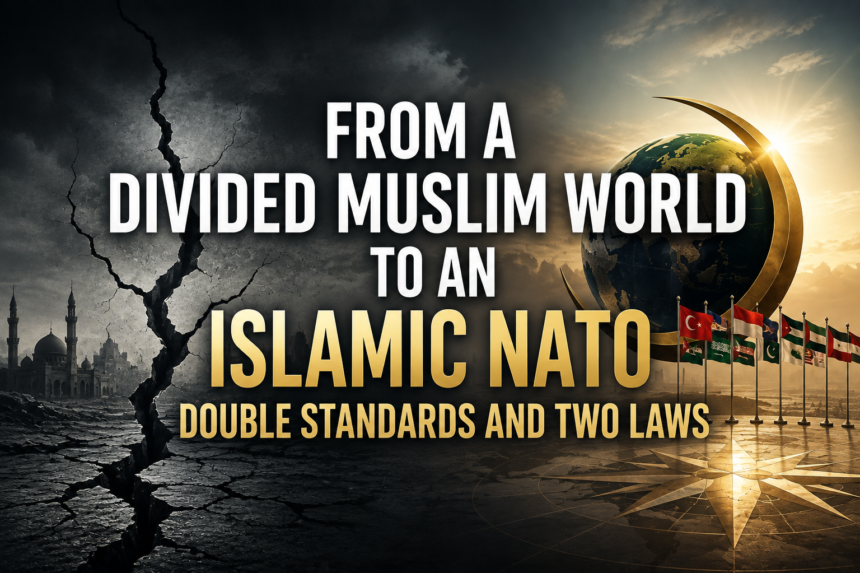
Towards an Islamic NATO
At a time of heightened regional tensions and emerging security threats, Pakistan, Türkiye and Saudi Arabia signed a landmark joint defence agreement in Makkah on August 7, marking a significant step towards deeper military and strategic cooperation among the three countries.
Türkiye possesses a well-established indigenous military-industrial base and has developed advanced fourth- and fifth-generation defence technologies.
The emerging trilateral arrangement brings together NATO’s second-largest military, the Gulf’s leading regional power and the Muslim world’s only nuclear-armed state.
This platform could potentially become the nucleus of a broader Muslim collective-security framework—an “Islamic NATO”—if other Muslim States decide to participate.
Egypt, Qatar, Kuwait, Bahrain, Bangladesh, Malaysia and Indonesia could potentially become future participants if the initiative develops into a broader multilateral security architecture.
Such an arrangement would represent another major attempt to overcome the historical fragmentation of Muslim States and could become a precursor to the emergence of stronger middle powers and a significant revision of the security architecture of the Middle East and South Asia.
The critical question, however, will be whether the participating states can overcome their historical rivalries and develop a genuinely independent collective-security mechanism rather than another arrangement dependent upon an external great power.
The US-Iran Confrontation and Its Wider Consequences
It is increasingly argued that the American decision to confront Iran at Israel’s urging could prove to be one of Washington’s most costly strategic miscalculations.
The United States faces a difficult strategic dilemma: escalation could prove extremely expensive, while withdrawal without achieving its principal objectives could damage American credibility.
The vulnerability of US military assets across the Middle East, the cost of defending Israel and American bases simultaneously, the enormous expense of ground operations in Iran, and the catastrophic consequences of any nuclear escalation all impose serious constraints upon Washington’s options.
The depletion of certain defence-munitions stockpiles, particularly missile interceptors, tensions within the Western alliance system and Iran’s determination to continue resisting pressure could further complicate American decision-making.
Should the United States eventually disengage from the Persian Gulf without achieving its principal strategic objectives, it could further weaken American influence, prestige and credibility in the region.
Such an outcome would also raise difficult questions about President Donald Trump’s ambition to “Make America Great Again.”
The Israel Factor
Another issue frequently highlighted by critics is the influence of the American Military Industrial Complex, whose economic interests are closely associated with sustained defence expenditure, weapons procurement and continuing geopolitical competition.
Critics also point to the exceptionally close strategic relationship between the United States and Israel.
They argue that powerful pro-Israel political and lobbying networks in Washington, combined with longstanding strategic considerations, have enabled successive Israeli governments to receive substantial diplomatic, financial, military and intelligence support from the United States.
According to this perspective, successive Israeli governments have benefited from Western diplomatic protection, limiting the extent to which Israel has faced meaningful international accountability.
Critics further contend that Israeli military campaigns have severely weakened armed groups such as Hamas in Gaza and Hezbollah in Lebanon while reducing Iran’s regional network of influence.
They argue that these outcomes would have been difficult to achieve without sustained American and Western political, military, financial and intelligence support.
Some observers also argue that Prime Minister Benjamin Netanyahu has used successive military confrontations to strengthen his domestic political position by presenting military achievements as evidence of decisive leadership during periods of political uncertainty.
Whether or not one accepts all of these assessments, the broader issue remains the same. The credibility of the international legal system ultimately depends upon the equal application of law.
International Justice and the Crisis of Credibility
The International Criminal Court has issued an arrest warrant for Benjamin Netanyahu over alleged war crimes and crimes against humanity. Yet the practical enforcement of such warrants remains dependent upon state cooperation.
This gap between legal pronouncements and actual enforcement has further fuelled criticism of the international justice system.
The devastating humanitarian consequences of the Gaza war have also transformed public perceptions of Israel in many parts of Europe and North America.
Images of civilian suffering, destruction and displacement have generated widespread criticism of Israeli military operations and of Western governments perceived to be providing unconditional support.
The civilian infrastructure, including water and sanitation facilities, in conflict zones have also been attacked.
International humanitarian law provides special protection to objects indispensable to the survival of civilian populations.
Article 54 of Additional Protocol I to the Geneva Conventions, for example, restricts attacks against objects indispensable to civilian survival under specified circumstances.
The deliberate destruction of civilian infrastructure, when not justified by military necessity and when the legal conditions for an attack are not met, can constitute a serious violation of international humanitarian law.
Yet critics argue that the international response to such allegations has been inconsistent and insufficient.
It is widely perceived that Israel’s actions are facilitated by American support, while Arab governments remain divided, the United Nations struggles to enforce its resolutions, and international courts lack effective enforcement mechanisms.
Loss of Confidence in the International Order
These shortcomings have deepened the crisis of confidence in the existing international order.
If international norms are enforced selectively—strictly against some states while being overlooked or weakly enforced against others—the principles of justice, accountability and the rules-based international order inevitably lose legitimacy.
Conclusion
A durable international peace cannot be built upon double standards.
One of the principal criticisms levelled against successive US administrations is that geopolitical considerations have frequently taken precedence over consistent application of international law, particularly where Israel’s strategic interests are involved.
If the international system is to retain credibility, every nation—irrespective of its military strength, economic power or political alliances—must ultimately be judged according to the same legal and moral standards.
For the Muslim world, however, the most important lesson is internal. From fragmentation to collective security — the Muslim world can no longer afford strategic fragmentation.
Unity without uniformity — Muslim States need not share identical political systems or foreign policies; they need only agree on core strategic interests.
From dependence to strategic autonomy — security cooperation should be complemented by economic, technological and diplomatic cooperation.
Disunity, mutual distrust and strategic dependence have repeatedly made Muslim States vulnerable to external manipulation.
Foreign powers have exploited internal rivalries, sectarian differences, competing national interests and economic dependencies to prevent the emergence of a coherent Muslim strategic bloc.
The transition from a divided Muslim world to an integrated Muslim security architecture will not be easy. But history has demonstrated that fragmentation invites external manipulation, while unity creates strategic weight.
The idea of an Islamic NATO could gain both traction and durability if it develops into an inclusive collective-security mechanism.
Iran’s possible participation would be particularly significant because of its military capability, geographical position and influence across the wider region.
If Iran were to join such an arrangement, however, the question of foreign military bases in the Gulf would inevitably become a major strategic issue.
The ultimate objective should not be directed against any particular country. Rather, it should be to establish a system in which Muslim States possess sufficient collective capability to deter aggression, defend their sovereignty and resolve their disputes without becoming dependent upon external powers.
A historic opportunity — Pakistan, Türkiye and Saudi Arabia can potentially become the nucleus of a broader Muslim security architecture, provided it remains inclusive and avoids sectarian or bloc politics.
The emergence of an Islamic NATO—if conceived wisely, built inclusively and sustained through mutual trust—could therefore mark not merely another military alliance, but the beginning of a new era of strategic autonomy for the Muslim world.
Islamic NATO should be defensive, not offensive — aimed at deterrence, sovereignty, territorial integrity and collective security.
Moral of the Story
The moral of the story for the Muslim world is therefore clear:
*Stop relying upon foreign security crutches.
*Forge unity.
*Build indigenous defence and economic capabilities.
*Develop strategic autonomy.
*And become collectively self-reliant.
Concluded
About the Author
Brigadier (Retd) Asif Haroon Raja, SI (M) is a war veteran. He is Command and Staff Course and War Course qualified, holds an MSc in War Studies, and served as Defence Attaché in Egypt and Sudan, as well as Dean of the Corps of Military Attachés in Cairo.
He is a defence, security, and geopolitical analyst, columnist, featured columnist of IntelDrop magazine Washington, author of five books, former Chairman of Thinkers Forum Pakistan, Patron-in-Chief of Centre for Development Studies Think Tank, Director of Meesakh Research Centre; he regularly appears on media platforms.