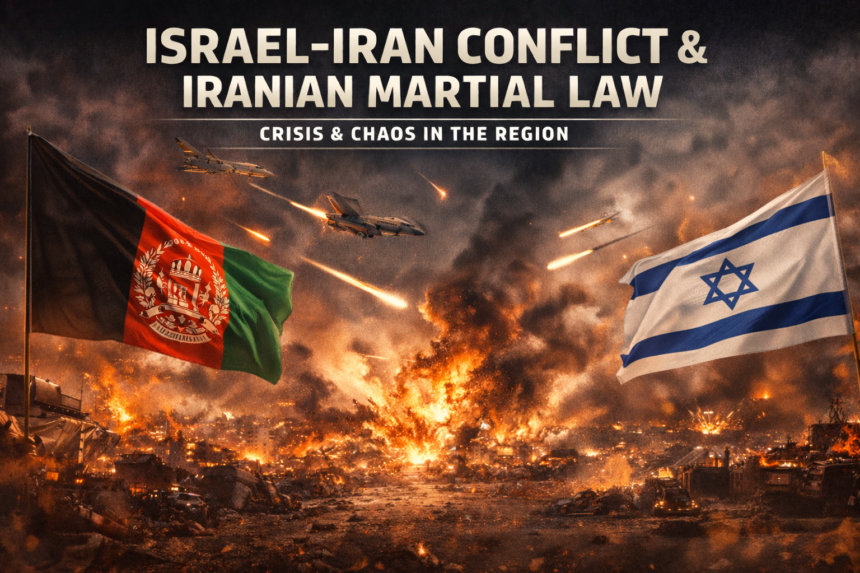

Israel-Iran Conflict & Iranian Martial Law
Updated Situation Report and Regional Implications
(By: Nuzhat Nazar)
What Has Happened So Far
On 28 February 2026, Israel Katz announced that Israel launched a “pre-emptive / preventative strike” against Iran, saying it was aimed at eliminating imminent threats from Iranian missile and strategic capabilities. Explosions were reported in Tehran and other Iranian cities, and Israel’s Home Front Command activated sirens, declared a state of emergency, and closed airspace in anticipation of Iranian retaliation.
Multiple news outlets report that the United States is directly participating alongside Israel in this operation, with joint air and missile strikes targeting Iranian military, intelligence, and government facilities, a significant escalation labelled by some sources as “major combat operations.”
According to available reports, Israeli strikes were focussed on Iranian missile infrastructure and command targets, while U.S. involvement appears to include strikes on broader strategic nodes, including nuclear-related infrastructure and IRGC command elements. This reflects a division of operational focus consistent with previously circulated planning frameworks.
Iran responded with its own first wave of missiles and drones, with explosions reported in central Tel Aviv and the Galilee. In addition, regional basing came under fire: Bahrain’s American naval base (U.S. 5th Fleet headquarters) was struck by missiles, signalling that the conflict has expanded beyond a purely bilateral Israel-Iran exchange.
Separately, numerous unverified open-source claims circulated on social media suggesting a missile hit on a Mossad headquarters building; these remain unconfirmed by major news agencies or official statements and should be treated cautiously.
Iranian Martial Law & Internal Security Deployment
In response to this dramatic escalation, reports now indicate that Iran has declared martial law and deployed Basij and paramilitary forces across major cities to maintain internal order and secure key infrastructure. This represents a significant domestic escalation coinciding with the external conflict.
The Basij are a large paramilitary force under the Islamic Revolutionary Guard Corps tasked historically with internal security, suppression of dissent, and mobilisation of volunteers. Their deployment en masse typically signals heightened internal threat perception by Iranian authorities and an attempt to regulate potential unrest, especially during times of crisis.
Iran has already been managing widespread internal unrest since late 2025, with large protests and significant use of security forces reported; martial law formalises and intensifies that domestic control architecture in the face of war and public fear.
Strategic Intent & Escalation Dynamics
Strategically, the initial stages of this conflict reflect a doctrine of pre-emption and deterrence reset by Israel and allied partners. Israel’s emphasis on degrading missile launchers and production sites trends toward neutralising immediate retaliatory capacity. U.S. involvement appears to extend toward Iran’s nuclear and command infrastructure, aiming at both preventing nuclear breakout and diminishing the military leadership’s cohesion and reach.
Iran’s apparent dual response, external strikes against Israeli and U.S. targets and the internal imposition of martial law, is consistent with a regime responding on two fronts: attempting both external military signalling and internal stabilisation. This raises the stakes significantly: the Iranian leadership is dealing simultaneously with an international conflict and pre-existing civil unrest pressures multiplied by war conditions.
Is This the Start of Full War?
The current crisis already surpasses a limited exchange. The direct involvement of U.S. bases in Gulf states (e.g., Bahrain) and Iranian retaliation inside Israel’s population centres suggests the conflict has expanded beyond a single strike-retaliation cycle.
If Iran continues missile salvos against internationally recognised military targets beyond Israel’s borders, such as U.S. bases, and Israel/U.S. forces respond in kind, the conflict could transition rapidly into a multi-front regional war. Hezbollah and other Iranian allied militias could soon be drawn in, especially if proxy pathways are activated, further widening the battlefield.
Regional & Global Implications
Middle East stability:
Gulf states are increasingly pulled into the conflict sphere as airspace closures and defensive alerts spread across countries including Iraq, Kuwait, and UAE.
The direct strike on a U.S. naval base in Bahrain heightens security risks for host governments and foreign forces alike.
Energy & economic risk:
Higher insurance premiums, disrupted shipping routes, and rerouted flights reflect immediate economic impacts as airlines suspend services and airspace closure widens.
Any disruption near the Strait of Hormuz could quickly spike global oil prices and add turbulence to already fragile markets.
Societal & humanitarian costs:
The deployment of Basij forces under martial law heightens risks of domestic repression, with potentially large numbers of civilian casualties and arrests as the regime seeks to control internal unrest that predates the conflict.
Political polarisation:
Regional actors – Gulf monarchies, Turkey, Egypt, and Iraq, now face pressure to navigate between security alignment with the U.S. and concern about Iranian backlash.
Pakistan, for instance, is likely to emphasise diplomatic restraint while monitoring energy and diaspora security implications closely.
Global security architecture:
This crisis intensifies debates in international law over the legitimacy of pre-emptive strikes; some states and organisations, including Gulf neighbours historically critical of Iranian regional activities, have raised concerns about sovereignty violations and escalation risks.
Conclusion
This conflict has evolved into a multi-layered confrontation that includes:
Direct Israeli and U.S. strikes on Iranian military and strategic targets.
Iranian missile responses against Israel and U.S. regional bases.
Martial law and Basij deployment indicating severe internal security measures in Iran.
These overlapping dynamics place the Middle East at a critical inflection point: what began as a pre-emptive nuclear/missile deterrence mission now carries significant risk of sustained regional war, compounded by internal Iranian pressures and geopolitical fault lines that span from the Gulf to Europe and beyond.