
By: Nuzhat Nazar
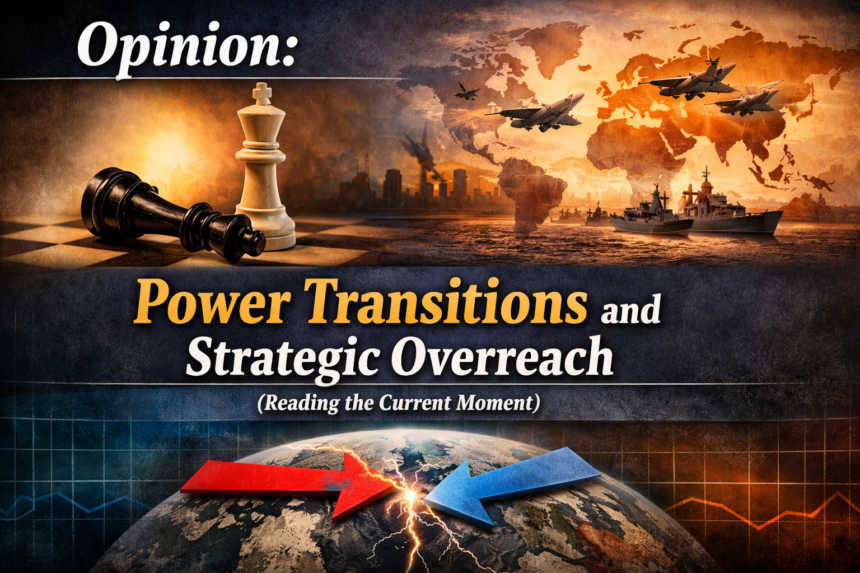
History rarely repeats itself in exact form, but it often follows recognizable patterns. The evolution of great powers tends to move through cycles of expansion, peak influence, and eventual strain. The present geopolitical moment, defined by intensifying competition between the United States and China, can be better understood through this historical lens.
Scholars of international relations have long examined these dynamics. Ray Dalio describes this as the cycle of empires, where economic strength, internal cohesion, and external commitments determine the rise and decline of powers. Similarly, Graham Allison popularized the idea of the “Thucydides Trap,” drawing on the classical observation that when a rising power threatens to displace an established one, the risk of confrontation increases significantly.
Historical cases reinforce this pattern. The relative decline of Spanish Empire decline was not sudden but driven by overextension and fiscal imbalance. The erosion of British Empire decline followed the mounting costs of global commitments. The collapse of the Soviet Union collapse revealed the limits of sustaining strategic competition without economic resilience.
Across these cases, a consistent structure emerges. Expansion creates influence but also obligations. Over time, these obligations generate financial and political strain. As a challenger rises, the dominant power enters a phase of heightened strategic anxiety.
This is the phase where behavior changes.
Decline, in strategic terms, does not initially appear as weakness. It often manifests as increased activity. The dominant power expands alliances, imposes sanctions, reinforces military presence, and seeks to shape multiple regions simultaneously. These actions are frequently interpreted as signs of continued strength. Yet historically, they can also reflect an effort to preserve an increasingly contested position.
In the current context, the United States retains decisive advantages. Its military capabilities remain unmatched, and the dollar continues to anchor the global financial system. However, China’s economic scale, technological advancement, and expanding global footprint introduce a structural challenge that differs from previous competitors.
This does not imply an imminent collapse of American power. Rather, it suggests the onset of a transitional phase. The question is not whether the United States is declining in absolute terms, but whether it is facing relative pressure within a changing distribution of power.
Equally, it would be analytically flawed to interpret every global development as part of a single coordinated strategy. Contemporary conflicts, sanctions regimes, and regional tensions are driven by multiple, overlapping factors. However, they are unfolding within a broader environment shaped by systemic rivalry.
The significance of this moment lies in its trajectory. Historically, periods of power transition have been marked by miscalculation, escalation, and attempts by the dominant power to delay or manage the rise of a challenger. The outcome is not predetermined, but the risks are structurally embedded.
A more grounded interpretation, therefore, avoids both extremes. It neither assumes inevitable decline nor dismisses emerging pressures. Instead, it recognizes a familiar historical rhythm: a dominant power adjusting to constraints while a rising power tests the boundaries of the existing order.
In that sense, the current geopolitical landscape is not an anomaly. It is part of a recurring pattern.