
By: Nuzhat Nazar
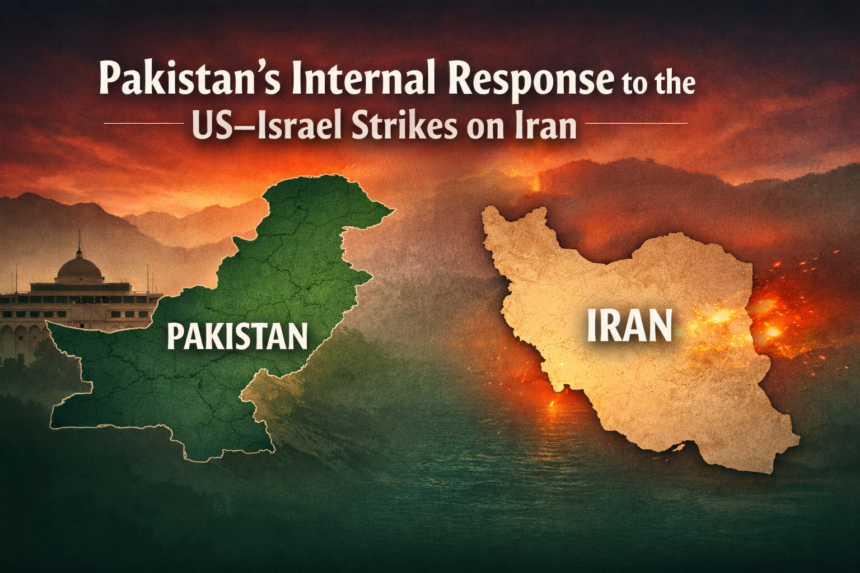
The US and Israeli strikes on Iran have triggered a sharp and emotionally charged reaction across Pakistan, placing the country at the intersection of regional geopolitics and domestic sensitivity. The crisis is not being viewed merely as a distant military confrontation; it is being interpreted through lenses of sovereignty, religious identity, regional alliances, and economic vulnerability. Islamabad’s official condemnation and calls for restraint reflect both principle and pragmatism. However, the internal response reveals deeper structural pressures that Pakistan must navigate carefully in the days ahead.
Political Convergence But Strategic Calculations
Pakistan’s political leadership has largely presented a united front in condemning the strikes. References to international law, sovereignty, and regional peace dominate official and opposition statements alike. This alignment mirrors past responses to major Middle Eastern escalations such as the 2003 Iraq War and the 2020 US–Iran tensions following the killing of General Qassem Soleimani, when Islamabad adopted principled criticism while avoiding direct entanglement.
However, beneath the consensus lies strategic positioning. Opposition voices have subtly questioned whether the government is exercising sufficient diplomatic activism, particularly in multilateral forums. At the same time, no major party has advocated military alignment or direct involvement. The political class appears aware that Pakistan’s internal fragility and economic exposure leave little room for adventurism.
Historically, Pakistan has sought to avoid being drawn into Middle Eastern rivalries. Even during peak Saudi–Iran tensions in the 1980s and again during the Yemen conflict in 2015, when parliament refused to commit troops despite close ties with Riyadh, Islamabad prioritized domestic stability over external alignment. The current posture appears consistent with that precedent.
The Iran Factor: Border, Security, and Spillover Risk
Iran is not a distant player in Pakistan’s strategic environment. The two countries share a long border across Balochistan, a region already burdened by insurgency, smuggling networks, and cross-border militancy. Any instability within Iran risks refugee flows, arms trafficking, and militant exploitation of porous border zones.
Past episodes offer cautionary lessons. The Soviet–Afghan war in the 1980s and the post-2001 Afghan conflict demonstrate how external conflicts can spill into Pakistan’s borderlands with long-term consequences. Islamabad is therefore acutely aware that escalation inside Iran could reshape security dynamics along its western frontier.
There is also the stalled Iran–Pakistan gas pipeline project, which, despite sanctions complications, symbolizes long-term energy aspirations. While dormant, it remains strategically relevant. A destabilized Iran would further complicate any future energy diversification strategy for Pakistan.
Gulf Dependencies and Economic Realities
While solidarity rhetoric dominates public discourse, Pakistan’s economic realities demand caution. Remittances from Gulf states account for a substantial share of Pakistan’s foreign exchange inflows. Millions of Pakistanis live and work in Saudi Arabia, the UAE, and Qatar. Any broader regional war that disrupts Gulf stability, energy infrastructure, or labor markets would directly impact Pakistan’s economy.
Energy markets represent another vulnerability. Pakistan is a net energy importer. Escalation in the Gulf, especially around maritime chokepoints, could drive oil prices upward, intensifying inflationary pressures. In past crises, including the 1990 Gulf War, Pakistan felt economic strain through energy costs and diaspora uncertainty. Policymakers are likely calculating similar risks today.
This explains Islamabad’s measured tone: condemnation without escalation, solidarity without alignment.
Public Sentiment: Religion, Sovereignty, and Street Pressure
The protests witnessed in Karachi, Islamabad, and Gilgit-Baltistan reflect multiple layers of sentiment. In Shia-majority regions, solidarity with Iran is partly religious and symbolic. However, anger is not confined to sectarian identity alone. For many Pakistanis, the strikes are framed as an example of unilateral power politics and aggression against a Muslim-majority state.
The 2020 protests after Soleimani’s killing offer a parallel. Then, too, demonstrations were widespread but eventually subsided once the regional confrontation stabilized. Pakistan managed to prevent sectarian escalation despite strong emotions. That experience likely informs the current security strategy.
The role of social media is more pronounced today. Narratives framing the conflict as part of a broader pattern of Western intervention are spreading rapidly, heightening emotional intensity. The state’s concern is not merely about protests but about the potential shift from issue-specific mobilization to broader anti-state or sectarian agitation.
Security Posture in Islamabad: Preventive Stability
Islamabad’s visible security reinforcement, restrictions in the Red Zone, heightened protection around embassies, and increased patrols reflects preventive containment. Diplomatic missions, particularly Western ones, represent symbolic targets during emotionally charged crises. Any breach would carry international repercussions, potentially affecting bilateral ties and investor confidence.
Yet, institutions remain functional. There is no systemic breakdown of order. Communications, government operations, and financial systems continue uninterrupted. This controlled security posture suggests that authorities are prioritizing deterrence rather than reacting to widespread instability.
Pakistan’s experience with managing politically sensitive protests from religious sit-ins to foreign policy-driven demonstrations, has strengthened the state’s capacity for layered response: negotiation, containment, and calibrated enforcement.
Sectarian Sensitivity: Historical Lessons
Pakistan’s sectarian landscape remains one of its most delicate fault lines. The 1980s and 1990s saw sectarian violence linked partly to broader Saudi–Iran rivalry dynamics. External polarization translated into internal fragmentation. Over the past decade, however, sustained counterterrorism operations and religious engagement have reduced overt sectarian violence.
The current crisis tests that progress. While solidarity demonstrations have largely remained peaceful, the risk lies in polarization narratives gaining traction. Importantly, mainstream Sunni political actors have also criticized the strikes, framing them in terms of sovereignty rather than sectarian alignment. This cross-sectarian condemnation reduces the likelihood of immediate internal confrontation.
Still, prolonged escalation in the region could revive dormant tensions. The state’s emphasis on unity messaging and avoidance of sectarian rhetoric is a deliberate preventive measure.
Strategic Outlook: Stress Test of Pakistan’s Neutrality Doctrine
Pakistan’s long-standing doctrine in Middle Eastern crises has been strategic neutrality combined with diplomatic advocacy for de-escalation. The Yemen vote in 2015, when parliament refused to commit forces despite Saudi expectations, remains a defining precedent. It demonstrated Islamabad’s willingness to prioritize internal stability over alliance pressure.
The current crisis represents another stress test of that doctrine. If the regional confrontation remains limited, Pakistan is likely to maintain calibrated neutrality. However, if escalation deepens particularly involving maritime chokepoints or regional proxy engagements, the pressure on Islamabad’s balancing act will intensify.
In the immediate term, further protests are probable, particularly around major congregational gatherings. Security will remain tight in Islamabad and sensitive regions. Diplomatic messaging will continue to emphasize restraint.
Pakistan’s internal system is under strain but not rupture. The central challenge is sustaining cohesion while regional polarization deepens. The coming days will determine whether Islamabad’s balancing strategy, forged through decades of navigating Middle Eastern rivalries, remains resilient in a rapidly evolving geopolitical landscape.