
Asif Haroon Raja
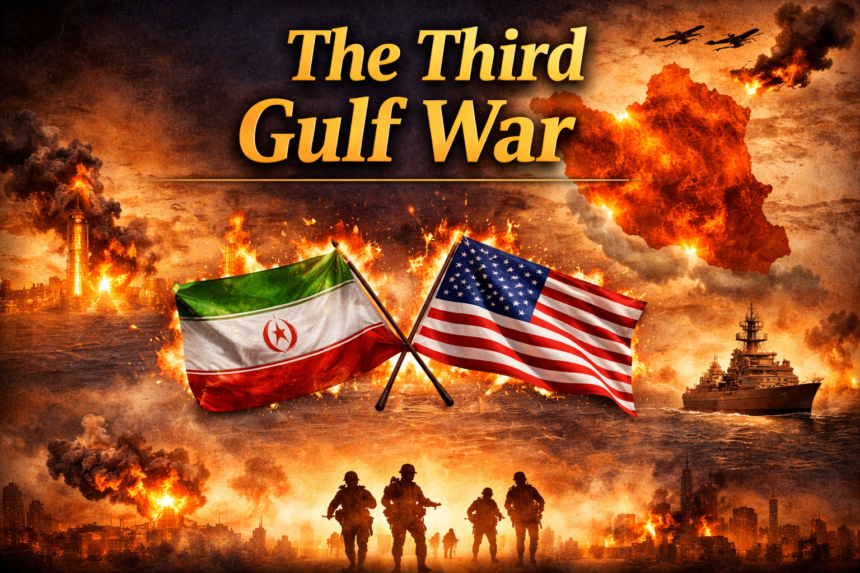
The war in the Persian Gulf began with U.S. strikes on 28 February, justified on what increasingly appears to be a questionable narrative.
President Donald Trump initiated hostilities over a threat his own intelligence community had downplayed. U.S. Director of National Intelligence Tulsi Gabbard testified before Congress that Iran was not building a nuclear weapon.
Similarly, the head of the International Atomic Energy Agency stated that there was no evidence of a “structured program” aimed at weaponization.
Yet, war followed.
Escalation Without Exit
Now in its fourth week, the conflict has seen relentless U.S. and Israel strikes on Iranian military and civilian infrastructure.
Thousands of targets have reportedly been hit, and the war has expanded regionally—inflicting heavy casualties across Iran, Lebanon, Israel, and even U.S. forces.
Rather than breaking Iranian resistance, the campaign has hardened it.
After targeting senior leadership, naval assets, and missile stockpiles, the attackers escalated further—striking strategic sites including Kharg Island and threatening the closure of the Strait of Hormuz.
In response, Iran intensified retaliation. The Islamic Revolutionary Guard Corps launched successive missile barrages, including large-scale strikes under “Operation Vaad-e-Sadiq,” targeting Tel Aviv and U.S. regional bases.
The war is no longer contained—it is cascading.
A Superpower in a Familiar Trap
Washington now finds itself in yet another open-ended conflict with no clear pathway to victory.
In frustration, Trump threatened to destroy Iran’s power grid and “obliterate” the country if Hormuz remained closed.
Yet within days, he extended deadlines and signaled openness to negotiations. The contradiction is telling.
A 48-hour ultimatum was followed by a five-day pause—less a strategy than an admission that escalation carries consequences far beyond the battlefield.
Closing Hormuz would not merely hurt Iran; it would disrupt global energy flows, fracture supply chains, and trigger economic shockwaves from Hsinchu to Wall Street.
Shifting Blame, Avoiding Ownership
As pressure mounted, Trump appeared to deflect responsibility, suggesting that Defense Secretary Pete Hegseth had been the first to advocate military action.
This is a familiar pattern.
Wars may be debated collectively, but they are owned singularly.
As Commander-in-Chief, the burden of decision—and its consequences—rests squarely with the president.
Six Strategic Headwinds
The war is now confronting the United States with six converging crises:
Financial Strain – War costs are spiraling into hundreds of billions, facing resistance in Congress.
Inflationary Shock – Energy disruptions are pushing inflation upward, undermining economic stability.
Allied Hesitation – Traditional allies are withholding military support, exposing diplomatic fractures.
Supply Chain Vulnerability – Energy chokepoints threaten global technology production, particularly in Taiwan.
Energy System Disruption – Damage to critical infrastructure is triggering a global supply crisis.
Domestic Backlash – Rising fuel prices and public disapproval are eroding political support.
The pause in operations may be real—but relief is not. The structural damage remains.
The Nuclear Shadow
The most dangerous dimension of this conflict is its potential trajectory.
Warnings have surfaced—even from within U.S. policy circles—that escalation could cross into nuclear territory.
The World Health Organization is reportedly preparing for worst-case scenarios.
In such an environment, miscalculation is not a possibility—it is a probability.
Iran’s Counter-Strategy
Iran’s response has been calibrated yet forceful.
By targeting energy infrastructure, critical nodes, and strategic assets—including facilities in Haifa—Tehran is signaling a doctrinal shift: from deterrence to economic disruption.
This marks a dangerous evolution in modern warfare—where crippling an adversary’s economic lifelines becomes as decisive as battlefield victories.
Diplomacy Emerges from the Periphery
When two major rivals — the United States and Iran — stood face to face, when the Gulf was thick with the smell of gunpowder, when the world held its breath wondering whether the next step would be war or peace — at that critical moment, one country quietly stepped forward. That country was Pakistan.
Pakistan, once dismissed as a fragile state, is now positioning itself as a mediator between Washington and Tehran.
Field Marshal Syed Asim Munir has engaged directly with Trump, while parallel channels have been opened with Iranian leadership.
According to the Financial Times, Islamabad is facilitating backchannel communications and may host talks.
This is not incidental—it reflects Pakistan’s enduring geostrategic relevance and its ability to engage both sides with credibility.
A War Without Winners
Even if a ceasefire emerges, the consequences are already profound:
The credibility of U.S. military dominance stands eroded.
Iran’s stature as a regional power is reinforced.
The myth of Israeli invincibility is dented.
Gulf security assumptions are shaken.
Global markets remain volatile and fragile.
Above all, the conflict underscores a deeper shift—the gradual erosion of unipolarity.
Conclusion
The central question is no longer who started the war, but who can end it—and at what cost.
This is not just another Middle Eastern conflict. It is a stress test of global order, a collision of power, perception, and miscalculation.
History suggests that wars launched on fragile premises rarely end on decisive terms.
And as the smoke thickens over the Gulf, one reality becomes clear:
This war may not define victory—but it will certainly define decline.
India and Israel are seen as war mongers, spoilers and villains of peace, while Pakistan is celebrated as a net stabilizer and a facilitator of peace.
About the Author
Brigadier (Retd) Asif Haroon Raja is a war veteran who fought in the Battle of Hilli in former East Pakistan and recovered the body of Major Akram Shaheed, NH. He is Command and Staff Course and War Course qualified, holds an MSc in War Studies, and served as Defence Attaché in Egypt and Sudan, as well as Dean of the Corps of Military Attachés in Cairo.
He served as the Pakistan Army’s spokesperson in 1992 and later as Honorary Colonel of the battalion he commanded for eight years. He is a defence, security, and geopolitical analyst, international columnist, author of five books, former Chairman of Thinkers Forum Pakistan, Patron-in-Chief of CDS Think Tank, Director of Meesakh Research Centre, and regularly appears on national and international media platforms.