
(By: Nuzhat Nazar)
The recent escalation along the Pakistan–Afghanistan border is being described in routine terms such as infiltration, retaliation and cross border fire. But inside Pakistan’s security calculus, these developments are no longer viewed as isolated frontier incidents. They are increasingly interpreted within a wider strategic framework, one that connects western instability with eastern rivalry.
For years, Pakistan has maintained that hostile actors have used Afghan territory to plan, finance and facilitate attacks inside Pakistan. This position has not remained confined to internal briefings. Islamabad has publicly presented dossiers at international forums, alleging Indian involvement in sponsoring or supporting anti Pakistan militant networks operating from Afghan soil. Pakistani officials have claimed that these dossiers contained intercepted communications, financial linkages and operational details intended to demonstrate external facilitation.
One of the most cited examples in Pakistan’s narrative was the arrest of Kulbhushan Jadhav, whom Islamabad described as an Indian intelligence operative linked to destabilizing activities. Beyond individual cases, Pakistan has consistently argued that Afghan territory, particularly during the previous Kabul administration, was used as a platform for hybrid pressure against Pakistan.
When the political transition took place in Kabul in 2021, the optics of India’s presence changed but its strategic interests did not disappear. New Delhi recalibrated rather than retreated. It reopened a technical mission in Kabul, maintained humanitarian assistance channels and sustained diplomatic engagement to preserve influence in a country it has long viewed as strategically significant in relation to Pakistan. Afghanistan remains part of India’s long term regional calculus.
Parallel to this, India’s partnership with Israel has expanded in both scale and sophistication. Cooperation spans drones, surveillance systems, missile defence, cyber capabilities and intelligence frameworks. This is not a symbolic relationship. It is institutional and operational. India has strengthened its technological depth through this partnership, enhancing its ability to monitor, deter and respond across multiple theatres.
Afghanistan’s recent signaling that it has no problem with Israel adds another subtle dimension. On the surface, this reflects diplomatic pragmatism. Afghanistan’s current leadership faces economic strain and international isolation, and reducing rhetorical hostility broadens diplomatic space. However, in Pakistan’s security assessment, such signals are not ignored. Even symbolic flexibility alters perceived alignments.
The concern in Islamabad is not that a formal India Israel Afghanistan alliance has emerged. There is no public evidence of structured trilateral coordination. The concern is more structural. If Afghanistan maintains openness toward actors aligned with India, and if India continues to expand its intelligence and technological edge through Israeli collaboration, Pakistan perceives a tightening strategic environment.
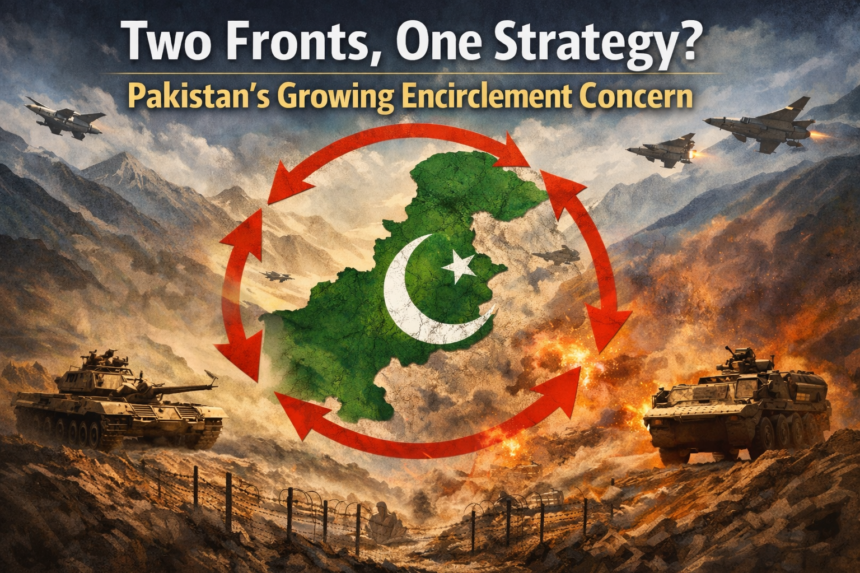
Historically, Pakistan has sought to avoid a two front challenge. The eastern border with India represents a conventional military rivalry. The western frontier, ideally, was expected to remain neutral or at least manageable. When border tensions rise in the west while India strengthens capabilities in the east, and when Pakistan alleges external support networks operating from Afghan territory, the perception of encirclement gains traction within policy circles.
Perception in national security matters because it shapes posture. Border fencing intensifies. Intelligence operations expand. Diplomatic messaging sharpens. Strategic partnerships deepen to offset vulnerabilities. Even absent definitive proof of coordination, states plan against worst case scenarios, not best case assumptions.
At the same time, realism demands caution. Afghanistan today is focused primarily on regime consolidation and economic survival. Open alignment with Israel would carry domestic and regional costs. There are no formal diplomatic relations between Kabul and Tel Aviv. The India Israel partnership, while deep, is primarily bilateral. What exists is not a declared bloc, but overlapping strategic interests operating in a region already marked by mistrust.
Yet South Asia’s history demonstrates that indirect pressure can be as consequential as formal alliances. If anti Pakistan groups continue to find space along the western frontier, and if Islamabad remains convinced that external actors are exploiting that space, tensions will persist regardless of diplomatic rhetoric.
The emerging picture is less about conspiracy and more about geometry. India seeks strategic reach. Afghanistan seeks diplomatic flexibility. Israel sustains defence partnerships. Pakistan seeks insulation from dual front vulnerability. These objectives intersect in ways that generate suspicion, especially during periods of border volatility.
Whether or not a coordinated strategy exists on paper, Pakistan’s growing encirclement concern is becoming a structural factor in its policy thinking. In a region where history weighs heavily on present decisions, structural concerns often drive long term strategy more than episodic events.