
Beyond Border Security: Rethinking Pakistan’s Afghanistan Policy in 2026
An evaluation of deteriorating Pakistan-Afghanistan relations, analyzing the TTP factor, Durand Line friction, and the need for a new regional approach.
The security relationship between Pakistan and Afghanistan has reached its most precarious juncture since the Taliban returned to power in Kabul. Recent diplomatic exchanges including statements by Pakistan’s Interior Minister Mohsin Naqvi during high-level bilateral discussions have reaffirmed Islamabad’s growing frustration over cross-border militancy originating from Afghan soil. Simultaneously, updated United Nations security assessments highlight the persistent operational footprint of Tehreek-e-Taliban Pakistan (TTP) and associated foreign militant networks operating within Afghan territory. Yet, reducing this breakdown to a mere sequence of border clashes and accusatory rhetoric misses the underlying structural dilemma: why has years of high-level engagement failed to yield a stable security partnership between Islamabad and Kabul?
When the Taliban assumed control of Kabul in August 2021, policy circles in Islamabad anticipated a fundamental shift along Pakistan’s western frontier. The expectation was built on a premise of strategic alignment: a friendly regime in Kabul would naturally dismantle anti-Pakistan sanctuaries and secure the shared border. However, this assumption miscalculated the internal dynamics of the Taliban movement. Rather than transforming into a conventional state actor responsive to external security demands, the de facto authorities in Kabul have prioritized internal cohesion, ideological continuity, and regime consolidation above foreign policy compromises.
At the core of this impasse lies the TTP. For Pakistan, neutralizing the TTP is a non-negotiable national security imperative. For the Afghan Taliban, however, the TTP represents a complex internal dilemma. Decades of shared battleground history, ideological kinship, and tribal alliances make forceful action against the TTP politically costly for Kabul’s leadership. Moreover, the Taliban’s internal power structure split between pragmatic administrative factions in Kabul and conservative ideological authorities in Kandahar further complicates decision-making. Feared defection of disgruntled fighters to rival extremist outfits like Islamic State Khorasan (ISKP) creates a powerful domestic disincentive for the Taliban to aggressively crack down on anti-Pakistan militants.
This divergence in security priorities has spilled directly onto the border. The fencing of the Durand Line, initiated by Pakistan to regulate movement and curb insurgent infiltration, remains a point of deep institutional sensitivity for Kabul. Afghan authorities continue to dispute the border’s formal status, viewing hard border enforcement as an infringement on traditional cross-border Pashtun mobility. Subsequent policy levers deployed by Islamabad ranging from targeted cross-border strikes to the mass deportation of undocumented Afghan refugees and strict trade transit regulations have heightened economic friction without altering Kabul’s security calculus. Tactical coercion has exacerbated bilateral mistrust without resolving the root cause of cross-border violence.
Faced with this impasse, Pakistan’s strategic options cannot rely solely on unilateral military deterrence or reactive border closures. Prolonged confrontation along the western border diverts vital state resources, destabilizes border provinces, and damages bilateral trade networks that sustain local economies on both sides. Coercive measures, if unmoored from a broader diplomatic strategy, risk pushing the Taliban into deeper isolation or encouraging tactical alignments with other regional actors to counter Pakistani influence.
A sustainable resolution requires a regionalized diplomatic framework. Regional powers most notably China and Iran, alongside key Gulf nations share a direct interest in preventing Afghanistan from re-emerging as an unmanaged hub for regional instability. China’s primary concern over Uighur militant activity and its desire to protect regional economic corridors align closely with Pakistan’s security objectives. Similarly, Tehran’s anxieties over border security and ISIS-K expansion create room for coordinated diplomatic pressure. By embedding its security requirements within a collective regional agenda, Pakistan can increase diplomatic leverage on Kabul without converting the issue into a purely bilateral standoff.
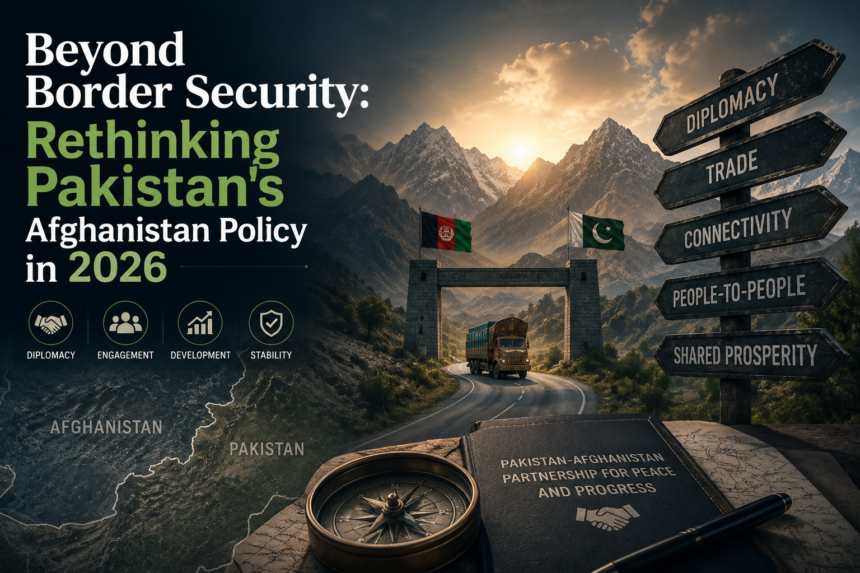
Ultimately, Islamabad requires a comprehensive recalibration of its Afghanistan policy one that moves beyond narrow border management toward an integrated strategic posture. First, Pakistan must institutionalize intelligence-sharing and border security mechanisms that offer Kabul structured, technical pathways to manage border zones collaboratively. Second, security demands should be coupled with targeted economic incentives, leveraging trade, transit corridors, and border market infrastructure to demonstrate the tangible benefits of state-to-state cooperation. Finally, Islamabad must engage Kabul through a unified regional front that explicitly links international recognition and economic assistance to measurable counterterrorism compliance.
Pakistan’s security challenges along its western frontier cannot be resolved through border fences and tactical containment alone. Only a clear-eyed strategy that balances firm national security boundaries with constructive regional diplomacy and economic engagement can break the cycle of friction and build a sustainable framework for stability.
Author
I am an independent researcher with a passion for exploring global affairs through the lens of critical thinking and evidence-based analysis. My writing examines contemporary political, economic, and strategic issues, with the aim of presenting balanced perspectives that inform, engage, and encourage meaningful discourse.