
Exploring how the August 2026 Strait of Hormuz crisis impacts Pakistan’s energy imports, inflation, and foreign exchange, driving the need for energy security.
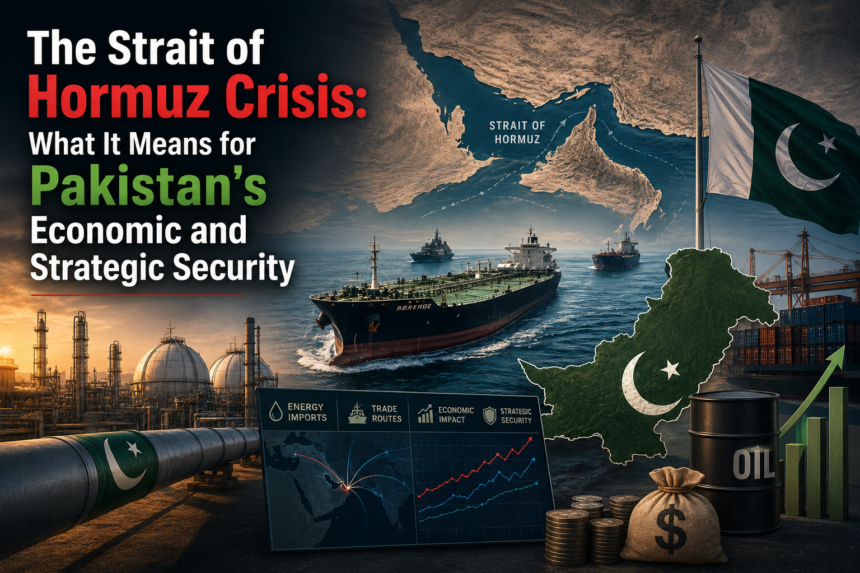
The Strait of Hormuz remains the world’s most critical maritime chokepoint, handling roughly one-fifth of global petroleum supplies and liquefied natural gas. The ongoing confrontation between the United States and Iran, alongside heightened security threats to commercial shipping, has once again brought traffic through the narrow waterway to a virtual standstill. As Washington intensifies economic sanctions and maritime blockades, Tehran has increasingly asserted administrative control over regional transit routes. For global energy markets, this friction drives immediate price spikes; for developing economies situated on the periphery of the Arabian Sea, it represents an immediate threat to domestic stability.
For Pakistan, the crisis in the Strait is not a distant Middle Eastern conflict. Islamabad’s physical proximity to the Persian Gulf converts every regional security breakdown into a direct shock to its domestic economy. Relying on imports for over 80 percent of its oil and a substantial portion of its natural gas needs, Pakistan relies almost entirely on sea lines of communication passing through Hormuz. Unlike larger economies that maintain extensive strategic petroleum reserves or overland pipelines bypassing maritime bottlenecks, Pakistan’s limited storage buffers leave its energy grid uniquely vulnerable to supply disruptions along its western maritime flank.
The macroeconomic consequences of this exposure are severe and immediate. Rising international crude prices directly widen Pakistan’s current account deficit, straining dwindling foreign exchange reserves and placing renewed downward pressure on the domestic currency. As import costs escalate, the domestic energy sector is forced to pass higher fuel and electricity tariffs onto households and industries, triggering inflationary pressures across agricultural and manufacturing supply chains. This systemic shock restricts industrial output, drives up the cost of living, and complicates fiscal management at a time when macro-financial stabilization remains the state’s primary domestic policy objective.
Beyond direct energy imports, the stability of the Gulf is intrinsically linked to Pakistan’s human capital and financial inflows. Millions of Pakistani citizens reside and work across Gulf Cooperation Council member states, contributing billions of dollars annually in foreign remittances. These financial transfers form a crucial pillar of Pakistan’s balance of payments, offsetting trade imbalances and sustaining household consumption. Prolonged maritime disruption, supply chain paralysis, or broader regional escalation risks disrupting economic activity across host countries, directly endangering the livelihoods of Pakistani expatriates and threatening a crucial source of foreign currency.
The crisis also tests Pakistan’s delicate diplomatic positioning regarding Iran. Sharing a direct land border with Tehran while maintaining historic strategic partnerships with Gulf monarchies and Washington, Islamabad must manage complex geopolitical competing interests. Pakistan has historically resisted pressure to join anti-Iran coalitions, recognizing that a stable western border is essential for national security. However, as Tehran leverages its geographic dominance over the Strait to counter Western containment, Islamabad has had to negotiate pragmatic, bilateral operational understandings to secure energy transits while avoiding actions that could draw secondary American sanctions.
In response to these multi-dimensional challenges, Islamabad has attempted to position itself as a stabilizing diplomatic actor. Pakistan’s foreign policy apparatus has consistently advocated for de-escalation, offering mediation channels to preserve regional maritime access and prevent full-scale military conflict. However, crisis-driven diplomatic interventions can only mitigate immediate fallout; they cannot alter the structural vulnerabilities caused by heavy reliance on a single maritime transit corridor. Effective security policy requires bridging the gap between diplomatic posture and physical energy resilience.
Ultimately, the Strait of Hormuz crisis highlights a fundamental truth: for resource-dependent states, geopolitical volatility rapidly morphs into an economic security crisis. To insulate itself against future disruptions, Pakistan must shift from reactive crisis management toward structural energy diversification. This requires expanding domestic renewable energy integration, accelerating indigenous exploration, and upgrading national strategic petroleum storage capacity. Concurrently, Pakistan must deepen its maritime security strategy along the Arabian Sea, ensuring its naval posture can protect sea lines of communication and secure alternative supply routes. Strategic autonomy cannot exist without energy security.
Author
I am an independent researcher with a passion for exploring global affairs through the lens of critical thinking and evidence-based analysis. My writing examines contemporary political, economic, and strategic issues, with the aim of presenting balanced perspectives that inform, engage, and encourage meaningful discourse.