
Maximum Pressure, Managed Restraint: Decoding Trump’s Iran Strategy and the Meaning of Renewed Talks
By: Nuzhat Nazar
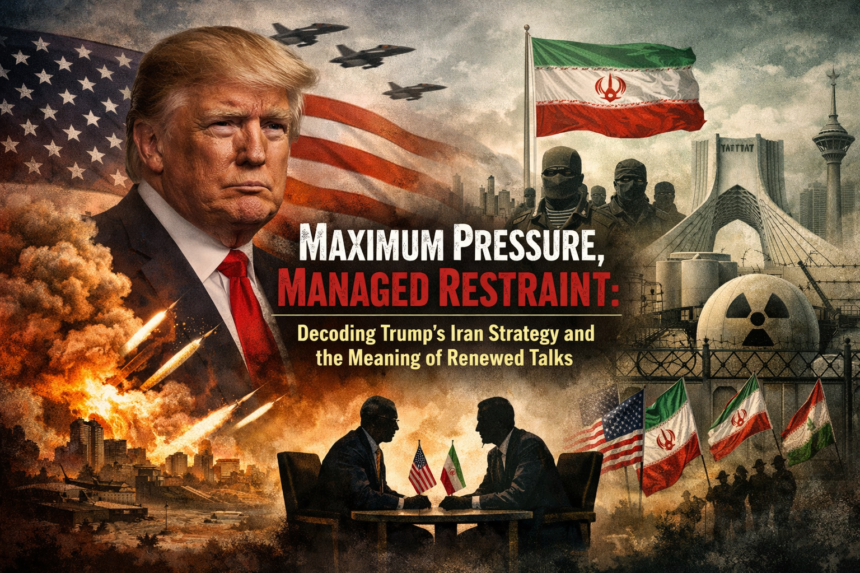
The renewed engagement between the United States and Iran under President Donald Trump should not be misread as a diplomatic opening or a step toward reconciliation. It is neither. What is unfolding instead is a familiar Trump-era pattern: maximum economic pressure paired with narrowly calibrated, tactical talks, aimed not at rebuilding trust but at managing escalation while preserving American leverage.
From the US perspective, the immediate objective is containment, not détente. Trump’s worldview treats diplomacy as an instrument, not a process, a means to extract concessions, reduce immediate risks, and avoid costly entanglements without offering structural relief. The talks with Iran, conducted indirectly and often through intermediaries, are therefore designed to prevent miscalculation rather than to resolve the underlying hostility that has defined US–Iran relations for decades.
This approach is consistent with Trump’s first term, when he withdrew from the JCPOA, dismantled multilateral frameworks, and replaced them with a sanctions-heavy strategy intended to coerce Tehran economically and politically. His return to the White House has brought a revival and expansion of that playbook. Washington has tightened sanctions on Iran’s energy exports, shipping networks, financial intermediaries, and entities linked to the Islamic Revolutionary Guard Corps, signaling clearly that talks do not mean relief.
For Trump, pressure is not a prelude to compromise, it is the core of strategy. Negotiations are acceptable only so long as they reinforce leverage. Any perception of weakness, especially toward Iran, carries domestic political costs Trump has no incentive to absorb. Sanctions remain popular with his political base, and confrontation with Tehran fits neatly into his broader narrative of American strength and unilateral assertiveness.
At the same time, Trump is acutely sensitive to the risks of uncontrolled escalation. A direct military confrontation with Iran would disrupt global energy markets, destabilise an already volatile Middle East, and risk dragging the United States into another protracted regional conflict, precisely the kind of entanglement Trump has long criticised. De-escalation talks, therefore, serve a risk-management function, allowing Washington to keep tensions below the threshold of war while sustaining economic and strategic pressure.
Iran, for its part, approaches the Trump administration with hardened realism. Years of sanctions (many imposed during Trump’s first term) have inflicted severe economic strain, but they have also forced Tehran to adapt. Iran has expanded informal energy exports, deepened strategic ties with China and Russia, and entrenched its regional influence through allied non-state actors. Engagement with Washington is not about rapprochement; it is about damage control.
Tehran understands Trump’s transactional logic. Any restraint it signals is calibrated, reversible, and designed to buy time. Iran has no expectation of a grand bargain, nor does it believe sanctions will be lifted in any meaningful way. Instead, it seeks to reduce immediate pressure points, prevent a military clash, and preserve strategic depth, particularly in its nuclear programme, missile capabilities, and regional posture.
The sanctions regime itself exposes a central contradiction in US policy. While intended to coerce Iran into behavioral change, sustained economic pressure has also incentivized Tehran to rely more heavily on asymmetric tools: proxy warfare, maritime brinkmanship, cyber operations, and calibrated escalation below the threshold of open conflict. In this sense, sanctions have reshaped Iranian behavior rather than moderated it, reinforcing precisely the grey-zone tactics Washington finds most destabilising.
Regionally, Trump’s Iran strategy has mixed effects. Gulf states welcome the hard line but remain wary of sudden shifts in US commitment, prompting them to hedge through their own dialogue with Tehran and diversified security partnerships. Israel strongly supports intensified pressure but fears that tactical de-escalation could allow Iran to advance its strategic programmes under cover of talks. Meanwhile, global energy markets remain sensitive to enforcement signals, as even limited Iranian exports can affect price stability.
What is notably absent from Trump’s approach is a coherent regional security framework. Institution-building, multilateral confidence measures, and long-term conflict resolution have little place in a strategy that prioritises bilateral leverage and economic coercion. The talks focus narrowly on managing flashpoints, sanctions evasion, proxy activity, maritime incidents — while leaving the deeper architecture of Middle Eastern insecurity untouched. As a result, calm, when achieved, is temporary and fragile.
For countries like Pakistan and others in the wider region, the US–Iran dynamic under Trump is less about ideology and more about predictability. Sudden escalations disrupt trade routes, energy flows, and regional stability, while prolonged sanctions distort economic alignments and encourage informal networks that undermine global financial norms. Stability achieved through managed restraint, even if coercive, is preferable to cycles of uncontrolled brinkmanship.
Ultimately, Trump’s Iran policy can be best described as controlled hostility. The United States is not seeking reconciliation, and Iran is not seeking realignment. Sanctions will remain central, talks will continue intermittently, and mutual suspicion will persist. This strategy can pause crises, but it does not resolve them.
The danger lies in mistaking restraint for resolution. As long as diplomacy remains tactical and pressure remains the primary currency of engagement, US–Iran relations will stay locked in a cycle of coercion, response, and temporary calm, a cycle that continues to shape, and destabilise, the Middle East.