
By Nuzhat Nazar
While Washington was escalating rhetoric and Tehran was calibrating responses, Pakistan’s military leadership was quietly on the phone – not once, but continuously – engaging with Steve Witkoff and JD Vance. These were not symbolic contacts. They were functional, meant to keep communication alive at a moment when formal diplomacy was tightening. At the same time, other channels were active. China and Russia were in touch with Tehran, each trying to shape the pace and limits of escalation. Meanwhile, Saudi Arabia and Turkey were working to contain spillover, aware that instability would not remain confined to one geography.
This is where the pattern begins to matter. What we are witnessing is not a single negotiation track, nor even a coordinated diplomatic effort. It is multiple actors, operating simultaneously, each managing a different layer of the same crisis. Some are trying to prevent escalation, some are trying to shape its direction, and others are simply trying to shield themselves from its consequences. When diplomacy begins to look this dispersed and parallel, it tells you something fundamental: no single actor is in a position to control the entire outcome.
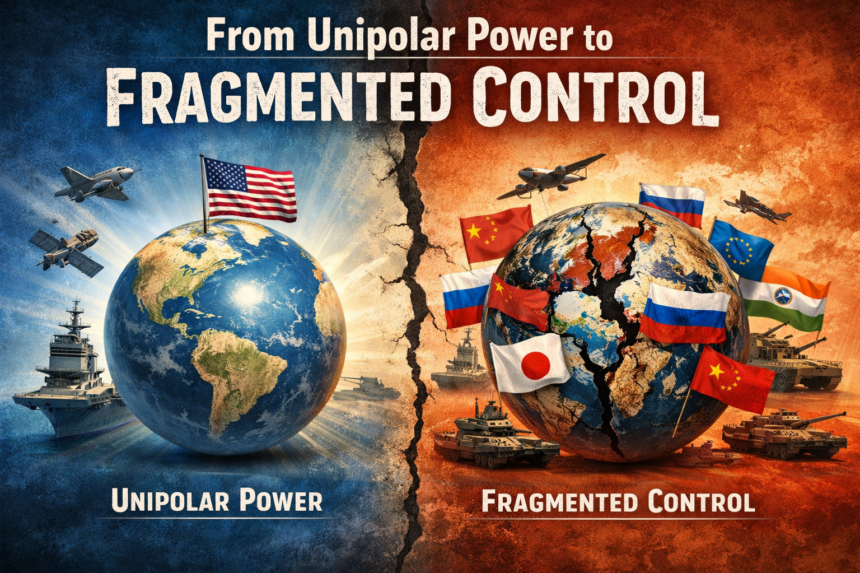
Much of the current commentary frames this moment as the “end of the unipolar world.” That diagnosis is partly correct, but analytically incomplete. It identifies the stress in the system, but it does not fully explain what has replaced it. Because this is not a clean transition from one dominant power to another. This is a transition into a more fragmented order, where power still exists, but control is distributed.
To understand why this matters, you have to look at the structure of the war itself. On one side is compellence – a strategy built on forcing immediate behavioral change through visible pressure. The logic is straightforward: apply enough force, create urgency, and the other side will comply. This is the space in which Washington is operating. On the other side, however, is a completely different logic—survival. And history shows that survival behaves differently.
In the Vietnam War, overwhelming force did not produce compliance. In the Soviet–Afghan War, superiority did not translate into control. Because when a state believes it is fighting for survival, it recalibrates its threshold for pain. It absorbs pressure instead of yielding to it. That is the logic Iran is operating under. It is not trying to win in a conventional sense. It is trying to ensure that it cannot be forced.
This explains why its responses have been calibrated rather than conventional. Missiles, drones, and proxies are part of the picture, but the more important tool is leverage. The Strait of Hormuz is no longer just a threat of closure; it has become a mechanism of control. It is not fully shut, because that would trigger uncontrollable global backlash, but it is not fully open either, because that would surrender leverage. This is not an escalation in the traditional sense. It is controlled pressure.
And this is where the limits of compellence begin to show. Compellence depends on outcomes; pressure must lead to visible compliance. Survival, on the other hand, does not require victory. It only requires endurance. When these two logics collide, the result is not resolution but prolongation.
This is also where the “unipolar illusion” argument needs to go further. The issue is not simply that American power is declining. The issue is that American power is no longer sufficient on its own to produce stable outcomes. The United States can still project force, mobilize alliances, and shape the initial trajectory of conflict. But it cannot fully control the second-order effects. Energy markets react, shipping routes become uncertain, regional actors reposition, and competing powers adjust without directly engaging.
China is not fighting this war, but it is exposed to its consequences, particularly through energy dependence. Russia is not directly involved, but it benefits economically from volatility in energy prices. Regional actors are not leading the conflict, but they are managing its spillover. This is no longer a battlefield-centric war; it is a system-wide event.
And in such a system, power is not measured only by who strikes. It is measured by who can absorb disruption, who can adapt to it, and who can shape outcomes without confrontation. This is the part missing in most analyses. This is not about who wins the war. It is about how the system adjusts to the war.
Within that adjustment, Pakistan’s role becomes more visible, not as a decisive actor, but as a connective one. Pakistan is not defining the conflict, but it is helping prevent its collapse into something uncontrollable. That function matters more in a fragmented system than in a centralized one, because when power is dispersed, stability depends less on dominance and more on coordination, even if that coordination is informal.
This is why the conflict is not stabilizing. Each side is operating under a different necessity. For Washington, pressure must produce results; without visible outcomes, the strategy weakens. For Tehran, survival is the outcome; endurance itself is success. These positions do not align easily. One seeks closure, the other resists it. One needs proof, the other needs time.
History suggests that when these dynamics take hold, conflicts do not end quickly. They stretch, not because they cannot be stopped, but because they cannot yet be resolved on terms acceptable to both sides.
The real conclusion, then, is not simply that the unipolar world is ending. It is that the ability to control outcomes decisively and alone is diminishing. What is emerging instead is a more complex order, fragmented, layered, and interdependent, where wars are not just fought on battlefields but across energy routes, trade systems, and diplomatic channels. And where, increasingly, the actors shaping stability are not the ones dominating the conflict, but the ones preventing it from breaking the system entirely.
That is the shift. Not the disappearance of power, but the redistribution of control. And in that redistribution, endurance is proving to be just as important as dominance.
Nuzhat Nazar is a journalist and strategic affairs analyst with more than ten years of experience reporting on foreign policy, defence, and economic developments. Based in Islamabad, she focuses on geopolitics, regional security dynamics, and Pakistan’s positioning in a shifting global order.