
Nuzhat Nazar
There are moments in international politics when the real story is not what is said loudly in public, but what is being negotiated quietly behind closed doors. The current Iran-US-Israel crisis has reached that point. Public statements, pressure tactics, maps, slogans and talk of the Abraham Accords are part of the optics. But the real story lies in the mediation track, the peace proposal and the attempt by regional actors, including Pakistan, to stop a dangerous conflict from turning into a wider Middle Eastern war.
Pakistan’s role in this moment should not be seen as symbolic. Islamabad is not simply issuing statements for peace. It is trying to help create an off-ramp from a conflict that directly affects Pakistan’s national security. A wider war involving Iran, the United States and Israel would not remain confined to the Gulf. It would affect oil prices, shipping routes, remittances from the Gulf, regional sectarian tensions, Pakistan-Iran border security and Pakistan’s fragile economic recovery. For Islamabad, de-escalation is not idealism. It is strategic necessity.
Reports suggest that Pakistan and Qatar have been involved in indirect efforts to move Iran and the United States toward an interim understanding. Diplomatic accounts indicate that consultations have focused on a possible arrangement to reduce escalation, though no final draft has yet been confirmed. Iranian officials have also indicated that progress has been made on several points in a potential memorandum with the United States, while stressing that no final deal is imminent.
This distinction is important. The process is moving, but peace is not yet settled. What appears to be emerging is not a grand regional settlement, but a conflict-management framework. Its purpose is likely to stop the immediate escalation, stabilise the Strait of Hormuz, keep indirect channels open and create space for further talks on harder issues. That may sound modest, but in the current environment, preventing a wider war is itself a strategic achievement.
The challenge is that different actors want different outcomes from the same peace process. Pakistan and Qatar want de-escalation. Iran wants a face-saving exit that does not look like surrender. The United States wants a deal it can present as a major diplomatic victory. Israel wants assurances that any agreement will not leave Iran strategically strengthened. President Donald Trump, meanwhile, appears to want something broader: any Iran arrangement to become part of a wider regional redesign built around the Abraham Accords.
That is where the complication begins.
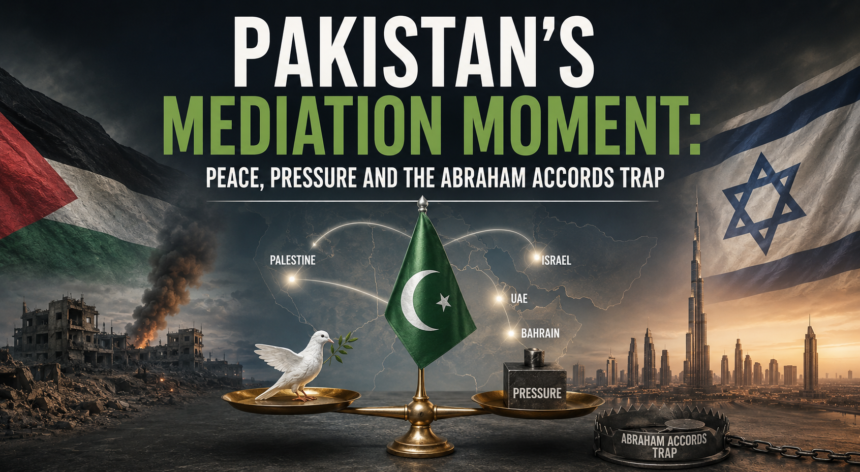
Trump’s call for countries including Saudi Arabia, Qatar, Turkey, Pakistan, Egypt and Jordan to join the Abraham Accords should be read as a pressure signal and political framing device, not the heart of the negotiation. The real negotiation is about war termination, Hormuz, sanctions sequencing, Iran’s red lines and regional security guarantees. But the Abraham Accords demand shows what Washington wants the political outcome to look like: not only an end to fighting, but a new regional alignment in which more Muslim-majority states normalize relations with Israel.
This is strategically ambitious, but politically unrealistic.
The Iran peace track and the Palestine-Israel normalization track are two different files. Merging them may help Washington create a grand narrative, but it risks overloading the diplomacy. Iran is unlikely to accept a deal that appears to place it inside an Israel-centred regional order. Pakistan cannot become part of a normalization framework without a just settlement of Palestine. Saudi Arabia has repeatedly linked normalization to progress on Palestinian statehood. Qatar’s diplomatic value lies in mediation, not in joining a bloc that would compromise its role. Turkey already has a complicated relationship with Israel, but its current political posture makes any Abraham Accords-style move deeply difficult.
For Pakistan, the issue is even more sensitive. Islamabad does not recognize Israel. Its position on Palestine is not a minor diplomatic preference; it is rooted in public opinion, parliamentary politics, religious sentiment and decades of foreign policy continuity. Official statements have made clear that Pakistan will not become party to the Abraham Accords and that its position on Palestine remains unchanged.
This is why Pakistan must be careful. Its value as a mediator comes partly from the fact that it is not part of the Abraham Accords camp. That distance gives Islamabad credibility with Tehran and with wider Muslim public opinion. If Pakistan is seen as helping deliver a US-Iran deal that later becomes a backdoor route to Israeli normalization, its mediation role will be damaged. Iran will become more suspicious. Domestic criticism inside Pakistan will grow. And Islamabad’s carefully balanced diplomatic position will weaken.
The Abraham Accords were originally designed to normalize relations between Israel and Arab states without first resolving the Palestinian question. Some states entered that framework under different calculations: security guarantees, economic incentives, diplomatic rewards and access to Washington. At that time, the argument was that normalization could create a new regional reality. But the Gaza war has changed the political environment. What may have been presented earlier as pragmatic normalization now looks, to many Muslim societies, like rewarding Israel while Palestine remains unresolved.
That is why expecting major Muslim countries to sign the Accords in the current atmosphere is unrealistic. Gaza has created a moral and political barrier. The issue is not only recognition of Israel. The issue is whether normalization can be justified while Palestinian suffering, displacement and political dispossession remain central to the regional crisis. For Pakistan, this question is even sharper because the state has consistently tied any change in its Israel policy to a just settlement of Palestine.
There is also another layer: many Muslim countries are not only looking at Palestine; they are watching Israel’s wider regional posture. The perception in several capitals is that Israel is seeking deeper strategic reach beyond its immediate conflict zones. The Somaliland issue strengthened this concern. In April 2026, Pakistan and eleven other countries issued a joint statement condemning Israel’s announcement of a diplomatic representative to the so-called Somaliland, calling it a violation of Somalia’s sovereignty, unity and territorial integrity.
This matters because regional states view such moves through a larger security lens. They are not just asking whether Israel wants peace with its neighbours. They are asking whether Israel is expanding its influence into sensitive maritime and strategic spaces, including the Red Sea and the Horn of Africa. Whether every claim about Israeli military positioning is independently confirmed or not, the perception itself is politically important. In diplomacy, perception shapes trust. And right now, trust is weak.
History offers a useful lesson. After the 1973 Arab-Israeli War, the United States used ceasefire diplomacy not simply to stop fighting, but to reshape the regional order. Henry Kissinger’s shuttle diplomacy eventually helped move Egypt into a US-led diplomatic framework, culminating in Camp David. After the 1991 Gulf War, Washington again used military and diplomatic leverage to convene the Madrid process and place itself at the centre of regional diplomacy. In both cases, war termination became the opening move for a new political architecture.
Trump appears to be attempting a similar move. He wants the Iran crisis to produce more than de-escalation. He wants it to produce a second-generation Abraham Accords moment. But today’s region is not the region of 1973 or 1991. Iran is not defeated. Gaza has transformed public opinion. Saudi Arabia is cautious. Qatar is protecting its mediator role. Turkey is politically constrained. Pakistan has officially ruled out joining the Accords. The room for forced normalization is far narrower than Washington may assume.
The more realistic outcome is a limited peace framework, not a historic grand bargain. That framework may reduce fighting, manage Hormuz, create temporary understandings between Iran and the United States, and delay the harder disputes for future talks. It may not resolve the nuclear question, the Iran-Israel rivalry or the Palestine issue. But it could prevent the immediate crisis from becoming a regional catastrophe.
For Pakistan, that is enough to justify continued mediation. Islamabad does not need to own the entire regional settlement. Its immediate objective is to prevent war, preserve channels, protect its economy from external shocks and avoid being dragged into bloc politics. Pakistan can help open doors, carry messages, support an interim understanding and work with regional partners to reduce tensions. But it cannot become the bridge through which Iran de-escalation is converted into pressure for Israel normalization.
That is the trap Islamabad must avoid.
The way forward lies in sequencing. First, stop the escalation and stabilise the Gulf. Then manage the Iran file through phased diplomacy on sanctions, security guarantees and nuclear limits. Separately, keep the Palestine-Israel question anchored in justice, statehood, reconstruction and a credible political process. If all these issues are forced into one overloaded package, the peace proposal may collapse under the weight of political symbolism.
In the end, this crisis is not only about Iran and the United States. It is about who gets to define the future regional order. Washington wants to turn the crisis into diplomatic architecture. Israel wants security guarantees and wider acceptance. Iran wants survival with dignity. Muslim states want stability without surrendering Palestine. Pakistan wants peace without becoming part of someone else’s geopolitical bargain.
That is the real story. Public statements and social media optics are only the surface. The substance lies in the mediation, the peace proposal and the struggle over what comes after the guns fall silent. For Pakistan, the challenge is to remain pro-peace without being pulled into pro-normalization politics: support de-escalation, protect regional stability, and ensure that Palestine is not erased from the equation.