
By Asif Haroon Raja
After the 12-day war in June, in which the United States and Israel failed to achieve their political and military objectives, the duo attempted to engineer regime change through an internal uprising during December–January. When that effort also failed, Iran was once again attacked on 28 February on a false pretext.
With each passing week, the intensity of airstrikes steadily escalated. Massive destruction of civil and military infrastructure and heavy loss of human life ensued. By the fifth week, the air war had taken a dangerous turn, with both sides employing increasingly lethal and sophisticated strikes. In the sixth week, the United States and Israel expanded their campaign to systematically target Iran’s energy sector, desalination plants, transport infrastructure, and nuclear assets.
Over 13,000 targets were reportedly struck, leading President Trump to believe that Iran’s military capability had been decisively crippled—its army, navy, air force, and air defence effectively neutralized. Despite overwhelming odds, Iran exercised its right of self-defence with determination, responding in kind to every offensive action. Gradually, its defensive posture evolved into an offensive-defensive strategy, with strikes becoming more precise and impactful.
Iran not only targeted Israel’s civil and defence infrastructure—including major cities such as Tel Aviv, Haifa, and the Negev—but also achieved success in downing several high-value American aerial assets within its territory. Furthermore, it extended its strikes to U.S. military bases across the region and selected energy installations in the Gulf.
The closure of the Strait of Hormuz by Iran sent shockwaves through the global economy. Simultaneously, concerns grew over the potential closure of Bab al-Mandab, particularly with the involvement of the Houthis. The reinvigoration of Iran’s regional allies, coupled with reported military support from China and Russia, further complicated the strategic landscape.
Unable to subdue Iran and frustrated by the reluctance of allies to assist in reopening critical maritime routes, President Trump’s rhetoric became increasingly aggressive and intemperate. He issued ultimatums to Iran, threatening catastrophic consequences, and hurled derogatory remarks against the allies and his own military generals and officials. Surprisingly, he praised Pakistan’s leadership, including Field Marshal Asim Munir and Prime Minister Shehbaz Sharif.
Reports indicated that Washington was considering ground operations to secure key strategic locations such as Kharg Island, nuclear storage sites in Isfahan, and the Strait of Hormuz. Even the option of employing tactical nuclear weapons at critical junctures was reportedly debated.
Unfazed, Iran issued stern warnings, signaling its capability to escalate further. IRGC issued a chilling warning that it could destroy OpenAI’s secret $30 billion Stargate AI data center in Abu Dhabi if the US dared to attack Iran’s power infrastructure. Claims of enhanced missile capabilities and expanded strategic reach underscored Tehran’s resolve to sustain a prolonged conflict if necessary. This marked a turning point—Iran had begun to influence the tempo and terms of engagement.
Intransigence of Both Sides
The region—and indeed the world—stood on the brink of catastrophe due to the rigid postures of both sides: the aggressive stance of the United States and Israel, and Iran’s firm refusal to capitulate. Repeated warnings regarding the catastrophic implications of escalation failed to temper decision-making in Washington. Strategic reasoning appeared increasingly overshadowed by impulsive brinkmanship.
China cautioned that the situation was approaching the threshold of a global conflict. The night of 7–8 April was widely perceived as a potential point of no return, with fears that a full-scale devastation of Iran’s infrastructure and civilization could be imminent.
Impact of the War and Strategic Implications
The war drew widespread criticism of the United States and Israel for initiating what many viewed as an illegal and avoidable conflict driven by geopolitical ambitions. Both countries faced increasing diplomatic isolation. Even traditional allies expressed unease, and divisions emerged within NATO.
Within the United States, political opposition intensified, with lawmakers and segments of the military establishment expressing serious reservations about the war. Domestic unrest grew, and criticism of leadership decisions became more pronounced. Similarly, internal divisions within Israel deepened due to the prolonged conflict and its consequences. For the first time, Israel experienced extensive damage on its home front, accompanied by significant civilian displacement and psychological strain.
In contrast, Iran garnered considerable international sympathy for its resilience. Despite severe losses, internal cohesion remained intact, and the state structure endured. Support from China, Russia, and North Korea further altered the strategic balance.
The shifting dynamics and mounting costs of war compelled a reassessment within Washington, opening space for diplomatic engagement. Global economic repercussions were also significant. Energy markets were destabilized, and there were renewed discussions on reducing dependence on petrodollar systems. Gold and other precious metals regained prominence as safe-haven assets, while energy-importing nations began reconsidering long-term security strategies.
Backchannel Diplomacy
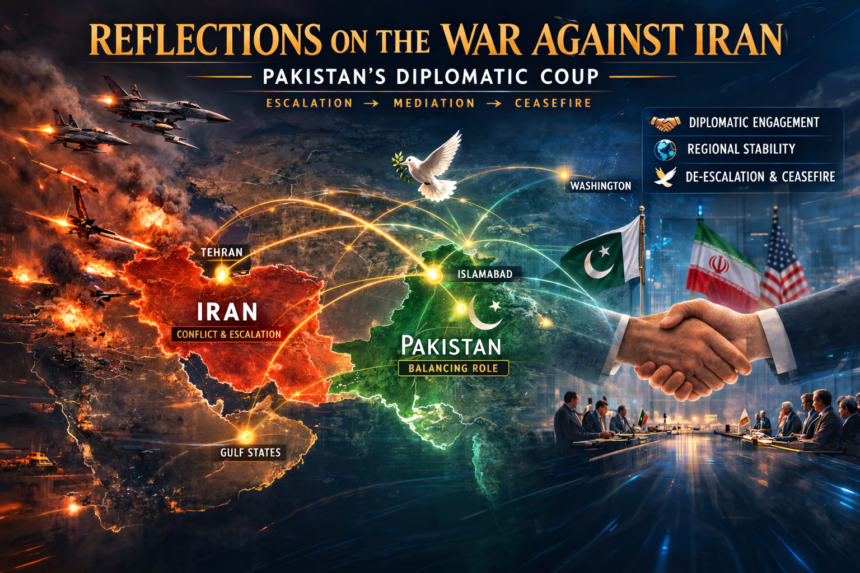
Amid escalating tensions, three major powers—the United States, China, and Russia—remained actively engaged in backchannel diplomacy. Pakistan emerged as a key intermediary, facilitating communication between Washington and Tehran. Supported by Türkiye, Saudi Arabia, and Egypt, Pakistan played a central role in steering efforts toward de-escalation.
The objective was clear: to secure an immediate ceasefire and lay the groundwork for a broader settlement under what came to be termed the “Islamabad Accord.”
Pakistan’s Diplomatic Masterstroke
Pakistan effectively shifted the trajectory from confrontation to restraint. It’s quiet yet persistent diplomacy became the sole ray of hope amid the intensifying conflict. Despite setbacks—including the negativity of one to two Gulf States, and attacks on a petrochemical refinery in Saudi Arabia and the Israeli Embassy in Istanbul that threatened to widen the war—Pakistan maintained focus on de-escalation.
High-level engagements, including critical communications between Field Marshal Asim Munir, U.S. leadership, and other global actors, helped reduce tensions. Pakistan’s unique position—enjoying the trust of major powers, regional states, and Iran—enabled it to act as a credible bridge. Strong backing from China further enhanced its diplomatic leverage.
The “Islamabad Accord” Framework
The diplomatic process gained momentum through key meetings involving regional and global stakeholders. A structured framework began to take shape, integrating proposals from both the United States and Iran. Pakistan’s diplomatic leadership, supported by its military and foreign policy institutions, injected urgency and direction into negotiations. This reinforced Pakistan’s central role in shaping the peace process.
Pakistan’s Diplomatic Coup
In a dramatic turn of events, Pakistan achieved a major diplomatic breakthrough, securing agreement on a two-week ceasefire proposal. High-level delegations from the United States are expected to engage in further negotiations in Islamabad, aimed at reaching a comprehensive settlement.
Prime Minister Shehbaz Sharif announced the ceasefire, marking a significant milestone in efforts to stabilize the region. Pakistan’s role as a geopolitical bridge has been firmly established. At a moment of extreme global peril, it stepped forward with clarity, credibility, and a workable plan.
Pakistan’s Rising Stature
At a critical juncture, Pakistan assumed the role of a stabilizing force, preventing further escalation and restoring a degree of strategic balance.
Through effective backchannel diplomacy and crisis management, Pakistan has elevated its standing in the international arena—emerging as a credible mediator and a key security interlocutor. This transformation reflects a broader shift: from being a passive actor to an active shaper of geopolitical outcomes.
Sustaining the Diplomatic Momentum
The current ceasefire, though temporary, offers a pathway toward a more durable peace. If momentum is sustained, a broader regional security architecture may emerge—anchored in cooperation, mutual respect, and conflict prevention.
Such a framework could mark a decisive shift away from cycles of confrontation toward a more stable and inclusive order.
A Tribute to the Peacemakers
Pakistan’s leadership deserves recognition for its calculated and composed diplomacy during a period of extreme volatility.
Special acknowledgment is due to Field Marshal Asim Munir, whose leadership played a pivotal role in steering Pakistan’s diplomatic efforts to success.
Brigadier (Retd) Asif Haroon Raja, a defence, security, and geopolitical analyst, Patron-in-Chief of CDS Think Tank, and regularly appears on national and international media platforms.