
By Maimona Saleem
In a region long dominated by great-power handling and deep-rooted rivalries, a noiseless but notable shift is underway. Over the past month, Pakistan has moved beyond its traditionally cautious posture and signaled a more active diplomatic role in efforts aimed at de-escalation and peace-building in the Middle East. Far from routine statements, these efforts reflect a calculated attempt to reposition Pakistan as a credible middle-power mediator in an increasingly fragmented regional order.
The key driver in this significant change is the Ministry of Foreign Affairs of Pakistan, which has demonstrated a level of diplomatic activism that departs from Pakistan’s historically reactive approach to Middle Eastern crises. For decades, Pakistan’s policy has been defined by careful balancing, maintaining cordial ties with competing regional actors while avoiding deep entanglement in their disputes. This approach was shaped by both necessity and prudence, given Pakistan’s economic dependencies and security considerations.
However, recent developments suggest a delicate but important evolution. Rather than merely ratifying others’ calls for restraint, Pakistan has decided to pursue initiative-based diplomacy, supporting joint frameworks, aligning with broader peace proposals, and signaling its willingness to contribute to mediation efforts.
Therefore, Pakistan not only engaged in active diplomacy, but the outcomes of its efforts were also widely acknowledged globally. For instance, Deputy Prime Minister/Foreign Minister Senator Mohammad Ishaq Dar held a telephonic conversation with José Manuel Albares on the latest regional developments. FM Albares commended Pakistan’s role in creating space for diplomacy, including efforts toward an initial ceasefire, and conveyed Spain’s full support for these efforts.
Similarly, a telephonic conversation was held with Turkish Foreign Minister Hakan Fidan. FM Hakan Fidan appreciated and extended full support to Pakistan for its role in helping secure the recent ceasefire. Besides, DPM/FM Senator Dar received a telephone call from UK Foreign Secretary Yvette Cooper of the Foreign, Commonwealth & Development Office. FS Cooper appreciated DPM/FM and paid tribute to Pakistan for its role in achieving the ceasefire, expressing support for Pakistan’s continued efforts to promote lasting peace and stability in the region.
DPM/FM Senator Dar also spoke with Saudi Foreign Minister Prince Faisal bin Farhan and exchanged views on the evolving regional situation. DPM/FM expressed deep appreciation for Saudi Arabia’s steadfast support of Pakistan in its efforts to promote peace and stability in the region. Another telephonic conversation was held with Azerbaijan FM Jeyhun Bayramov on the latest developments in the regional situation. FM Bayramov commended DPM/FM and Pakistan’s leadership for its role in securing the initial ceasefire and promoting peace and stability in the region.
Likewise, a telephone conversation was held with South Africa’s Minister of International Relations and Cooperation, Ronald Lamola. They discussed the latest developments in the Middle East and the broader region. Minister Lamola appreciated Pakistan’s efforts in helping achieve a temporary ceasefire and expressed hope for lasting peace, while extending South Africa’s support for Pakistan’s role in promoting regional stability.
DPM/FM Dar also spoke with European Union High Representative for Foreign Affairs (EU HR/VP) Kaja Kallas. Both sides expressed concern over serious violations of the ceasefire in Lebanon and emphasized the importance of the full implementation of the temporary ceasefire in the Middle East. EU HR/VP reaffirmed the EU’s support for Pakistan in its efforts to promote peace and stability.
In conversation with FM Bakhtiyor Saidov, DPM/FM discussed the latest developments in the Middle East and the wider region. FM Saidov appreciated Pakistan’s leadership and conveyed Uzbekistan’s full support for all initiatives undertaken by Pakistan in pursuit of peace and stability, especially in securing the initial two-week ceasefire.
DP/FM in telephonic conversation with Saudi FM Prince Faisal bin Farhan, both counterparts expressed deep concern over ceasefire violations in Lebanon and stressed the urgent need for full respect and implementation of the ceasefire to ensure lasting peace & stability.
Even after the ceasefire, Israel’s aggressive actions did not subside, and it attacked Lebanon. Pakistan condemned Israel’s aggression in the strongest terms, which resulted in the loss of innocent lives and the widespread destruction of infrastructure. Pakistan reiterated its unwavering solidarity with the Government and people of Lebanon during this difficult time and supports Lebanon’s sovereignty and territorial integrity, as well as its peace and stability.
The Israeli actions undermine international efforts to establish peace and stability in the region and constitute a blatant violation of international law and fundamental humanitarian principles. Pakistan called upon the international community to take urgent and concrete steps to end Israeli aggression against Lebanon.
DPM/FM Senator Dar also held a telephonic conversation with Jarrah Jaber Al‑Ahmad Al‑Sabah, FM of Kuwait, on regional developments and Pakistan’s diplomatic efforts. FM Al‑Sabah welcomed the initial ceasefire, appreciated Pakistan’s efforts, and extended full support to Pakistan in this endeavor.
Furthermore, DPM/FM spoke with Anita Anand on the latest regional developments and Pakistan’s ongoing diplomatic efforts. FM Anand appreciated Pakistan’s role, including its efforts toward achieving the initial ceasefire, and conveyed Canada’s support for promoting stability and peace.
Similarly, DPM/FM Senator Dar received a phone call from the FM of France, Jean-Noël Barrot. FM Barrot congratulated Pakistan on its role in securing the initial ceasefire agreement and expressed support for Pakistan’s continued efforts toward a diplomatic pathway for lasting peace and stability in the region. All these conversations mark a transition from quiet balancing to more visible engagement, where Pakistan is not just responding to events but attempting to shape them.
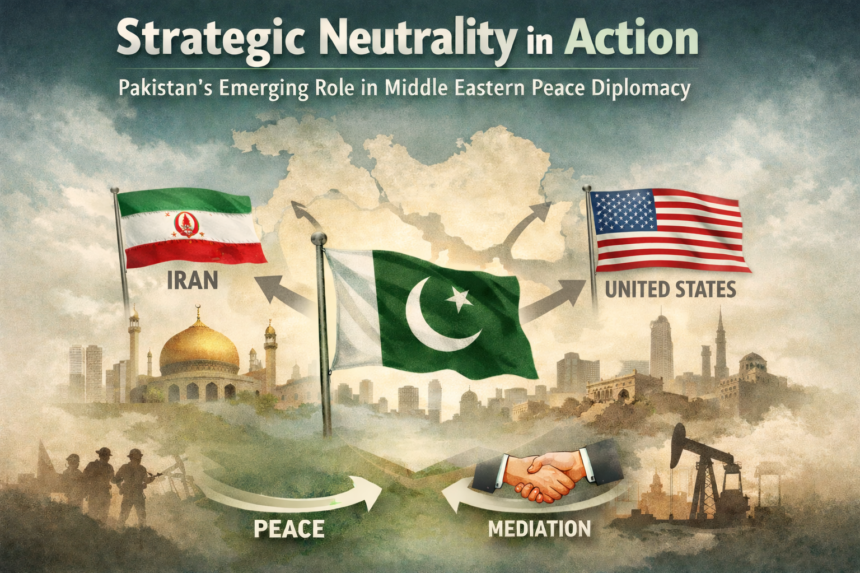
A key pillar of this emerging role is Pakistan’s position of strategic neutrality. Pakistan maintains functional relationships with both Iran and Saudi Arabia, two countries whose rivalry has historically defined much of the Middle East’s geopolitical fault lines. At the same time, Islamabad enjoys a close strategic partnership with China, while retaining longstanding ties with other Muslim states.
This multi-aligned posture provides Pakistan with a unique form of diplomatic capital. In an environment where most actors are perceived as partisan, Pakistan can engage multiple sides without being immediately viewed through a lens of suspicion. This permits Pakistan to position itself as a potential bridge between rival states, particularly at a time when trust deficits continue to hamper formal mediation conduits.
Since traditional Western-led mediation efforts face challenges of credibility and consistency, alternative arrangements available in the form of regional actors are gaining power. The timing of Pakistan’s diplomatic outreach is also significant. Because the Middle East is currently characterized by overlapping conflicts, fragile ceasefires, and a persistent risk of escalation.
The absence of a coherent and universally accepted mediation mechanism has created a vacuum. In this context, Pakistan is playing its role as a mediator in an environment where trust and access are limited. Pakistan appears to be cautiously stepping into this space, testing its capacity to contribute to conflict management without overextending itself.
Notably, this diplomatic activism is not driven solely by external considerations. For Pakistan, stability in the Middle East carries direct implications for its own national interests. Economic linkages, energy dependencies, and the presence of a large Pakistani diaspora in the Gulf region all tie Pakistan’s well-being to the region’s security environment. Seen from this perspective, Pakistan’s recent efforts can be understood as part of a broader strategy to mitigate external risks by promoting regional stability. This pragmatic calculation adds depth to Pakistan’s diplomatic posture, highlighting that its engagement is not merely symbolic but rooted in tangible strategic concerns.
Pakistan positioned itself as a facilitator capable of connecting actors, supporting dialogue, and contributing to incremental de-escalation. And in an era defined by fragmentation and shifting alliances, such roles are becoming increasingly valuable. If sustained and carefully managed, Pakistan’s recent diplomatic efforts could mark the beginning of a longer-term transformation in its foreign policy orientation. From a cautious witness, Pakistan is evolving into a potential bridge in a limited yet meaningful way.