
By Asif Haroon Raja
The Fallacy of Binary Outcomes
Some analysts are advancing the theory that the US–Iran conflict can end only in either the total destruction of Iran or a humiliating American retreat. This proposition, in my view, is analytically flawed.
Modern conflicts, particularly those involving asymmetric adversaries, rarely culminate in absolute victories. Instead, they evolve into prolonged and managed confrontations characterized by calibrated escalation, coercive signaling, and negotiated pauses.
The US–Iran standoff is no exception. What is unfolding is not a march toward decisive victory or defeat, but a transition toward conflict management, where both sides seek to avoid catastrophic escalation while preserving their core strategic interests.
Iran’s Leverage: Real but Not Decisive
Considerable emphasis is being placed on Iran’s ability to threaten the Strait of Hormuz, with some portraying it as a decisive strategic advantage. This assessment, however, appears overstated.
Iran undoubtedly possesses the capability to disrupt maritime traffic through drones, naval mines, missile systems, and swarm tactics.
However, sustaining such disruption over time would invite overwhelming international retaliation, jeopardize Iran’s own economic survival, and strain its relations with major partners dependent on stable energy flows.
Iran’s strength lies in deterrence and disruption, not in sustained control or regional dominance.
Drone Warfare: A Tool, Not a Panacea
Some commentators are comparing weaponized drones to the machine gun of the First World War. While intellectually appealing, the comparison is strategically overstretched.
Drones have unquestionably altered the tactical landscape by lowering the cost of precision strikes and enhancing the capabilities of weaker actors.
Yet they remain complementary systems rather than decisive instruments of war.
No conflict has yet been won solely through drone warfare.
Even in the Russia-Ukraine War, frequently cited as evidence of drone supremacy, drones have contributed more to battlefield attrition and operational stalemate than to decisive strategic victory.
Misreading American Constraints
It is also being asserted that the United States has been compelled into negotiations from a position of weakness. This interpretation misreads the nature of American restraint.
The US retains overwhelming military, technological, and economic superiority. Its limitations stem not from incapacity, but from strategic choice — a conscious effort to avoid the costs, uncertainties, and geopolitical risks of large-scale war.
This distinction is critical. Choosing not to escalate is not the same as being unable to escalate.
Neglect of the Wider Strategic Environment
The ongoing confrontation must not be viewed solely through the narrow prism of a US–Iran binary. It must instead be assessed within the broader regional matrix.
To conclude that Iran is emerging as the uncontested gatekeeper of the Persian Gulf appears premature.
The roles of Israel, the Gulf States, and multiple proxy theatres cannot be ignored. These actors significantly shape the trajectory of the conflict and constrain both Washington and Tehran.
The Real Strategic Picture
The United States has not achieved decisive strategic gains, but it retains escalation dominance.
Iran has not secured victory, but it has demonstrated resilience and the ability to impose costs.
The conflict is moving toward a phase of managed competition rather than resolution.
Neither side is currently in a position to dictate terms unilaterally.
Both are instead engaged in shaping the conditions of a negotiated equilibrium.
Iran’s New Two-Stage Peace Plan
Stage One
End of war within 30 days, including de-escalation in Lebanon.
Gradual reopening of the Strait of Hormuz.
Lifting of the US naval blockade.
Reduction of US military pressure around Iran’s borders.
Iranian clearance of naval mines and restoration of safe maritime passage.
Stage Two
Complete freeze on uranium enrichment for 15 years.
Resumption of enrichment after 15 years at a capped level of 3.67%.
No stockpiling of enriched uranium.
No dismantling of Iran’s nuclear infrastructure.
Gradual sanctions relief.
Release of frozen Iranian assets tied directly to nuclear compliance measures.
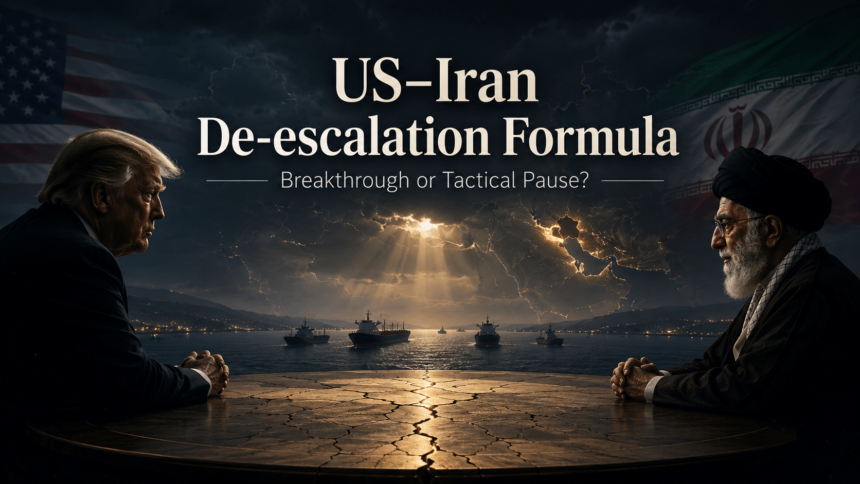
Iran’s reported 14-point framework for ending the US–Iran confrontation signals a potential inflection point in a long-running conflict that has oscillated between covert hostility and open brinkmanship.
Whether this initiative matures into a durable settlement or merely becomes another tactical pause depends on deeper structural realities shaping both sides.
Another Pause
After Pakistan’s Mediation
Pakistan has once again stepped into the arena of high-stakes diplomacy as President Donald Trump reportedly announced a temporary pause in “Project Freedom” in the Strait of Hormuz amid Islamabad’s efforts to facilitate forward movement in US–Iran talks.
Trump’s abrupt suspension of “Project Freedom” reportedly surprised several Gulf allies.
According to circulating reports, Saudi Arabia expressed reservations regarding further escalation and banned the use of military facilities and airspace for operations against Iran.
This, in turn, compelled Washington to reconsider plans involving extensive US naval escort operations through the Strait of Hormuz.
Trump reportedly stated on Truth Social:
“Project Freedom (the movement of ships through the Strait of Hormuz) will be paused for a short period of time to see whether or not the agreement can be finalized and signed.”
-
- Strategic Context: War Fatigue vs Strategic Compulsion
After years of sustained confrontation, both Washington and Tehran appear constrained by the mounting costs of prolonged escalation.
The United States, despite its overwhelming conventional superiority, has struggled to convert military dominance into decisive strategic outcomes, particularly against Iran’s asymmetric doctrine rooted in proxies, geography, and ideological resilience.
Iran, meanwhile, has demonstrated endurance, though at considerable economic cost.
Sanctions, internal pressures, and strain on its regional networks have created incentives for tactical de-escalation without surrendering long-term strategic objectives.
The emerging framework therefore reflects mutual exhaustion rather than mutual trust.
-
- Nature of the Proposed Deal:
Managed De-escalation, Not Reconciliation
- Nature of the Proposed Deal:
US officials have claimed that a one-page Memorandum of Understanding (MOU) has been prepared to formalize an end to the current phase of confrontation and establish a new framework for nuclear negotiations.
According to reports, the two sides are closer to an agreement than at any point since the conflict intensified.
The reported MOU is not a peace treaty in the classical sense. It is essentially a conflict-management instrument.
Its principal objectives appear to be:
*Freezing the conflict.
*Stabilizing maritime routes such as the Strait of Hormuz.
*Creating diplomatic space without resolving the core disputes.
This indicates that both sides are seeking operational breathing space rather than strategic convergence.
-
- Critical Next 48 Hours
According to media reports, Washington is awaiting Tehran’s final response on several key points within the next 48 hours.
Although no formal document has yet been signed, Trump’s close advisers Jared Kushner and Steve Witkoff are reportedly engaged in direct and indirect contacts with Iranian interlocutors to break the deadlock.
-
- Nuclear Dimension: *Tactical Flexibility. *Strategic Ambiguity.
Iran’s reported willingness to relocate highly enriched uranium is significant, but must be interpreted cautiously.
Tehran has historically used its nuclear program as a bargaining instrument, offering reversible concessions while preserving technical capability and strategic ambiguity.
The proposal resembles earlier diplomatic frameworks associated with the Joint Comprehensive Plan of Action, where restrictions on enriched uranium were linked to sanctions relief.
For Washington, such a transfer would be presented as a non-proliferation success.
However, unless accompanied by intrusive verification mechanisms and durable long-term constraints, it may amount to symbolic rollback rather than irreversible dismantlement.
-
- Key Features of the Proposed 14-Point Agreement
*Immediate End to Hostilities.
*Formal cessation of military operations upon signing of the MOU.
*Islamabad/Geneva Negotiations.
*Detailed talks within 30 days in Islamabad or Geneva focusing on sanctions relief and the future of Iran’s nuclear program.
*Restoration of Maritime Navigation.
*Gradual lifting of Iranian restrictions on maritime traffic alongside phased easing of the US naval blockade.
*Nuclear and Financial Measures.
*Possible transfer of highly enriched uranium outside Iran in exchange for the release of frozen assets and sanctions relief.
US Secretary of State Marco Rubio described the situation as “extremely complicated,” noting divisions within the Iranian leadership and warning that failure of negotiations could result in restoration of the naval blockade and renewed military pressure.
-
- Plausibility of the MOU
Several aspects of the reported MOU appear plausible.
Both sides possess strong incentives to avoid prolonged war.
The United States faces military overstretch, economic pressures, domestic political considerations, and the risk of wider regional escalation.
Iran, despite demonstrating resilience, has also endured severe economic strain and strategic pressure.
Backchannel diplomacy is also consistent with the history of US–Iran engagement.
Secret or indirect negotiations through intermediaries such as Oman, Qatar, and Switzerland have historically preceded formal understandings.
-
- Major Obstacles
At the same time, several major obstacles remain:
*Internal divisions within Iran between hardliners, the Revolutionary Guard establishment, and pragmatic factions.
*Opposition from hardliners in both Tehran and Washington.
*Potential Israeli resistance to any arrangement allowing Iran to preserve nuclear capability.
*The emergence of a developing strategic axis involving Israel, India, and the UAE.
*Reports that Israel has enhanced regional air defence coordination with the United Arab Emirates to counter potential Iranian threats.
-
- Internal Dynamics:
Fragmentation vs Centralization
- Internal Dynamics:
Marco Rubio’s remarks regarding divisions within Iran’s leadership are particularly significant.
Iranian decision-making is not monolithic. It involves multiple competing power centres, including the political executive, the Islamic Revolutionary Guard Corps, and the office of the Supreme Leader.
This fragmentation complicates negotiations but simultaneously provides Tehran with strategic flexibility and deniability.
In contrast, US policy coherence is often shaped by electoral cycles and domestic political pressures, particularly with figures associated with Trump reasserting influence.
This raises legitimate questions regarding the durability of any future agreement.
-
- Role of Intermediaries: Quiet Diplomacy at
Work
- Role of Intermediaries: Quiet Diplomacy at
The involvement of Jared Kushner and Steve Witkoff indicates that backchannel diplomacy is playing a decisive role.
Such channels often allow greater flexibility than formal negotiations, but they also lack institutional guarantees and remain vulnerable to abrupt reversals.
- Regional Implications:
-
- Controlled De-escalation, Not Stability
A temporary easing of tensions could:
*Reduce immediate risks to global energy flows.
*Lower the probability of direct US–Iran confrontation.
*Provide operational breathing space to regional actors.
However, it is unlikely to fundamentally alter the underlying security architecture of the Middle East.
Iran’s regional ambitions and America’s alliance system remain structurally opposed.
-
- China’s Position
China has stated that it does not recognize unilateral US sanctions related to Iran and intends to continue purchasing Iranian oil despite mounting American pressure.
Chinese officials have described the sanctions regime as contrary to international norms while emphasizing Beijing’s intention to protect its energy and trade interests.
Chinese refineries continue to play a major role in sustaining Iranian oil exports.
At the same time, China appears to be providing varying degrees of technical, technological, and strategic support to Iran, while carefully avoiding direct military involvement in the conflict.
-
- Pakistan’s Strategic Relevance
The mention of Islamabad as a possible venue for negotiations is strategically noteworthy.
It reflects Pakistan’s potential utility as a relatively neutral diplomatic platform acceptable to both Washington and Tehran.
Pakistan has maintained working relations with both sides while carefully avoiding overt alignment.
If leveraged prudently, this role could enhance Pakistan’s diplomatic profile without entangling it directly in great-power rivalries.
-
- Bottom Line: Pause, Not Peace
Even if formalized, this initiative should be viewed as:
*A temporary de-escalation mechanism.
*A confidence-building phase rather than a final settlement.
*A tactical convergence of interests rather than a strategic transformation.
The fundamental contradictions —
US containment versus Iran’s regional assertion — remain unresolved.
Conclusion
The emerging 14-point framework represents a pragmatic recognition by both Washington and Tehran that outright victory is unattainable at an acceptable cost.
It is a classic case of adversaries stepping back from the brink — not out of reconciliation, but out of strategic necessity.
The real test will not be the signing of the MOU, but its sustainability under pressure, particularly when the next regional crisis inevitably emerges.