
Asif Haroon Raja
I am quoting an apparently small incident which took place during the two-day summit between the two most powerful presidents of the World – Donald Trump and Xi Jinping in Beijing.
By making the whole world stand in lines at its airports, humiliating people in the name of visas, and even forcing travelers to remove their belts and shoes, America built an image of unquestioned authority.
Yet in China, a simple security guard stopped the U.S. Treasury Secretary at a gate.
The incident lasted only a few moments, but its message resonated across the world.
Calmly, the guard asked:
“Where is your ID card?”
The same America whose embassies make even influential people wait for hours, whose airports subject elderly travelers, ministers, generals, and intellectuals to extra scrutiny without exception, suddenly found one of its top officials being reminded of the rules by a Chinese security guard.
This was not merely a delayed entry for one individual; it was a silent declaration of shifting global power.
There was a time when Washington was considered the center of world politics. The American passport symbolized power, the dollar ruled the global economy, and wherever U.S. officials traveled, protocol bowed before them. But the world is changing.
China has quietly reached a position where it projects not only economic strength, but also psychological confidence. Beijing no longer looks toward Washington before making decisions; instead, it deals with the world according to its own rules.
That is why even a Chinese security officer today feels assured that the law applies equally to everyone, even if the person standing before him happens to be a minister from the world’s largest superpower.
History shows that power is never permanent. There was once a saying about Britain that “the sun never sets on its empire,” yet that same empire eventually shrank into a small island nation. The Soviet Union once stood as America’s equal, only to collapse within a few years.
Today, for the first time, the United States is facing a world in which a massive economic, technological, and diplomatic giant stands opposite it.
China invested less in wars and more in factories, ports, semiconductor chips, artificial intelligence, railway networks, and trade. Through the Belt and Road Initiative, it expanded its influence across Asia, Africa, and Europe.
Today, the economies of dozens of countries are connected in one way or another to Chinese trade.
That is why the global landscape now produces moments in which those who once lectured others about protocol are themselves seen standing before the rules.
The real lesson is that the world is moving toward balance rather than absolute dominance.
Military power alone is no longer enough; economic strength, technology, discipline, and national confidence have become the true measures of power.
And perhaps that is why the Chinese guard’s brief question became so widely discussed around the world:
“Where is your card?”
Because sometimes history’s biggest announcements are not made by cannons or missiles, but by a simple sentence spoken by an ordinary guard standing at a gate.
Comparison Drawn
A striking comparison is now being drawn between the relatively subdued reception accorded to President Donald Trump at the Beijing airport and the exceptionally warm welcome extended to President Vladimir Putin at the same venue only two weeks later.
To many observers, the contrast symbolized the rapidly shifting currents of global politics.
Emerging Geopolitical Alignments
New geopolitical alignments are emerging, and the world appears to be entering a period of profound strategic transformation.
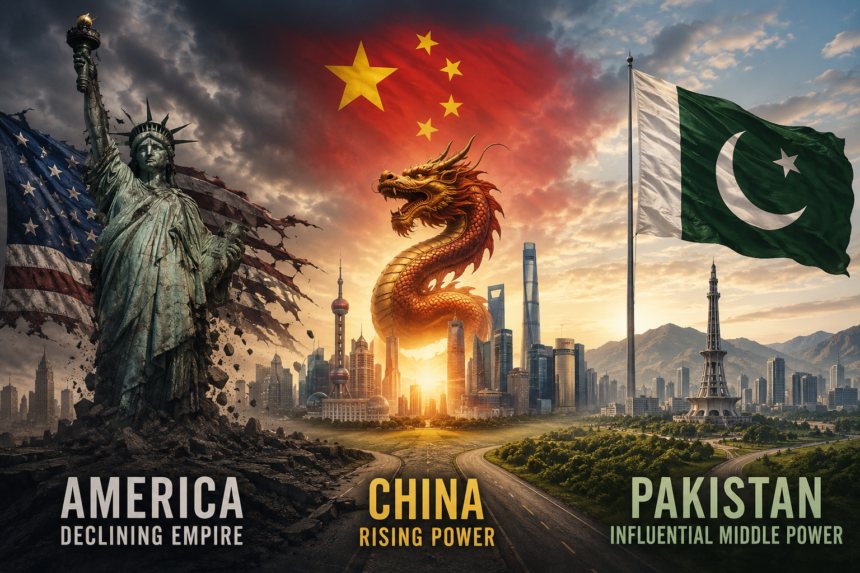
The post-Cold War unipolar order, once dominated by the United States, is steadily giving way to a more complex multipolar system.
The United States, despite remaining the world’s foremost military and technological power, is increasingly facing challenges to its global influence.
Critics argue that while the US dented its supremacy after the debacle in Afghanistan, President Trump’s unpredictable policies strained long-standing alliances have deepened divisions among Western partners, and accelerated perceptions of American strategic decline.
In their view, these policies weakened the image of a cohesive and confident America and hastened the erosion of its unchallenged global primacy.
Last Nail in the Coffin
Uncalled for attack on Iran on February 28 is proving to be the last nail in the coffin of the US military ascendency.
Kremlin spokesperson Dmitry Peskov just confirmed that Putin shared with Xi the idea of transporting and storing Iran’s enriched uranium in Russia.
The single announcement has made every US and Israeli demand about Iran’s nuclear program irrelevant overnight, because the source of trouble over which Washington has been threatening war is allegedly heading to Moscow.
This is exactly what the 40 deals and the joint declaration in Beijing were actually about.
Trump’s Strategy and Netanyahu’s Plans
Trump’s entire Iran strategy has been built around one demand:
Dismantle the nuclear program and hand over the enriched uranium.
Netanyahu pushed for special forces to physically seize it.
The assault plan was finalized.
CNN reported targets ready for next week. and the US was one hour away from striking.
All of it to get control of uranium that Putin and Xi just agreed to take out of Iran’s hands themselves.
Wanted Uranium Still Exists
Here is what Washington isn’t saying out loud, uranium stored in Russia is still uranium, it doesn’t get destroyed, it doesn’t get dismantled.
It gets relocated to a country with the world’s largest nuclear arsenal that just ran three-day nuclear drills with 64,000 troops and intercepted British NATO aircraft over the Black Sea.
End Story of Uranium
Iran keeps its program intact on paper, and avoids the strike.
Russia gains leverage over the most sensitive nuclear material in the Middle East.
- Xi gets credit for the solution.
- Washington gets to call it a win if it wants to.
Paradoxical
Putin who allegedly transferred advanced weapons to Iran throughout this conflict, while publicly calling for de-escalation, is now being asked to store Iran’s 460 kg enriched uranium in Russia.
Putin and Xi decided in Beijing, and Peskov confirmed it on May 21. Washington which almost went to nuclear war with Iran over uranium, has been given the new address of uranium storage.
Rise of China
At the same time, China, through its emphasis on economic connectivity, infrastructure development, trade partnerships, and diplomacy, has significantly expanded its influence across Asia, Africa, and beyond.
By promoting cooperation, investment, and shared economic opportunities, Beijing has cultivated a wide network of strategic partners and strengthened its standing as a rising global power.
China has also demonstrated that it cannot be easily contained, either economically or strategically.
China – Russia Strategic Partnership
China’s growing partnership with Russia — itself re-emerging as a major geopolitical actor — reflects a shared desire to reshape the prevailing international order, which both countries view as selective, inequitable, and overly dominated by Western interests.
Together, Moscow and Beijing advocate a more balanced global framework in which emerging and middle powers, particularly from the Global South, play a greater role in shaping international affairs.
Countries across Asia, Africa, and Latin America are increasingly asserting strategic autonomy rather than aligning exclusively with any single power bloc.
Pakistan’s Rising Stature
In this evolving environment, Pakistan is also gaining recognition as an important regional stabilizer and diplomatic bridge connecting South Asia, Central Asia, the Middle East, Africa, and Europe.
Pakistan’s geostrategic location, expanding regional connectivity, and growing diplomatic outreach have enhanced its relevance in regional and global affairs. In case of a peaceful settlement of the Gulf crisis through Pakistan’s sustained diplomacy and mediation, its stature would scale new heights.
Pakistan- Saudi Arabia strategic mutual defence pact signed in September 2025 is likely to be expanded and the expected new members are Kuwait, Bahrain and Qatar.
Unification of Muslim Ummah
Likewise, influential Muslim-majority states such as Saudi Arabia, Qatar, Turkey, Egypt, Iran, Indonesia, and Malaysia are poised to play increasingly significant roles in shaping the future geopolitics of South Asia, the Middle East, and the wider Indo-Pacific region.
The reawakening among the 22 Arab States could lead to unification of the divided Muslim Ummah.
About the Author
Brigadier (Retd) Asif Haroon Raja, SI (M) is a war veteran. He is Command and Staff Course and War Course qualified, holds an MSc in War Studies, and served as Defence Attaché in Egypt and Sudan, as well as Dean of the Corps of Military Attachés in Cairo.
He is a defence, security, and geopolitical analyst, international columnist, author of five books, former Chairman of Thinkers Forum Pakistan, Patron-in-Chief of Centre for Development Studies Think Tank, Director of Meesakh Research Centre; he regularly appears on media platforms.